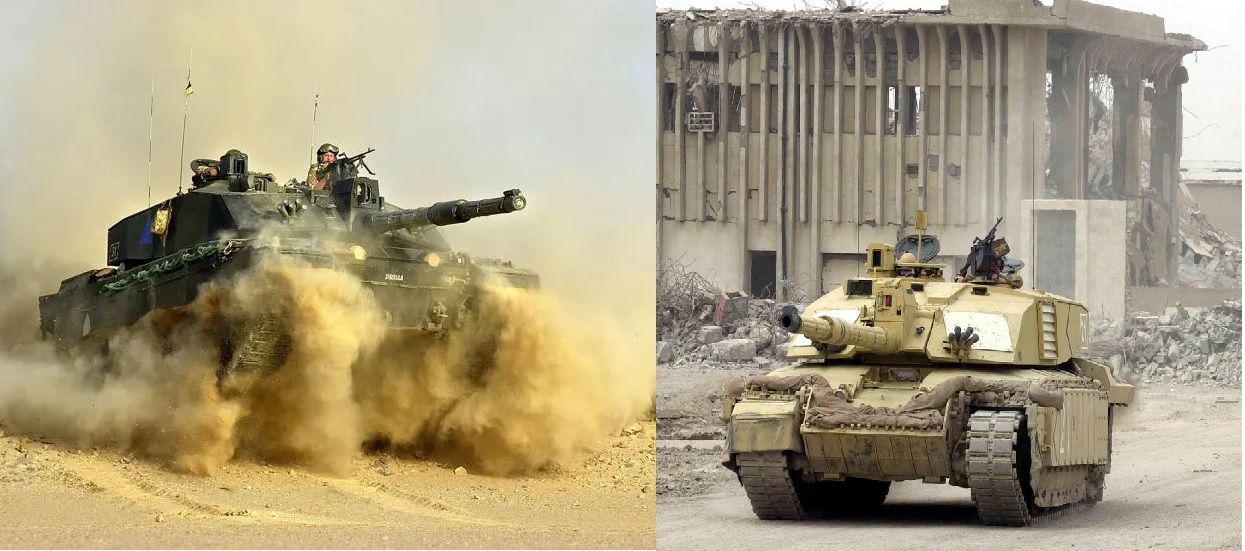
On 30 October 2025, the United Kingdom’s Ministry of Defence released its annual report, UK Armed Forces Equipment and Formations 2025, revealing that the British Army now holds 288 Challenger 2 main battle tanks (MBTs) — a significant rise from 219 listed a year earlier. At first glance, this jump appears to mark a revival of Britain’s heavy armour capability. However, defence analysts note that this figure reflects total inventory, including tanks in storage, training use, or awaiting refurbishment — not all of which are combat-ready.
This apparent resurgence of armoured mass comes at a time when Europe is once again preparing for high-intensity conflict scenarios, with Russia’s war in Ukraine reshaping defence postures across NATO. For the UK, which has spent much of the past two decades focusing on expeditionary and counterinsurgency warfare, the latest figures signal a strategic return to conventional deterrence — but also expose the deeper question of how much of this strength is real and deployable.
Challenger 2: The Core of Britain’s Armoured Power
The Challenger 2 remains the cornerstone of British armoured warfare. Designed for survivability and endurance, it features Chobham-derived Dorchester armour, a 120 mm L30A1 rifled gun, and a sophisticated fire-control system. The tank has proven itself in battle — from the Balkans to Basra — surviving hits that would have disabled most other Western tanks. Yet, despite its reputation for protection, its firepower and upgrade potential have lagged behind newer designs, largely due to its rifled gun, which limits its compatibility with NATO-standard smoothbore ammunition.
The increase to 288 tanks, therefore, reflects fleet preservation more than new production. Over recent years, the Ministry of Defence (MoD) has reactivated stored hulls and cannibalised vehicles for spares to rebuild fleet depth. With no new Challenger 2s produced since 2002, this figure represents the entirety of the UK’s surviving stock, not freshly built tanks.
From Attrition to Renewal: The Road Back from Decline
In 2023, reports indicated that only 150–160 Challenger 2s were combat-capable out of a nominal fleet of more than 220. Ageing equipment, long supply-chain delays, and a shortage of spare parts had eroded readiness. The decision to donate 14 Challenger 2 tanks to Ukraine early in 2023 further strained available strength but underscored Britain’s commitment to Kyiv’s defence.
These challenges triggered a shift in the UK’s armoured policy. Rather than letting attrition hollow out its force, London has pursued a strategy to restore fleet volume while accelerating the Challenger 3 modernisation programme. The MoD’s renewed emphasis on maintaining a credible number of heavy vehicles indicates a recognition that the UK must retain a deployable armoured core for NATO’s forward defence posture — particularly in Eastern Europe.
Challenger 3: The Bridge to NATO Standards
Announced in 2021, the Challenger 3 programme aims to modernise 148 Challenger 2s to a next-generation standard. The upgrade, led by Rheinmetall BAE Systems Land (RBSL) under a £800 million contract, will give the British Army a new turret design, the Rheinmetall 120 mm L55A1 smoothbore gun, digital architecture, improved optics, and an active protection system (APS).
The Challenger 3 will finally align the UK with the NATO 120 mm smoothbore ammunition ecosystem, enabling logistical and operational interoperability with Germany’s Leopard 2s and the U.S. M1A2 Abrams. With deliveries expected to ramp up by 2027, the Challenger 3 will serve as Britain’s primary MBT beyond 2035, replacing the last remaining unmodernised Challenger 2s.
This transition, however, is not instantaneous. Converting 148 hulls will take time, and sustaining the rest of the fleet through maintenance and rotation cycles will determine whether the Army can maintain operational readiness during the handover period.
A European Context: Rebuilding the Armoured Core
Britain’s recalibration mirrors similar trends across Europe’s major land powers.
-
Germany is modernising its Leopard 2A7/A8 fleets with advanced optics and active protection.
-
Poland is building a massive multi-type armoured force of Leopard 2s, K2s, and Abrams tanks.
-
France and Italy are moving toward a joint next-generation MBT concept under the MGCS framework.
-
Even smaller NATO members like the Czech Republic and Romania are acquiring Leopard 2 variants or K2s to rebuild heavy armour units.
In this competitive environment, the UK’s decision to retain a full 288-vehicle inventory — even if not all are front-line ready — ensures it remains a credible player in NATO’s heavy force structure. It also strengthens Britain’s position in future European cooperation projects on tank development, since only nations with functioning armoured industries and fleets can influence future requirements.
The Readiness Question
Despite the encouraging headline number, the real test lies in readiness. The MoD’s figure includes vehicles in long-term storage, used for training, or stripped for parts. Without robust through-life support contracts, supply-chain modernisation, and sustained funding, the Army could again face a situation where fewer than 200 tanks are deployable — as seen two years ago.
To address this, the UK is reportedly developing a new Integrated Support and Availability Model, ensuring consistent maintenance and quicker part replacement. The plan would see private industry and the Army co-managing readiness rates, mirroring successful models used in the Royal Air Force.
Strategic Significance
Politically, the timing of this increase sends a strong message to NATO allies and adversaries alike. It reassures Central and Eastern European members that Britain remains committed to continental defence despite past cuts. It also signals that London is not trading away its heavy armour capability in favour of lighter, expeditionary forces — a concern raised during earlier defence reviews.
At the same time, the rebuilt inventory supports the UK’s ambition to serve as a “framework nation” for NATO’s armoured formations in Europe, capable of leading multinational battle groups and contributing to forward-deployed deterrence missions.
Numbers Are Not Enough
The UK’s declaration of 288 Challenger 2 tanks marks an important step in rebuilding national armoured strength, but it should not be mistaken for a full return to Cold War-era capability. The figure represents potential, not immediate combat power.
The challenge now lies in turning paper strength into operational readiness — ensuring that upgraded Challenger 3s arrive on time, that spare parts and maintenance cycles are funded, and that the Army can field credible armoured formations at short notice.
If the UK sustains this effort, the rising number of tanks could once again reflect not just storage totals, but a battle-ready armoured force aligned with NATO’s frontline demands — restoring Britain’s long-held reputation as one of Europe’s leading heavy land powers.
——— End of Article ———