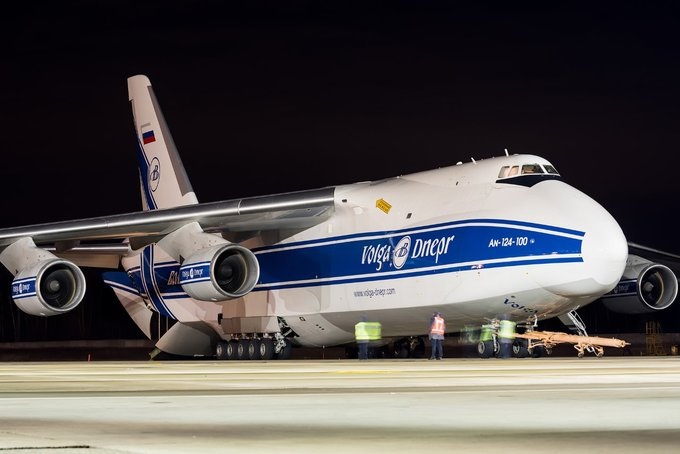
In a development that has attracted regional and international attention, Russia’s largest military cargo aircraft, the Antonov An-124 “Ruslan,” has landed in Iran, according to Iranian media sources. The massive transport plane is designed to carry some of the heaviest and largest military equipment in the world, including fighter jets, radar arrays, missile systems, and armored vehicles. Its sudden arrival in Iran has triggered widespread speculation about the nature of its mission — and what it might be carrying.
The An-124, operated by Russia’s Air Force and its state cargo operator Volga-Dnepr, has a carrying capacity of over 150 tons. This makes it capable of moving equipment like Su-35 fighter jets or air defense batteries — systems that Iran has long expressed interest in acquiring. The aircraft reportedly landed at a major military airbase in central Iran, where security around the runway was immediately tightened and radar activity in the area temporarily increased, according to open-source flight tracking data.
Although neither Moscow nor Tehran has confirmed the reason behind the flight, Iranian state-linked outlets claimed that the aircraft may be part of a broader defense exchange program between the two countries. Over the past two years, Russia and Iran have grown increasingly close, particularly after the start of the war in Ukraine. Iran has supplied Shahed-series drones and drone engines to Russia, while Moscow, in return, is believed to be offering advanced aircraft and radar technologies to Tehran.
Analysts have noted that this could be connected to Iran’s long-awaited Su-35 fighter jet deal, which has been discussed since early 2023. Russia had initially produced several Su-35s for Egypt, but those deliveries were frozen under Western pressure, leaving Tehran as a potential recipient. The landing of the An-124 could therefore signal logistical movements related to this deal, or possibly the delivery of support systems or spare parts necessary for the jets’ integration into Iran’s air force.
Other reports suggest the An-124 may be carrying radar overhauls, missile components, or heavy maintenance equipment for Iran’s existing defense systems. Given the aircraft’s past role in transferring large-scale machinery to war zones such as Syria, it’s plausible that the current mission is linked to strengthening Iran’s defensive infrastructure amid growing tensions with Western naval forces operating in the Persian Gulf.
The arrival of such a strategic transport plane is not just about equipment—it’s a political signal. It demonstrates that Russia views Iran as a critical ally in countering Western influence across the Middle East. For Tehran, the partnership offers access to advanced technologies that have long been denied under international sanctions.
This development is expected to raise alarms in Washington and among European allies, who have already voiced concern about arms collaboration between Moscow and Tehran. Western intelligence agencies have repeatedly warned that any such exchange could destabilize the region, especially if it involves offensive systems like fighter aircraft or long-range radar networks.
In essence, the landing of the An-124 in Iran symbolizes far more than a cargo delivery. It reflects a deepening axis of cooperation between two sanctioned powers seeking strategic resilience through shared defense capabilities. As Russia and Iran continue to align their military interests, the movement of such aircraft will likely become a common feature in their evolving partnership, with implications that could reshape the security dynamics from the Caspian region to the Persian Gulf.
——— End of Article ———