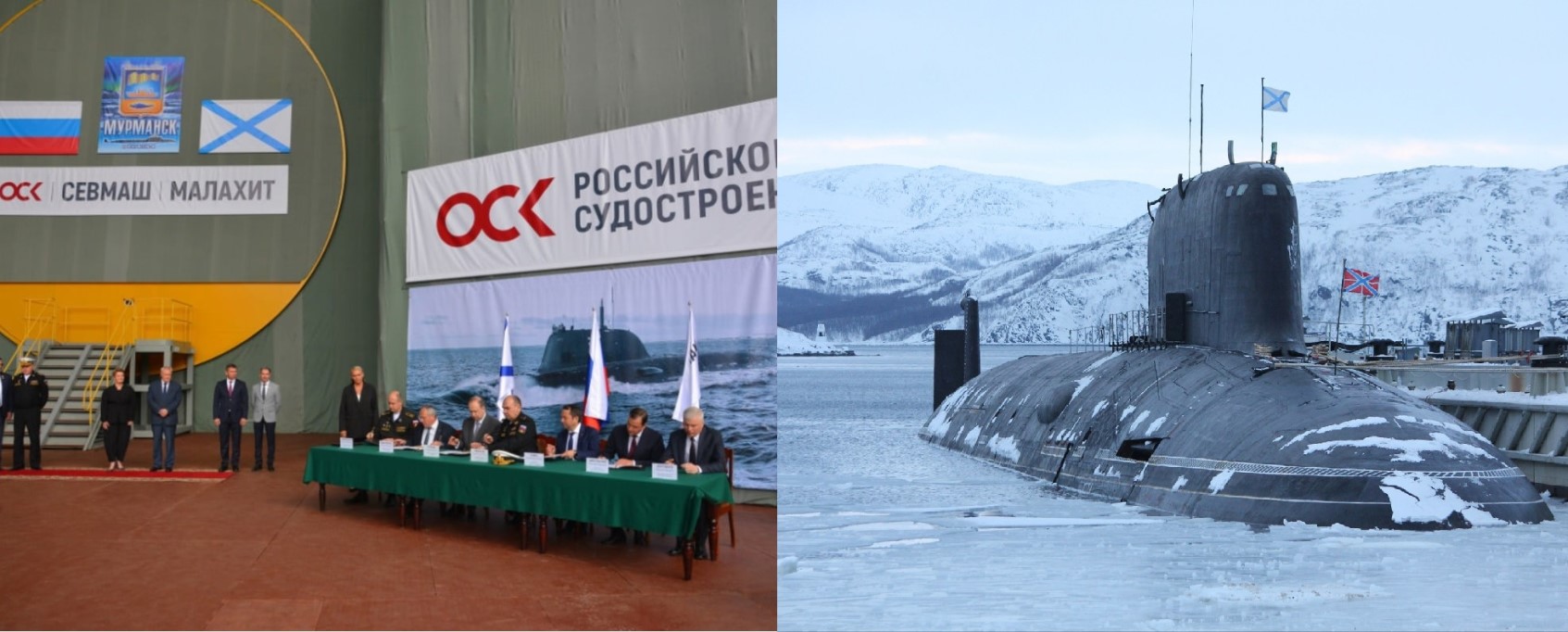
SEVERODVINSK, Russia, — June 20, 2026 : Russia has officially begun construction of a new nuclear-powered attack submarine, Murmansk, marking the latest addition to its Project 885M Yasen-M submarine program. The keel-laying ceremony took place on June 17 at the Sevmash shipyard in Severodvinsk, Russia’s primary center for nuclear submarine construction.
The submarine, assigned factory number 169, is the ninth vessel of the Yasen-M class and the first submarine of the program to be laid down under a new contract following a six-year gap since the previous pair of boats entered construction in 2020. The project underscores Russia’s continued investment in advanced naval capabilities despite ongoing economic and industrial pressures.
The ceremony was attended by Admiral of the Fleet Alexander Moiseyev, Commander-in-Chief of the Russian Navy; Andrei Puchkov, Director General of the United Shipbuilding Corporation (USC); Mikhail Budnichenko, Director General of Sevmash; as well as the governors of the Murmansk and Arkhangelsk regions. The submarine was named in honor of the Hero City of Murmansk, continuing a longstanding tradition within the Russian Navy.
Sevmash Remains Central to Russia’s Submarine Fleet
The keel-laying took place at Sevmash, officially known as the Severnoye Mashinostroitelnoye Predpriyatiye production association. Located on the White Sea in Russia’s Arctic region, Sevmash is the country’s largest shipyard and the sole producer of Russia’s nuclear-powered submarines.
The facility is currently responsible for constructing both strategic ballistic missile submarines and multi-purpose attack submarines for the Russian Navy, making it one of the country's most important defense-industrial assets.
Yasen-M Class Capabilities
Known by NATO as the Severodvinsk class, the Project 885M Yasen-M submarines are regarded as Russia’s most advanced operational nuclear-powered attack submarines. Designed as multi-role platforms, they are capable of conducting anti-submarine warfare, anti-surface warfare, long-range precision strikes, intelligence collection, and escort missions.
The submarines feature advanced acoustic quieting technologies intended to reduce detectability and improve survivability during operations in contested maritime environments.
Their weapons suite includes:
- Kalibr land-attack cruise missiles, with a reported range of approximately 2,500 kilometers.
- P-800 Oniks anti-ship missiles, designed to engage high-value naval targets.
- 3M22 Zircon hypersonic cruise missiles, capable of speeds around Mach 9 and ranges of roughly 1,000 kilometers.
The Yasen-M design incorporates vertical launch systems capable of carrying up to 32 cruise missiles, alongside 10 torpedo tubes that can deploy heavyweight torpedoes and naval mines.
Russia has increasingly emphasized the integration of Zircon hypersonic missiles into the class. These missiles are intended to penetrate modern naval defense systems through a combination of high speed and low-altitude flight profiles.
Development of the Yasen Program
The current Yasen-M fleet is an evolution of the original Project 885 Yasen design. The lead submarine of the class, K-560 Severodvinsk, was laid down in December 1993 during the post-Soviet economic downturn and entered service only in June 2014 after a lengthy construction period.
The improved Project 885M variant introduced design modifications, updated combat systems, and more efficient production processes.
The first Yasen-M submarine, K-561 Kazan, was laid down in July 2009 and commissioned in May 2021.
Subsequent vessels have entered service at a more consistent pace:
- K-573 Novosibirsk — commissioned in December 2021 and later assigned to the Pacific Fleet.
- K-571 Krasnoyarsk — commissioned in December 2023.
- K-562 Arkhangelsk — entered service with the Northern Fleet in December 2024 after completing sea trials.
- K-572 Perm — rolled out from Sevmash in March 2025 and is currently undergoing trials.
During the launch ceremony for Perm, Russian President Vladimir Putin stated that the submarine would become the first multi-purpose submarine in the Russian Navy equipped with the Zircon hypersonic missile as part of its standard weapons load.
Another vessel, Ulyanovsk (factory number 166), remains under construction. In addition, Voronezh (167) and Vladivostok (168), which were laid down in July 2020 under a separate contract, are expected to join the fleet later in the decade, although Russian naval construction schedules have historically experienced delays.
Long-Term Fleet Modernization
The start of construction on Murmansk signals the continuation of Russia’s long-term submarine modernization efforts. The Russian Navy plans to gradually replace older Soviet-era attack submarines with Yasen and Yasen-M vessels, creating a force centered on modern multi-purpose nuclear-powered submarines.
Industry analysts estimate that construction and testing of Murmansk will take several years, with entry into service likely in the early 2030s based on the timelines of previous submarines in the class.
Once completed, the submarine is expected to strengthen Russia’s ability to conduct operations across the Arctic, Atlantic, and Pacific theaters while expanding the Navy’s long-range strike and undersea warfare capabilities.
No changes to the delivery schedules of other Yasen-M submarines currently under construction were announced during the keel-laying ceremony.
——— End of Article ———