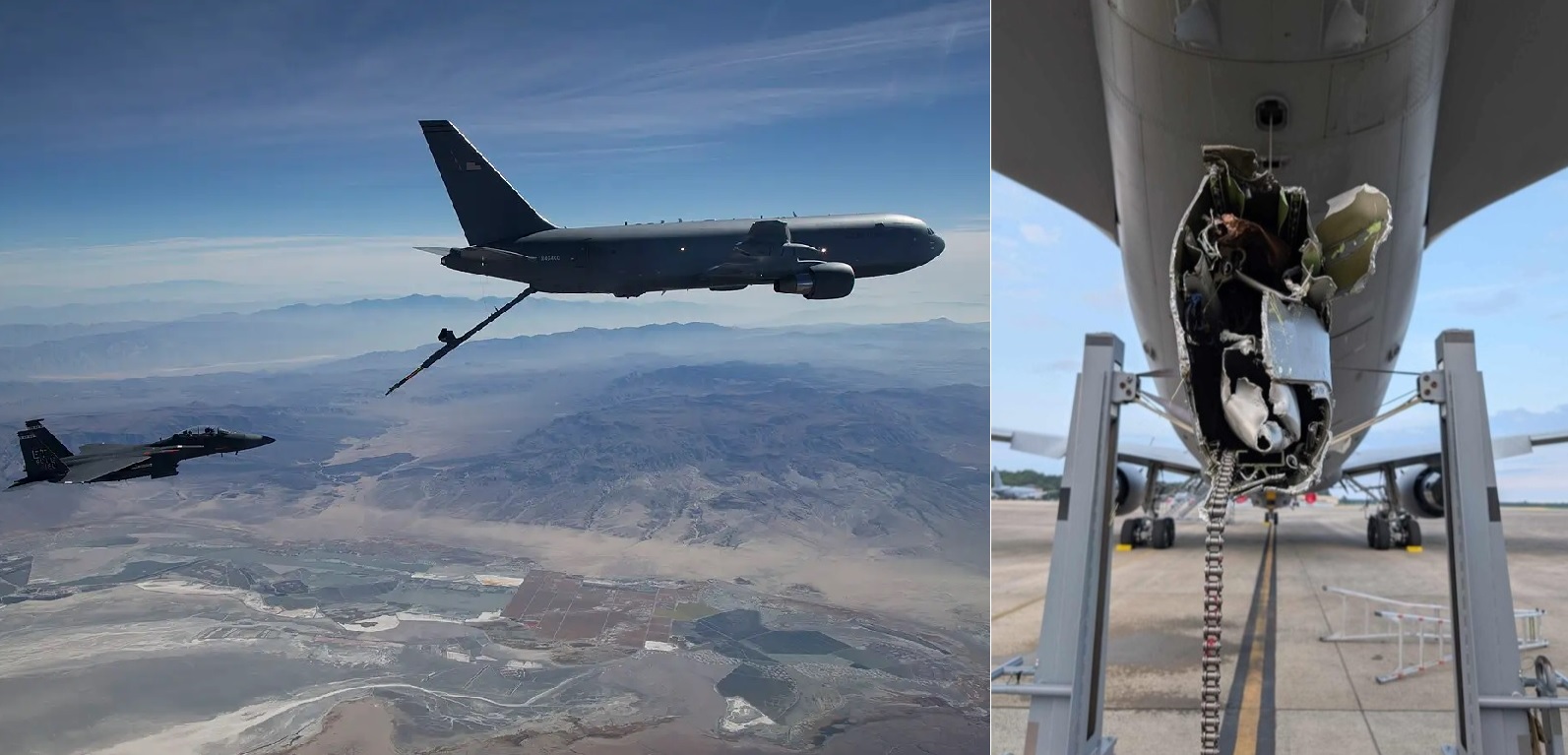
WASHINGTON, D.C. — June 20, 2026 : A known design deficiency in the U.S. Air Force’s KC-46A Pegasus aerial refueling tanker contributed to a July 2025 midair accident that resulted in the loss of the aircraft’s refueling boom and nearly $10 million in damages, according to a declassified Air Force Accident Investigation Board report released on June 12, 2026.
The incident is the latest in a series of refueling mishaps linked to the KC-46A’s long-documented “stiff boom” issue, a Category 1 deficiency that the Air Force considers capable of causing major equipment damage or the loss of an aircraft. Since 2022, four nozzle-binding incidents have been associated with the problem, including two cases in which the boom separated from the tanker during flight.
Training Mission Ends in Major Mishap
The accident occurred on July 8, 2025, during a routine aerial refueling training mission approximately 100 miles off the coast of Virginia.
A KC-46A assigned to the 22nd Air Refueling Wing at McConnell Air Force Base, Kansas, was conducting refueling operations with F-22A Raptor fighters from Joint Base Langley-Eustis, Virginia.
According to the report, the refueling sequence experienced difficulties from the beginning. An F-22 student pilot with only 13 flight hours in the aircraft made several unsuccessful attempts to establish contact with the tanker, resulting in multiple aborted refueling attempts and emergency breakaways before a successful connection was achieved.
Once connected, the fighter aircraft moved forward toward the tanker after the pilot failed to sufficiently reduce engine thrust to compensate for the KC-46A’s known boom resistance. The aircraft approached the inner limit of the boom’s telescoping tube, creating a potentially hazardous situation.
To prevent a collision, the boom operator initiated a disconnect procedure. However, the nozzle became stuck inside the F-22’s fuel receptacle in a condition known as nozzle binding, setting the stage for the accident.
Boom Torn Off and Lost in Atlantic Ocean
As the F-22 executed an emergency breakaway maneuver, the bound boom remained trapped in the fighter’s receptacle. The resulting forces caused the boom to suddenly release and enter an unrecoverable fly-up condition.
The boom then struck the KC-46A’s fuselage and tail section before breaking apart. The detached aft portion, including the telescoping tube and U-tail assembly, fell into the Atlantic Ocean and was not recovered.
The accident caused extensive damage to the tanker, including:
- Structural separation of boom components
- Damage to the tail section
- A hole in the fuselage
- Ruptured shock absorber
- Torn hydraulic lines and electrical wiring
- Damage to the auxiliary power unit
The Air Force estimated the total damage at $9,979,567.
Despite the severity of the incident, both aircraft landed safely and no injuries were reported. The KC-46A diverted to Seymour Johnson Air Force Base, while the F-22 returned safely to base.
Investigation Points to Crew Actions and Aircraft Deficiency
The Accident Investigation Board, led by Col. Kevin E. White, determined that the primary cause of the mishap was manual control inputs made by the boom operator that generated radial forces, causing the nozzle to bind within the F-22’s receptacle.
Investigators also concluded that the student pilot’s failure to properly account for the KC-46A’s stiff boom characteristics was a substantial contributing factor.
However, the report also acknowledged the role of the tanker’s long-standing mechanical deficiency.
The KC-46A’s boom requires greater force than expected to move during refueling operations, making it more difficult for receiving aircraft to maintain a stable position. Pilots often need to apply additional thrust to remain connected, increasing the risk of sudden forward movement if adjustments are not made quickly.
Recurring Problem Across the KC-46 Fleet
The Air Force has documented the stiff boom issue since at least 2018, and it remains one of the most significant unresolved deficiencies affecting the KC-46A program.
The July 2025 mishap marked:
- The fourth nozzle-binding incident linked to the boom deficiency since 2022
- The second case in less than a year in which a KC-46A boom was completely torn off during flight
A previous investigation into a similar 2022 incident reached a different conclusion. In that case, investigators found that limitations in the KC-46A boom control system played a direct role in the event and attributed the operator’s actions largely to the aircraft’s design characteristics rather than human error.
Readiness Concerns Continue
The latest accident comes amid broader concerns about the operational readiness of the KC-46A fleet.
A Government Accountability Office (GAO) report released in June 2026 found that the tanker failed to meet Air Force availability and mission-capability targets for six consecutive fiscal years, from FY2019 through FY2025.
In addition to the boom telescope deficiency, Air Force units have reported:
- Electrical component failures
- Sensor inaccuracies
- Structural airframe cracks
- Other reliability-related issues affecting fleet availability
As a result, the Air Force continues to rely heavily on its aging KC-135 Stratotanker fleet to support global aerial refueling operations.
Boeing Working on Corrective Measures
The KC-46A Pegasus, based on the Boeing 767 commercial aircraft platform, is the Air Force’s primary replacement for the KC-135. Each aircraft has an estimated unit cost of approximately $239 million, and more than 100 aircraft have been delivered.
To address the boom issue, Boeing is developing a Boom Telescope Actuator Redesign (BTAR) intended to reduce stiffness and improve boom performance. The modification is expected to begin entering service in late fiscal year 2027, with additional hardware and software improvements planned through 2028.
Until those upgrades are fielded, the Air Force and Boeing will continue implementing corrective actions while working to improve the tanker’s reliability, availability, and operational effectiveness.
——— End of Article ———