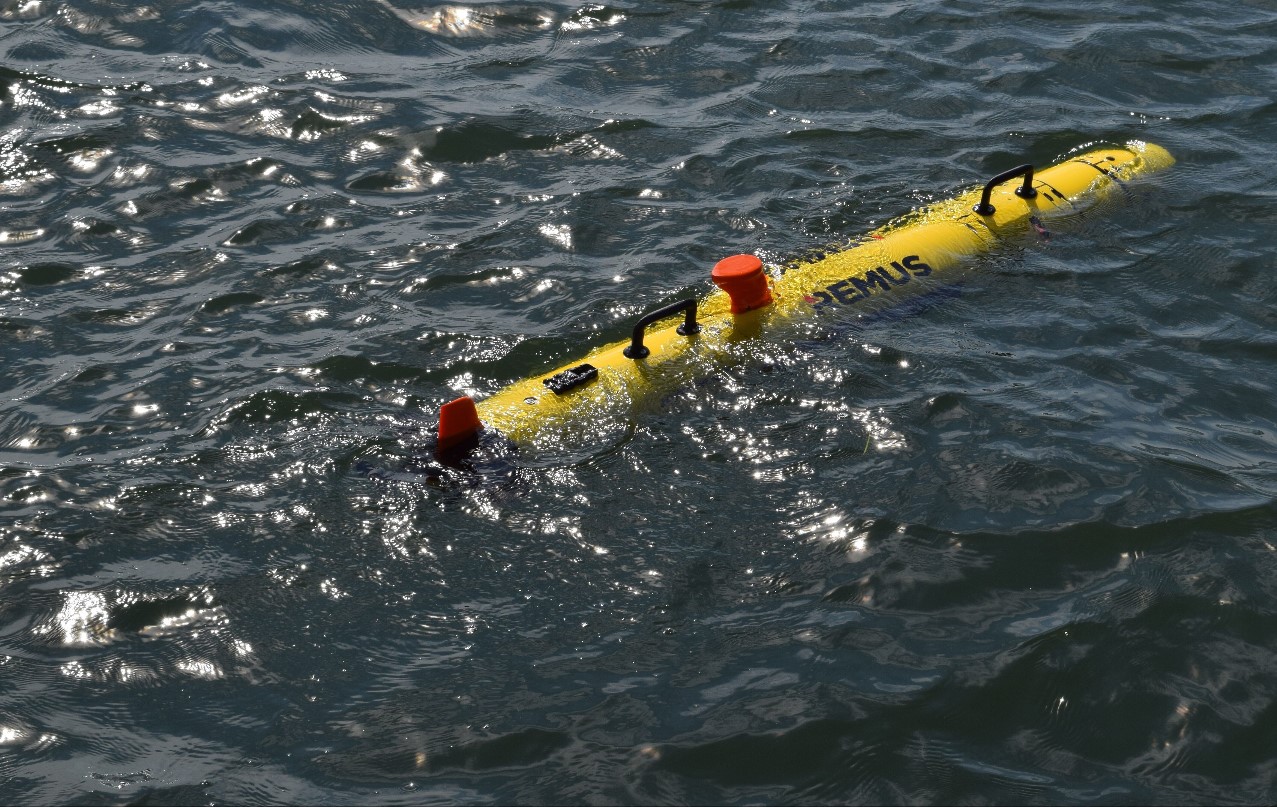
POCASSET, Massachusetts, — June 20, 2026 : Huntington Ingalls Industries (HII) has delivered the first REMUS 130 unmanned underwater vehicle (UUV) to an undisclosed U.S. ally, marking the introduction of the latest generation of the REMUS family of autonomous underwater systems.
The REMUS family has more than 25 years of operational history and is used by the U.S. Navy, allied militaries, government agencies, research institutions, and commercial operators. More than 750 REMUS vehicles have been delivered worldwide and are currently operated in over 30 countries, including by 14 NATO navies.
The REMUS 130 is the third-generation evolution of the REMUS 100 series. It combines the reliability and ease of operation of earlier REMUS platforms with upgraded electronics, open-architecture interfaces, and greater payload flexibility.
“The delivery of the first REMUS 130 represents an important step in the continued evolution of the REMUS family,” said Duane Fotheringham, president of the Unmanned Systems group in HII’s Mission Technologies division.
“For decades, customers have relied on REMUS vehicles for their durability, ease of operation and proven performance. REMUS 130 builds on that legacy with a highly capable, modular platform that delivers greater flexibility, interoperability and value while leveraging common architecture across the REMUS fleet.”
The REMUS 130 features a compact, two-person-portable design, weighing approximately 107 pounds (48.5 kg) and measuring 80 inches (2.03 m) in length. It can operate at depths of up to 100 meters (330 feet), reach speeds of up to 5 knots, and provide up to 10 hours of endurance with a maximum range of approximately 55 kilometers (29 nautical miles).
The vehicle is powered by 1.5 kWh field-swappable lithium-ion battery modules, allowing rapid battery replacement and increased operational availability. It is built on the same technology foundation as the larger REMUS 300 and REMUS 620 platforms.
A key feature of the REMUS 130 is its open-architecture design, which enables the rapid integration of commercial, government, and customer-developed payloads. This modular approach helps reduce lifecycle costs while allowing the vehicle to adapt to changing mission requirements.
The UUV integrates HII’s Odyssey Autonomous Control System (ACS), which supports collaborative autonomy, sensor fusion, advanced navigation, and multi-vehicle coordination. The system is already deployed on REMUS platforms operating in more than 30 countries.
The REMUS 130 is equipped with advanced navigation, processing, and communication systems, including high-frequency acoustic communications, Wi-Fi connectivity, and integrated side-scan sonar for high-resolution underwater imaging.
The platform is designed to support a wide range of missions, including mine countermeasures, harbor clearance, search and recovery operations, oceanographic research, environmental monitoring, seabed mapping, and offshore energy infrastructure inspection.
The delivery expands HII’s portfolio of autonomous maritime systems as demand continues to grow for adaptable and cost-effective unmanned underwater capabilities.
——— End of Article ———