Brussels, Belgium, — June 20, 2026 : Six European nations have formally moved their joint long-range strike cooperation from the planning phase into active development, launching eight separate weapon programs under the European Long-Range Strike Approach (ELSA). The initiative includes the development of a ground-launched cruise missile with a range exceeding 2,000 kilometers, alongside several other deep-strike and air-defense suppression capabilities.
According to Aviation Week, defense ministers from Germany, France, Poland, Italy, Sweden, and the United Kingdom signed the agreement on June 18, marking a major milestone after nearly two years of collaborative planning. The participating countries concluded that several capability areas had reached sufficient maturity to transition into dedicated development programs, now organized as ELSA Implementation Groups (EIGs).
The ELSA framework was established to strengthen Europe's sovereign deep-strike capabilities, reduce dependence on U.S. military assets in key mission areas, and address capability gaps highlighted by recent conflicts, particularly the war in Ukraine. The initiative is also intended to reinforce European defense-industrial cooperation and support NATO's long-term deterrence and defense requirements.
Eight ELSA Implementation Groups Established
Under the agreement, development efforts will be divided into eight specialized implementation groups, with at least one lead nation assigned to oversee each project's development and procurement activities.
The eight capability areas include:
- Airborne Early Warning Systems
- Long-Range Anti-Radar Missiles for Suppression of Enemy Air Defenses (SEAD)
- Long-Range Air-to-Ground Missiles
- European Multiple Launch Rocket Systems (Euro Multi Missile Launcher)
- Ground-Launched Missiles with ranges of 300–500 kilometers
- Ground-Launched Missiles with ranges of 500–2,000 kilometers
- Ground-Launched Missiles with ranges exceeding 2,000 kilometers
- Low-Cost Long-Range Strike Weapons with ranges greater than 500 kilometers
Officials stated that the implementation groups will enable focused development while allowing additional European partners to participate in future phases of the program.
France Proposes MdCN for Over-2,000 km Missile Requirement
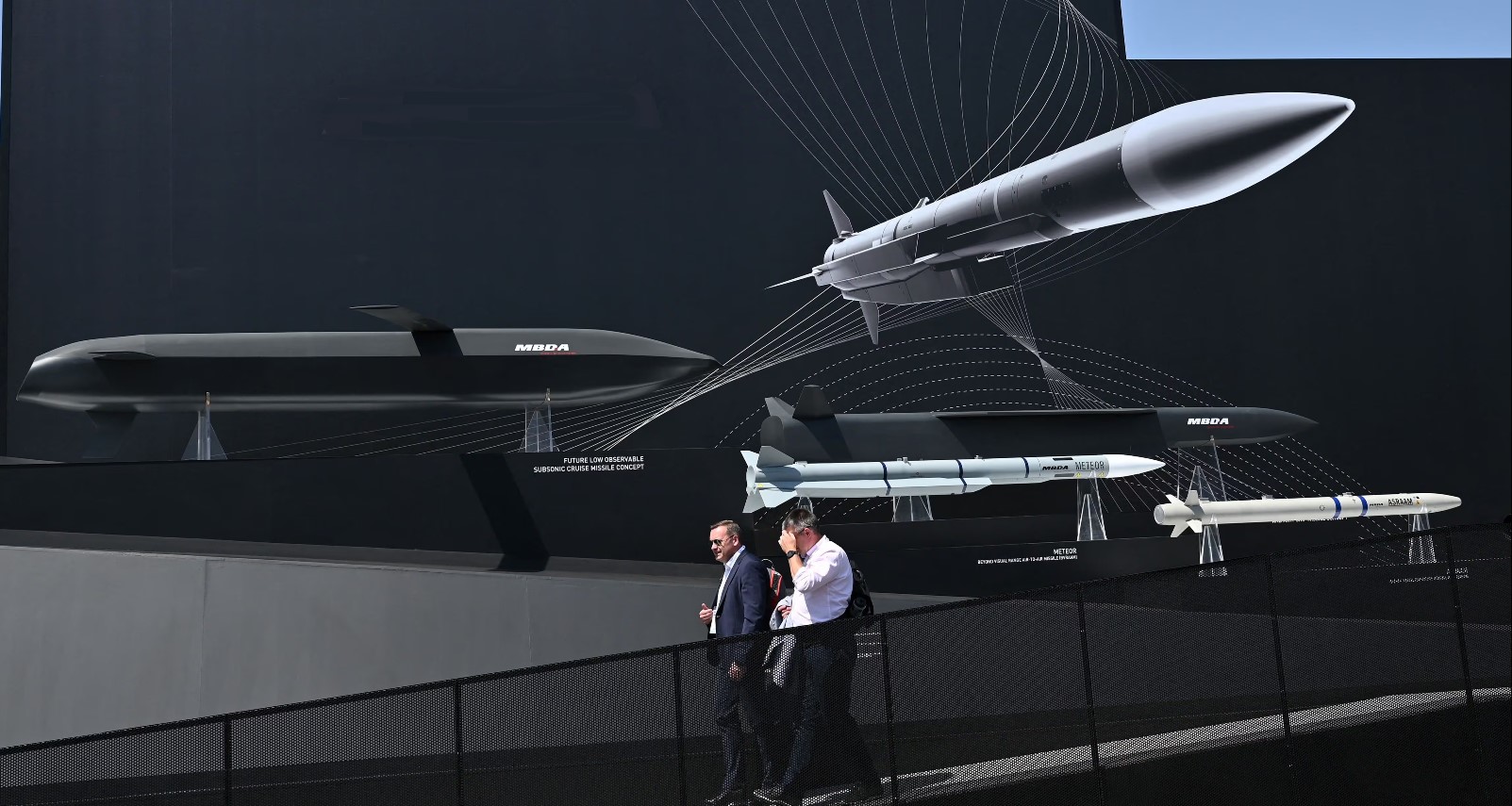
For the long-range missile category exceeding 2,000 kilometers, France has proposed adapting its Missile de Croisière Naval (MdCN), also known as SCALP Naval, as the foundation for the future ground-launched system.
Developed by MBDA, the MdCN is currently a sea-launched cruise missile used by the French Navy. In its existing configuration, the missile offers a range of up to 1,000 kilometers. French officials believe the platform's mature design and proven technologies could allow a relatively rapid transition to a ground-launched variant capable of meeting ELSA's extended-range requirements.
The missile incorporates stealth features designed to reduce detectability and improve survivability in contested environments. It flies at very low altitudes, typically between 30 and 40 meters above the terrain, using terrain-following flight profiles to minimize exposure to enemy air-defense networks.
For navigation and targeting, the MdCN combines inertial navigation, satellite guidance, active radar homing, and infrared guidance systems, providing multiple layers of precision targeting capability. Although the missile is not currently in serial production, MBDA has stated that its production facilities are prepared to resume manufacturing upon receiving orders.
United Kingdom Leads Low-Cost Long-Range Strike Effort
While France is focusing on the longest-range missile category, the United Kingdom is taking a leading role in the development of the Low-Cost Long-Range Strike Weapons project.
Known internally as the OWE 500+ (One-Way Effector 500+), the effort seeks to develop autonomous strike systems capable of engaging targets at ranges beyond 500 kilometers. The concept emphasizes affordability and mass production, with participating nations targeting a unit cost below €100,000.
The objective is to create expendable, drone-like strike systems that can be produced in large quantities and rapidly replenished during prolonged conflicts. By simplifying design requirements and expanding manufacturing participation across multiple European countries, the program aims to establish a resilient and scalable production base.
Supporting Broader European Strike Capabilities
In addition to missile development, ELSA will support complementary projects across the long-range strike ecosystem. These include airborne early warning platforms, anti-radar weapons designed to suppress enemy air defenses, and advanced rocket artillery systems.
Among the supporting efforts is the Thundart rocket artillery program being developed by MBDA and Safran, which is intended to provide a strike capability at ranges of approximately 150 kilometers. Such national programs are expected to contribute technologies and operational experience that can support wider ELSA objectives.
The participating nations view the initiative as a long-term effort to enhance Europe's ability to conduct deep precision strikes using sovereign technologies while strengthening industrial cooperation across the continent.
With the establishment of the ELSA Implementation Groups, development activities are expected to accelerate during the coming years, with participating countries aiming to field new long-range strike systems and supporting capabilities during the 2030s.
——— End of Article ———