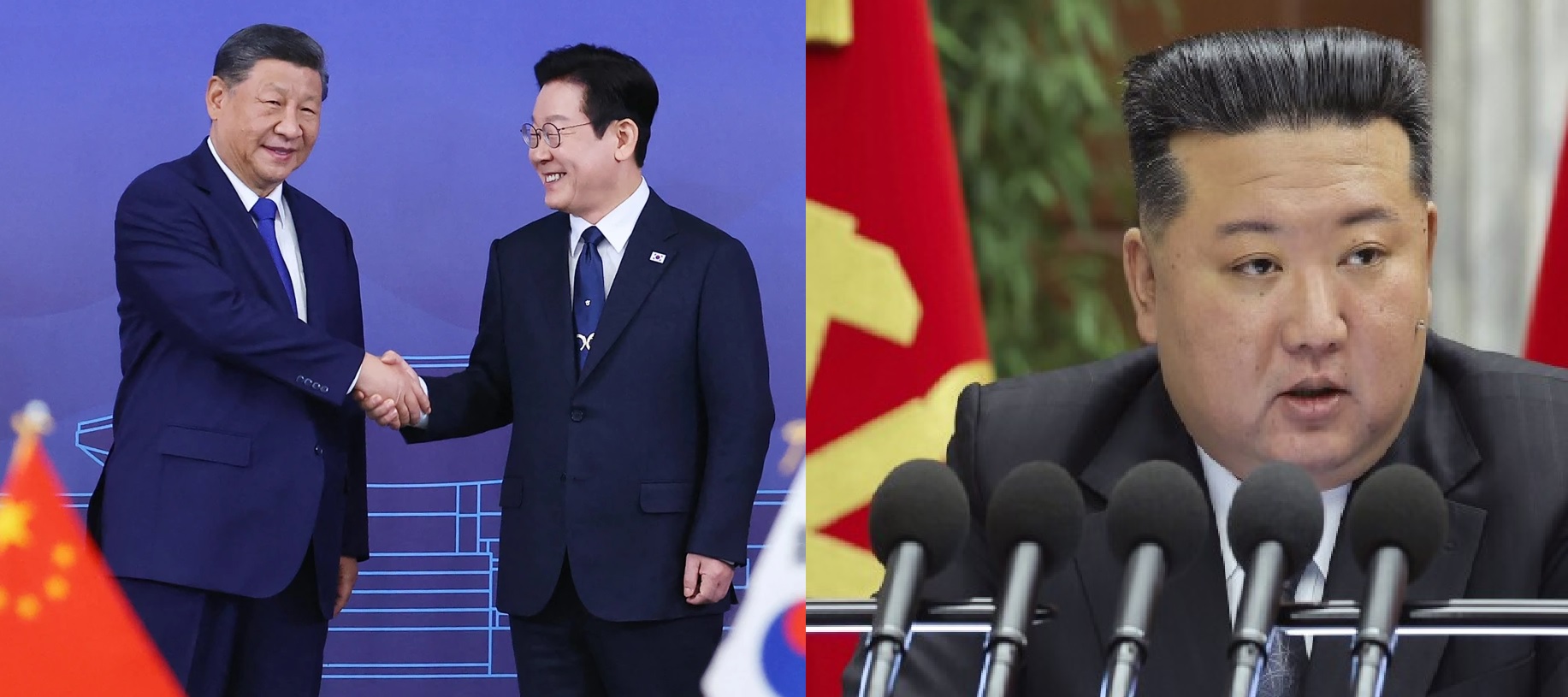
North Korea has firmly rejected the idea of denuclearisation on the Korean peninsula, calling it an “unrealisable pipe dream” just hours before a key meeting between Chinese President Xi Jinping and South Korean President Lee Jae Myung. The summit, held on the sidelines of the Asia-Pacific Economic Cooperation (APEC) forum in Gyeongju, South Korea, was expected to include discussions on regional stability and Pyongyang’s growing nuclear ambitions.
According to a statement released by North Korea’s state-run KCNA, Vice Foreign Minister Pak Myong Ho criticised Seoul for what he described as “daydreaming” about disarmament. He asserted that the Democratic People’s Republic of Korea (DPRK) would never give up its nuclear status, warning that the South’s continued push for denuclearisation only highlighted its “lack of common sense.”
“The ROK is still unaware that struggling to deny the DPRK's position as a nuclear weapons state and talking about its daydream of realizing the denuclearization just reveal its lack of common sense,” Pak said, using the official titles of both Koreas. “We will show with patience that denuclearization is a ‘pipe dream’ which can never be realized.”
The sharp remarks came as Seoul and Beijing prepared for their first major summit in months, with both leaders expected to discuss ways to revive stalled diplomacy and manage the volatile North Korean issue. South Korea’s presidential office had earlier confirmed that President Lee would urge China to play a “constructive role” in restraining Pyongyang’s weapons program, echoing similar requests made by Washington in recent years.
However, Beijing’s stance has remained carefully balanced. China, North Korea’s largest trading partner and most significant political ally, has publicly called for restraint on all sides, while privately urging Pyongyang to avoid provocative military tests. Yet, China’s strategic interest in maintaining a stable but divided Korean peninsula often limits how far it is willing to go to pressure Kim Jong Un’s regime.
North Korea’s statement also underscores the widening gap between Pyongyang and Seoul since diplomacy collapsed in 2019 following the failed Hanoi summit between Kim Jong Un and then-U.S. President Donald Trump. Since then, North Korea has declared itself a “nuclear weapons state” in its constitution and accelerated tests of new ballistic missiles, tactical nuclear warheads, and hypersonic delivery systems.
Analysts believe the timing of North Korea’s declaration — just before the Xi–Lee summit — was deliberate. It serves as both a warning to Seoul and a subtle message to Beijing that Pyongyang will not be swayed by diplomatic overtures or economic incentives. “This is North Korea drawing a red line before China’s talks with South Korea,” said one Seoul-based expert. “It wants to make sure that denuclearisation is not even entertained as a viable agenda.”
For South Korea, however, the issue remains central. President Lee’s administration has repeatedly emphasised that a nuclear-free Korean peninsula is essential for lasting peace and regional security. Yet, with North Korea continuing to modernize its arsenal and dismissing dialogue efforts, Seoul faces the challenge of balancing diplomacy with deterrence.
The Xi–Lee summit thus represents another test of how far Beijing is willing to go to mediate between two estranged neighbours — one bound by historical ties and the other by economic interdependence. But for now, North Korea’s latest statement makes its position unmistakably clear: its nuclear program is not up for negotiation.
——— End of Article ———