WASHINGTON / TEHRAN / ISLAMABAD, — April 8, 2026 : The United States and Iran have agreed to a two-week ceasefire effective April 8, 2026, introducing a temporary framework that permits Iran and Oman to charge fees on commercial vessels transiting the Strait of Hormuz. The arrangement, reported by the Associated Press, is designed to restore maritime traffic through the strategic waterway while establishing a revenue mechanism for Iran’s post-conflict reconstruction.
The agreement follows more than a month of hostilities that began on February 28, 2026, when Israel launched airstrikes targeting Iranian military sites, nuclear facilities, and urban areas. The United States joined the campaign shortly thereafter, focusing on Iran’s ballistic missile and nuclear infrastructure. Iran responded with missile strikes across the Gulf region. The conflict caused significant damage to Iranian infrastructure, including energy facilities, and led to a sharp disruption in maritime activity through the Strait of Hormuz.
Ceasefire Framework and Maritime Provisions
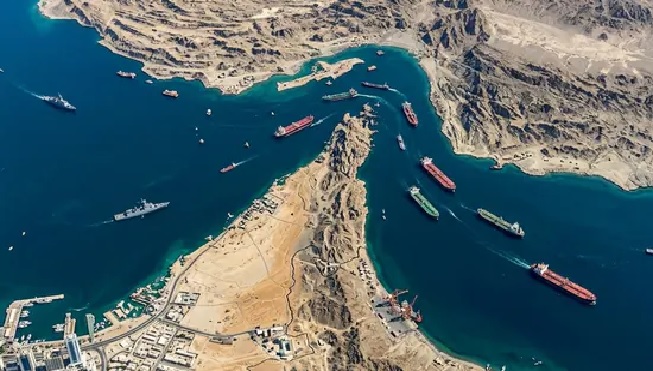
Under the terms of the ceasefire, Iran will suspend restrictions that had effectively limited passage through the Strait of Hormuz, a 34-kilometer-wide chokepoint connecting the Persian Gulf to the Gulf of Oman. The waterway is bordered by Iran to the north and Oman to the south and is a critical corridor for global energy supplies, handling a substantial share of international oil and liquefied natural gas shipments.
In exchange for reopening the route and halting military operations, both Iran and Oman are authorized to levy transit fees on commercial vessels, including oil tankers and cargo ships. The ceasefire also includes provisions ensuring safe passage for vessels during the two-week period.
Oman’s inclusion reflects its geographic position along the southern side of the strait. However, no detailed breakdown has been released regarding Oman’s fee structure, collection mechanisms, or potential revenue-sharing arrangements between the two countries.
Revenue Structure and Economic Impact
Iran has been charging transit fees of up to $2 million per vessel over the past month, even amid reduced shipping activity. Under the ceasefire framework, this pricing model is expected to continue as traffic normalizes.
Prior to the conflict, vessel traffic through the strait averaged approximately 129 ships per day in late February. At the height of the disruption in March, traffic fell to as few as nine vessels per day, with more than 34,000 shipping routes diverted globally due to security concerns.
At restored traffic levels, the $2 million per-ship fee is projected to generate approximately $8 billion in monthly revenue for Iran, equivalent to around $96 billion annually. Based on current estimates, this influx would increase Iran’s gross domestic product (GDP) from $475 billion to approximately $571 billion, representing a 20 percent rise.
Iranian officials have stated that all revenue collected from these transit fees will be directed toward rebuilding infrastructure damaged during the recent strikes conducted by the United States and Israel. The funding is intended to support reconstruction of civilian, administrative, and energy-related facilities without reliance on external compensation.
Diplomatic Process and Mediation
The ceasefire was facilitated through diplomatic channels with Pakistan acting as a primary mediator. Further negotiations between the United States and Iran are scheduled to begin in Islamabad on Friday, April 10, 2026. The talks are expected to address longer-term arrangements for maritime security, economic measures, and a broader framework for de-escalation.
The two-week ceasefire period is intended to stabilize the situation in the Strait of Hormuz, reduce pressure on global energy markets, and allow time for continued diplomatic engagement. Officials from both sides have indicated that the temporary agreement may serve as a foundation for a more comprehensive settlement.
Operational and Strategic Context
The Strait of Hormuz remains one of the most strategically significant maritime corridors in the world. The disruption during the conflict had immediate global effects, halting shipments, increasing insurance and transit risks, and forcing rerouting of commercial vessels.
The introduction of a formalized transit fee system under the ceasefire represents a notable development in the management of the waterway during periods of conflict and recovery. While the current arrangement is limited to two weeks, its structure may influence future negotiations regarding maritime access, security guarantees, and economic compensation mechanisms in the region.
——— End of Article ———