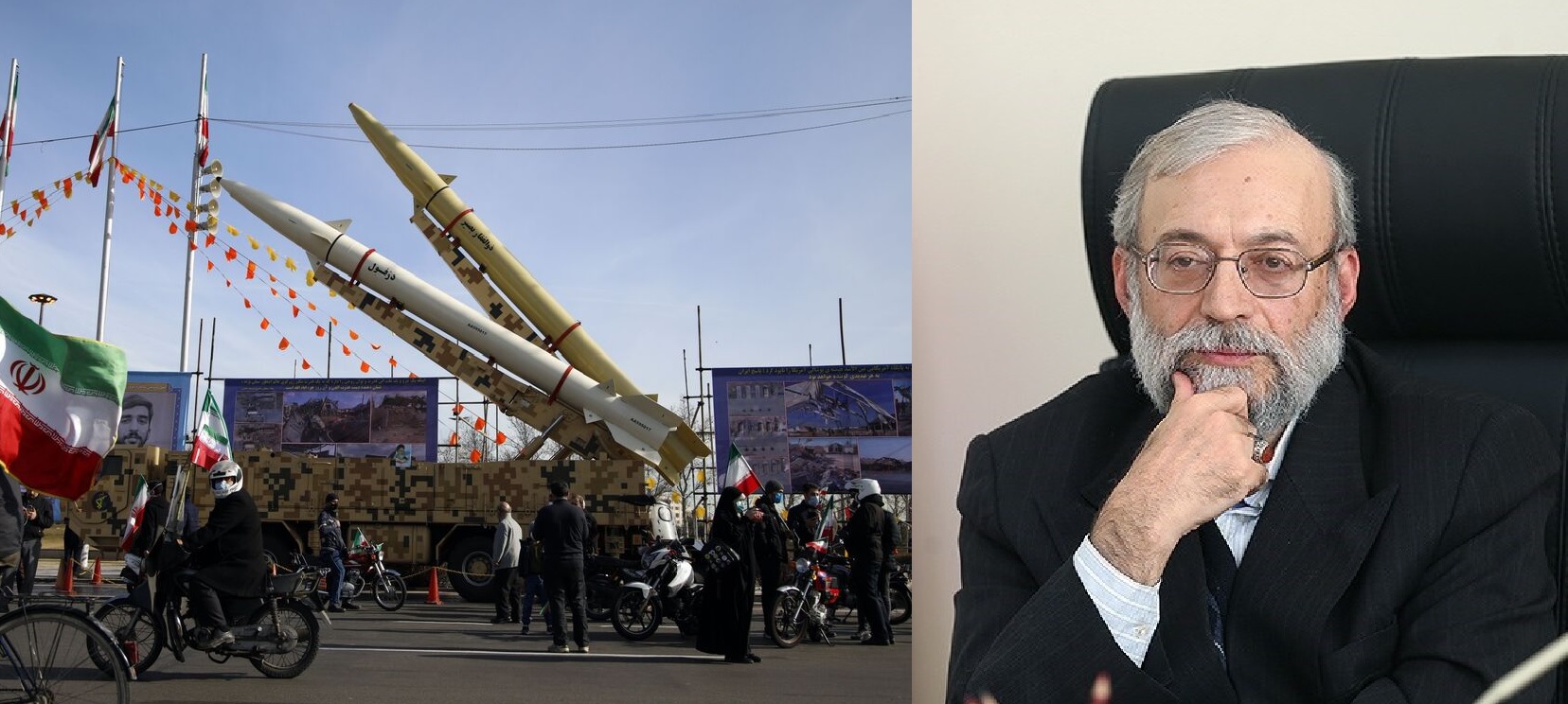
Tehran — A recent statement by Javad Larijani, an adviser of Iran’s supreme leader, that Iran could build a nuclear weapon “in under two weeks” sparked alarm and confusion. At the same time, Ayatollah Ali Khamenei has long issued a fatwa — a religious edict — declaring the use of nuclear weapons forbidden. Those two facts — a technical-capability claim and a religious prohibition — are not the same. Below is a plain-language, technical and political unpacking of what the claim likely means, how close Iran might be in practical terms, and what the fatwa implies for policy.
What people mean by “build a weapon in two weeks”
When officials say a country could “build” a bomb in days or weeks, they are almost always referring to breakout time — the interval between a political decision to weaponize and the moment a state has enough weapons-usable fissile material for at least one device. This is not the same as producing a tested, reliable warhead mated to a delivery system.
Short breakout time is possible when a country already has:
-
sizable stocks of enriched uranium at intermediate levels (for example, 60% U-235 rather than natural or low-enriched uranium);
-
a large, operational bank of centrifuges that can be reconfigured to push enrichment from intermediate to weapons-grade (≈90% U-235); or
-
a clandestine or pre-existing plutonium route (reactor fuel and reprocessing) — typically slower and more visible.
If such stocks and infrastructure exist, pushing material to weapons-grade can — in some scenarios — be done in days to a few weeks. But that is only the first step.
The technical pipeline: from fissile material to a deliverable weapon
Turning fissile material into a fieldable nuclear weapon requires several further stages, each with its own time, facilities and expertise:
-
Conversion and metallurgy. Enriched uranium hexafluoride (UF₆) must be converted into metal and fabricated into a core or “pit.” This needs glove-box facilities, precision machining and materials expertise. This step can take weeks to months depending on capability.
-
Weapon design and high-explosive lensing. An implosion device requires carefully shaped explosive lenses to compress the core symmetrically. Designing, manufacturing and calibrating these components is technically demanding and typically takes months if the design is not already mature.
-
Integration and testing. Integrating the fissile core, firing set and safety/arming mechanisms into a warhead requires engineering work and usually some form of testing (subcritical tests, simulations, or historically, a full test) to ensure reliability. This adds months.
-
Delivery integration. Attaching a warhead to a missile or other delivery vehicle and validating survivability and re-entry behavior are additional programs that can take months to years.
So the oft-quoted “two-week” claim most plausibly refers to the fissile-material production leg (how fast a state could produce enough weapons-usable material), not the entire chain to a proven, deployable weapon.
How near might Iran actually be?
Public monitoring has shown Iran possessing significant enrichment infrastructure and stockpiles of enriched uranium — facts that shorten theoretical breakout estimates under specific assumptions: an immediate political decision to weaponize, centrifuges devoted entirely to weapons-grade enrichment, and available conversion/fabrication resources.
But precise timing depends on details usually kept secret: the exact quantity and enrichment level of uranium stocks, the number and efficiency of centrifuges running, and the existence and readiness of covert facilities. Even with large enrichment capacity, many analysts stress that converting material into a reliable warhead and mating it to a tested delivery system remains materially harder and more time-consuming than a single line “two-week” claim suggests.
The fatwa — religious prohibition versus practical policy
Ayatollah Khamenei’s fatwa that declares nuclear weapons forbidden carries symbolic and political weight inside Iran. It serves as a moral justification for non-use, a public assurance to outsiders, and a domestic legitimizing statement for Iran’s nuclear posture.
However, important practical realities follow:
-
Interpretation and flexibility. Religious edicts are subject to interpretation. In extreme circumstances or under perceived existential threat, leaders could reinterpret or rescind positions. The fatwa reduces political appetite for overt weaponization but does not physically prevent technical activity.
-
Capability vs. intent. States often maintain a latent capability — the materials, technology and know-how — while publicly denying intent. Possessing a latent option gives political leverage even if there is no intention to weaponize.
In short, the fatwa is a serious political constraint but not a technical barrier.
Larijani’s “under two weeks” remark should be read narrowly: it most likely refers to how quickly Iran could produce weapons-usable fissile material if it chose to concentrate all resources on that task. It does not mean a tested, delivery-ready nuclear arsenal could be assembled and fielded in that time. Ayatollah Khamenei’s fatwa imposes a significant political-religious constraint on the use (and in some readings the possession) of nuclear arms, but it does not eliminate the technical reality that enrichment and weaponization pathways exist and can be accelerated if political will changes.
For policymakers and readers, the essential distinction is between technical capability (what a state could do if ordered) and political intent (what leaders choose to do). Both matter — one defines the clock, the other decides whether it is ever wound.
——— End of Article ———