DA NANG, Vietnam — Vietnam has begun construction of its first indigenously designed multipurpose anti-submarine warfare frigate for the Vietnam People’s Navy (VPN), marking a major step in the country’s effort to expand domestic warship design, construction and combat-system integration capabilities.
A steel-cutting ceremony for the new frigate was held on August 10, 2026, at the Song Thu Corporation shipyard in Da Nang. Song Thu Corporation operates under the Ministry of National Defence’s General Department of Defence Industry, while the Vietnam People’s Navy is the project investor. Senior Lieutenant General Pham Hoai Nam, Deputy Minister of National Defence, attended the ceremony along with other officials.
Vietnamese state media described the vessel as the country’s largest and most advanced domestically designed and built combat ship to date. Vietnamese engineers have designed the frigate, while a high proportion of its weapons and technical systems are being developed or assembled domestically.
Construction is expected to take 36 months. Viettel Military Industry and Telecoms Group and other defence research and manufacturing organisations will work with the Navy and Song Thu Corporation on weapons, equipment development and systems integration. Pham Hoai Nam instructed the organisations involved to give the programme priority, maintain technical and safety standards and complete construction according to schedule.
Design and configuration
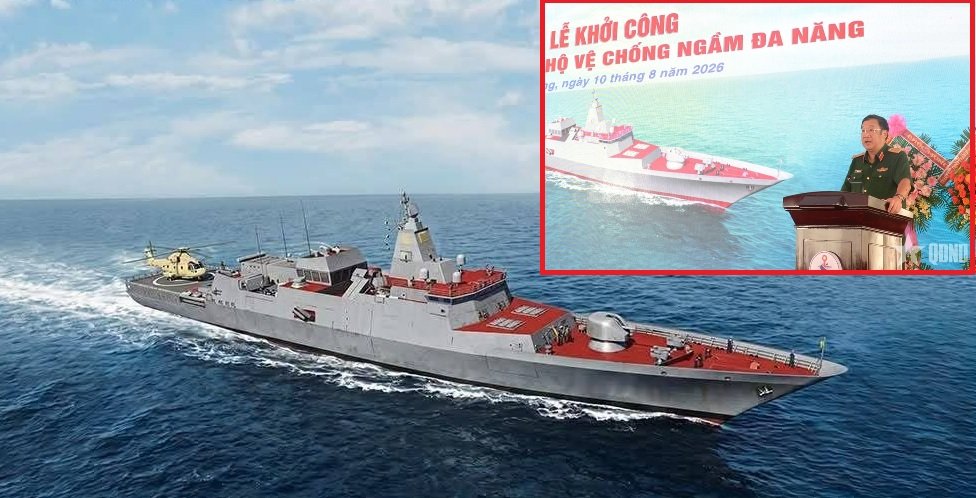
Vietnam has not yet released a complete official technical specification for the frigate. Available information on its configuration comes from the scale model and digital rendering displayed during the August 10 ceremony, together with assessments of the equipment shown.
The ship is estimated to be around 105 metres long, with displacement reported in the 2,500-to-3,000-tonne range. It is therefore slightly larger than Vietnam’s Russian-built Gepard 3.9-class frigates, which have a displacement of about 2,500 tonnes.
Earlier reports had described a possible 4,000-tonne vessel based on a heavily modified Russian Project 11356R/Admiral Grigorovich-class design. Those reports do not describe the frigate now under construction, which is a new domestic design.
The configuration shown in the model includes a combination of anti-submarine, air-defence, anti-ship and close-in weapon systems.
At the bow are two RBU-6000-style anti-submarine rocket launchers, followed by an AK-176-based 76 mm naval gun. The 76 mm gun is already manufactured by Vietnam's Z173 and Z125 factories.
The model also shows four chaff launchers, with two positioned toward the forward section and two near the rear hangar.
A 12-cell vertical launch system (VLS) is positioned forward of the superstructure in two groups of six cells. The precise missile type for these cells has not been officially disclosed. Earlier assessments have linked the configuration to a possible naval version of Viettel's TLĐK-01 surface-to-air missile, which has been associated with an estimated range of around 70 kilometres. The possibility of using a quad-packed missile configuration remains an assessment rather than a confirmed specification.
Two quadruple anti-ship missile launchers are positioned amidships. These are understood to be intended for missiles from Viettel's VCM family, although the exact missile configuration has not been officially confirmed.
The bridge structure also shows two twin launchers for man-portable air-defence missiles, associated with systems produced by the Z131 Factory.
For close-in defence, the ship has two AK-630M-type 30 mm close-in weapon systems positioned aft of the funnel. These are manufactured by Factory Z173.
The frigate is also shown with two trainable twin 533 mm torpedo launchers, providing a further anti-submarine capability.
Radar, sonar and aviation facilities
The frigate's sensor configuration includes a four-panel phased-array multifunction radar positioned above the bridge superstructure, together with a separate fire-control radar.
The radar, combat management system and electronic support measures are expected to involve Viettel, although complete official details of the systems have not been released.
As an anti-submarine warfare platform, the frigate is expected to use a hull-mounted sonar. A towed-array sonar has also been discussed in assessments of the ship's configuration, but its installation has not been officially confirmed.
At the stern, the frigate has a flight deck and hangar designed to accommodate a medium helicopter such as the Ka-28 operated by the Vietnam People's Navy.
The propulsion system uses four engines. The exact engine types and suppliers have not been officially disclosed. The configuration has been assessed as a combined diesel and gas-turbine arrangement, potentially using two diesel engines and two gas turbines.
Expanding domestic defence production
The new frigate represents a significant expansion of Vietnam's domestic naval shipbuilding programme. Vietnam has traditionally relied heavily on foreign suppliers for major naval platforms, particularly Russia. Its fleet includes four Gepard 3.9-class frigates and six Project 636.1 Kilo-class submarines.
The new programme is intended to increase Vietnam's ability to independently research, design, manufacture and integrate major defence systems. Vietnamese officials have linked the project to a broader policy of developing a defence industry that is autonomous, self-reliant, self-strengthening, dual-use and modern.
The policy is also connected with Vietnam's wider maritime strategy and its objective of becoming a strong maritime nation. Resolution No. 20 of the 14th Party Central Committee, issued on July 28, 2016, is part of this broader policy framework.
At the August 10 ceremony, Pham Hoai Nam described the frigate programme as an important task and called for close coordination between the Navy, shipbuilder, research organisations and defence manufacturers. Song Thu has been instructed to maintain technical quality, construction safety and schedule discipline.
Other domestic naval programmes
The frigate is part of a wider range of naval construction projects being undertaken in Vietnam.
Song Thu Corporation is also nearing completion of a second submarine rescue vessel. The first vessel, Yết Kiêu, was commissioned into the Vietnam People's Navy in 2021. Song Thu has previous experience in constructing military and support vessels for Vietnam's defence sector.
The Naval Technical Institute conducted the TN-75 midget-submarine project between 2020 and 2025. The 75-tonne submarine has been reported as capable of operating at depths of 200 to 300 metres, remaining submerged for up to seven days and carrying a six-to-seven-person commando team. A larger TN-300 design has also been mentioned, although details have not been publicly disclosed.
Vietnam is also expanding its domestic landing-ship and troop-transport programmes. Ba Son Corporation launched the VDC-01 landing ship in August 2025, while the X55 Factory launched the third ST-294 aluminium troop-transport vessel on July 24, 2026. These vessels are assigned to patrol and transport duties, including operations in the southwestern Mekong Delta.
Ba Son is also producing PS500 guided-missile corvettes, a class originally represented by a locally built 850-tonne vessel based on the Russian Pauk-class design. Construction of the second vessel, designated A2, began in October 2025, while work on the third and fourth units, A3 and A4, began in April 2026. The A2 vessel is scheduled for completion in 2027, with subsequent deliveries expected by September 2028.
Vietnam is scheduled to host the Vietnam International Defence Expo in Hanoi in December 2026, providing another platform for the country's defence industry to present its growing domestic manufacturing and technology capabilities.
The new multipurpose frigate remains Vietnam's most complex domestic naval shipbuilding programme announced so far. Its construction will bring together the Vietnam People's Navy, Song Thu Corporation, Viettel and other defence research and manufacturing organisations as Vietnam seeks greater domestic control over warship design, production and combat-system integration.
——— End of Article ———