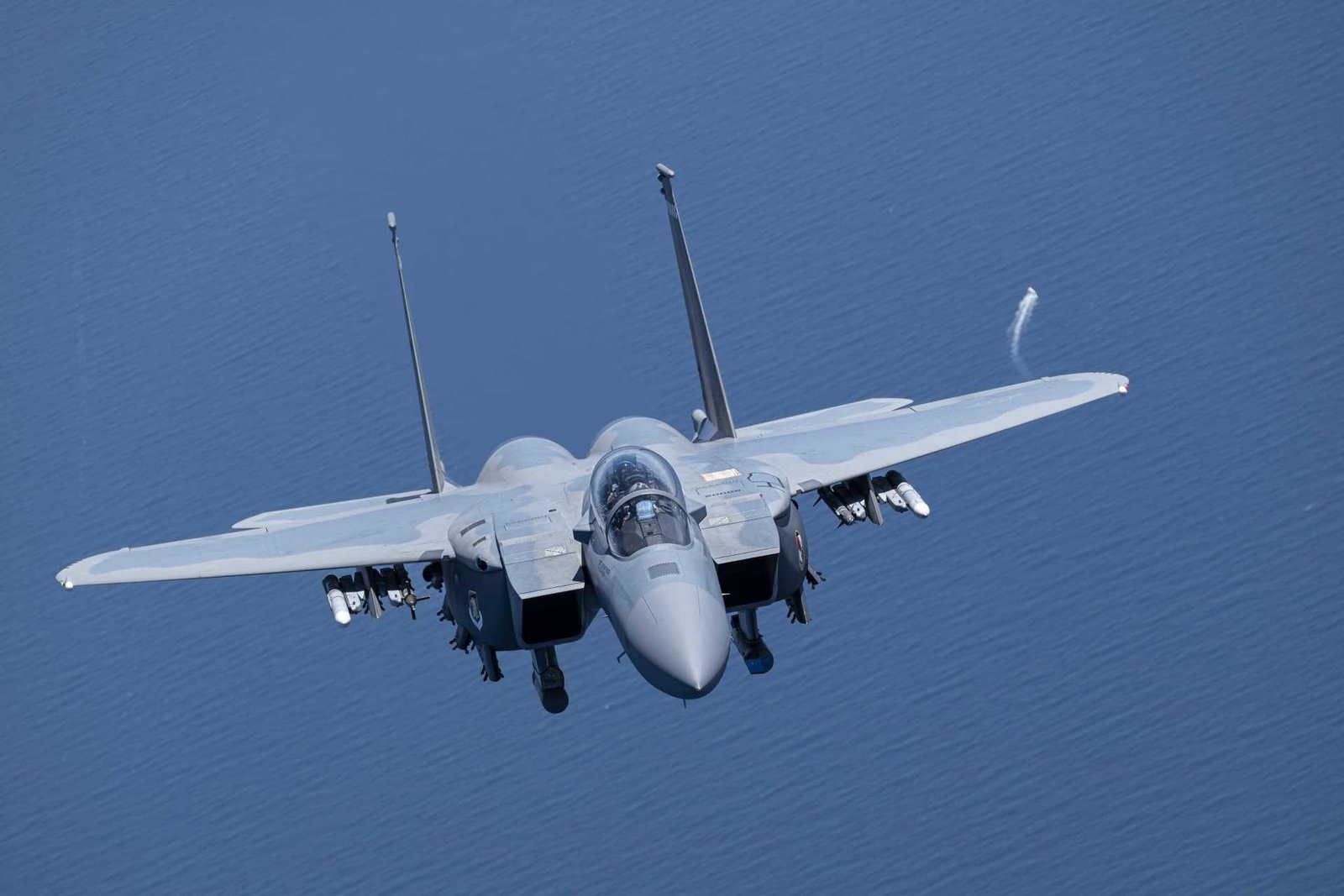
WASHINGTON — The U.S. Air Force is seeking a dedicated missile warning system (MWS) for its F-15EX Eagle II fighter fleet to improve the aircraft's ability to detect incoming missiles, particularly infrared-guided heat-seeking weapons.
The Air Force Life Cycle Management Center's Fighters and Advanced Aircraft Directorate issued a sources-sought notice on September 29, 2026, requesting information on an operationally qualified missile launch and approach warning system that can be rapidly integrated into the F-15EX. The system must provide timely warnings while limiting false alarms.
F-15EX Already Has Provisions for an MWS
Although the F-15EX entered service without a dedicated missile warning system, the aircraft already has infrastructure for one.
The Air Force requires a proposed system to use six existing sensor locations. Two are horn-like positions below the cockpit canopy, two are located near the ends of the tail booms, and two provide additional upward and downward coverage.
The aircraft already has associated data and power wiring and cooling provisions. The system must connect with the existing MIL-STD-1553 data bus and be installable and removable by Air Force maintenance personnel in the field without broader aircraft configuration changes.
Closing an Infrared Detection Gap
The F-15EX is equipped with BAE Systems' Eagle Passive/Active Warning Survivability System (EPAWSS), which is designed mainly to detect, locate and counter radar-based threats.
However, infrared-homing missiles do not need to transmit radar signals. A dedicated MWS uses electro-optical sensors to detect missile launches and approaching threats, providing aircrews additional time to deploy flares, use other countermeasures or maneuver.
The F-15EX's requirement is notable because related export versions already have missile warning capability. The F-15QA operated by Qatar and F-15SA operated by Saudi Arabia, which are related to the F-15EX design, use missile warning systems. Singapore's F-15SG also has such capability.
One system used on the F-15SA and F-15QA is the AN/AAR-57 Common Missile Warning System (CMWS) from BAE Systems. Versions of the AN/AAR-57 are also used on U.S. Army AH-64, UH-60 and CH-47 helicopters. The Air Force notice, however, does not specify the AN/AAR-57 or any other system.
Recent Combat Experience
The requirement follows recent combat experience involving infrared-guided threats.
In April 2026, an F-15E Strike Eagle was shot down over Iran. Reports indicated that a shoulder-fired heat-seeking surface-to-air missile, or MANPADS, was involved. The F-15E also lacks a dedicated MWS, and reports indicated that its defensive system provided only about half a second of warning.
In Yemen, Houthi forces have also used infrared-related targeting capabilities and have claimed to have shot down a Saudi F-15SA, which is equipped with a missile warning system. The incident shows that an MWS provides an additional defensive capability but does not eliminate the threat from infrared-guided weapons.
F-15EX Fleet
The Air Force had 22 F-15EX aircraft in its inventory as of late September 2026 and plans to operate approximately 267 to 268 aircraft.
Boeing is under contract to build 120 aircraft. On September 29, the Air Force awarded Boeing a $2.38 billion contract for 22 additional F-15EX fighters under Lot 7, bringing the contracted total to 120. Individual aircraft cost more than $100 million, excluding separately purchased engines.
The current MWS effort remains in the market-research phase and is not a commitment to purchase a specific system. Industry responses to the notice are due by November 12, 2026. The Air Force has not yet identified a preferred system or announced a contract award timeline.
——— End of Article ———