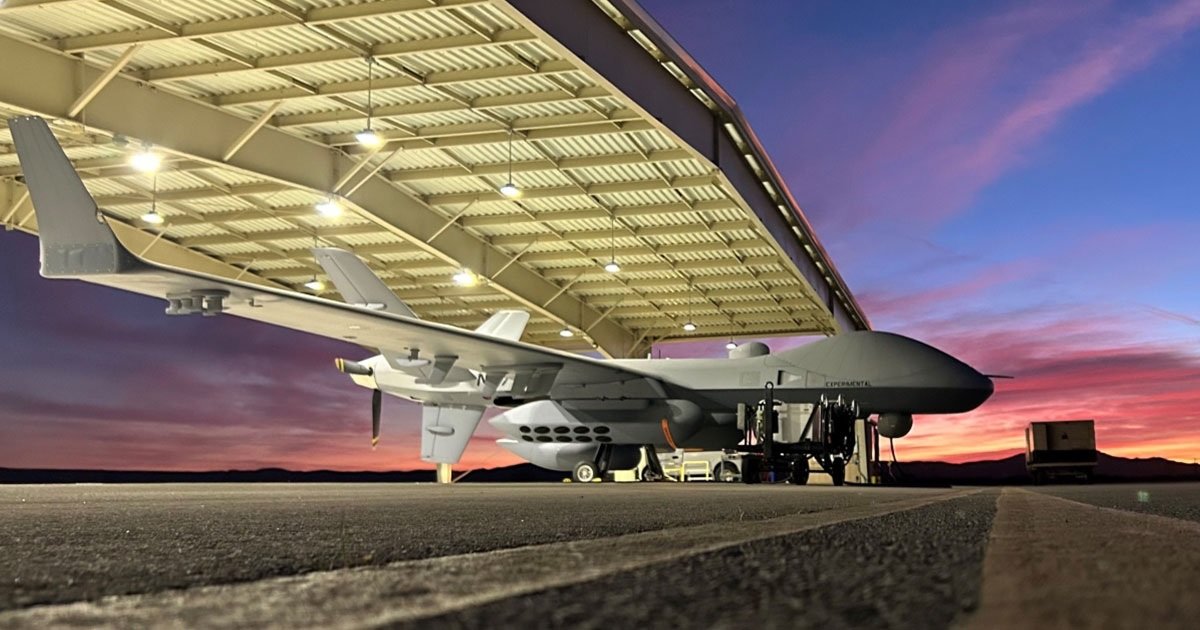
OAK HARBOR, Wash. — The U.S. Navy recently evaluated the General Atomics Aeronautical Systems Inc. (GA-ASI) MQ-9B SeaGuardian at the Maritime Patrol and Reconnaissance Force (MPRF) Commander’s Operational Group (COG) at Naval Air Station Whidbey Island (NASWI) in Oak Harbor, Washington.
The evaluation focused on how the SeaGuardian can support wide-area maritime surveillance, patrol and anti-submarine warfare (ASW) operations. The Navy is assessing the aircraft as a potential “force multiplier” for the MPRF and as part of an ongoing capability assessment supporting the U.S. 7th Fleet.
The SeaGuardian is the maritime variant of the MQ-9B Group 5 remotely piloted aircraft system (RPAS). The Navy currently operates it under a Company-Owned, Company-Operated (COCO) contract with GA-ASI. This arrangement allows the Navy to conduct capability assessments and evaluate the aircraft in operational scenarios.
The MQ-9B SeaGuardian has supported aircraft carrier pre-deployment workups and participated in major fleet exercises, including Northern Edge and the Integrated Battle Problem. The aircraft has also been displayed alongside the crewed P-8A Poseidon to demonstrate how uncrewed and crewed maritime patrol aircraft can operate as part of the same force.
Anti-Submarine Warfare and Surveillance
SeaGuardian is designed to take on long-endurance maritime surveillance missions and support crewed maritime patrol aircraft. In its standard maritime surveillance and ASW configuration, the aircraft has a 1,200-nautical-mile mission radius.
The aircraft uses an open-architecture system equipped with a centerline wide-area maritime radar, electronic support measures and a self-contained ASW mission kit.
For ASW missions, four wing stations can carry up to four sonobuoy dispenser pods. The configuration can carry, release and monitor up to 40 A-size or 80 G-size sonobuoys, with operators managing the data from a single remotely piloted aircraft.
The SeaGuardian can provide operational and acoustic data to naval command centers, supporting the detection and tracking of underwater and surface threats. Its modular sensor configuration can also support missions such as search and rescue, disaster relief and law enforcement.
The latest evaluation at Whidbey Island is part of the Navy's continuing assessment of how the MQ-9B SeaGuardian could expand the capabilities of its maritime patrol and reconnaissance forces.
——— End of Article ———