Kyiv — Russia has expanded the deployment of electronic warfare (EW) systems along the Novorossiya highway and border regions, making it more difficult for Ukrainian forces to carry out drone strikes, according to Serhii "Flash" Beskrestnov, an electronic warfare specialist and advisor to Ukraine's Ministry of Defense.
Beskrestnov said Ukrainian forces had previously conducted active attacks on Russian infrastructure using medium-range unmanned aerial vehicles (UAVs), particularly during June and July. Those strikes targeted several sections of the Novorossiya highway, disrupting traffic and logistics while affecting travel to the Crimean Peninsula and the supply of the region.
According to Beskrestnov, Russian forces have responded by expanding the use of electronic warfare systems designed to interfere with Starlink satellite communication terminals used for drone control. Ukrainian drone operators are recording increased activity from these systems, which has made remote control of attack drones more difficult.
He also stated that Russia has established a radiographic network along border areas and key highways, while anti-aircraft interceptor drones are conducting regular patrols over the roads. These combined measures have significantly complicated Ukrainian drone operations along the corridor.
The Novorossiya highway, also known as the R-280 route, serves as a major land corridor connecting Russian-controlled areas in southern Ukraine with Crimea and is used for military logistics. Independent reporting has previously confirmed that Ukrainian medium-range drone operations targeted vehicles, fuel transports, and related infrastructure along the route earlier in 2026, leading to temporary traffic restrictions and reported supply challenges in occupied territories.
New EW System Targets Starlink Communications
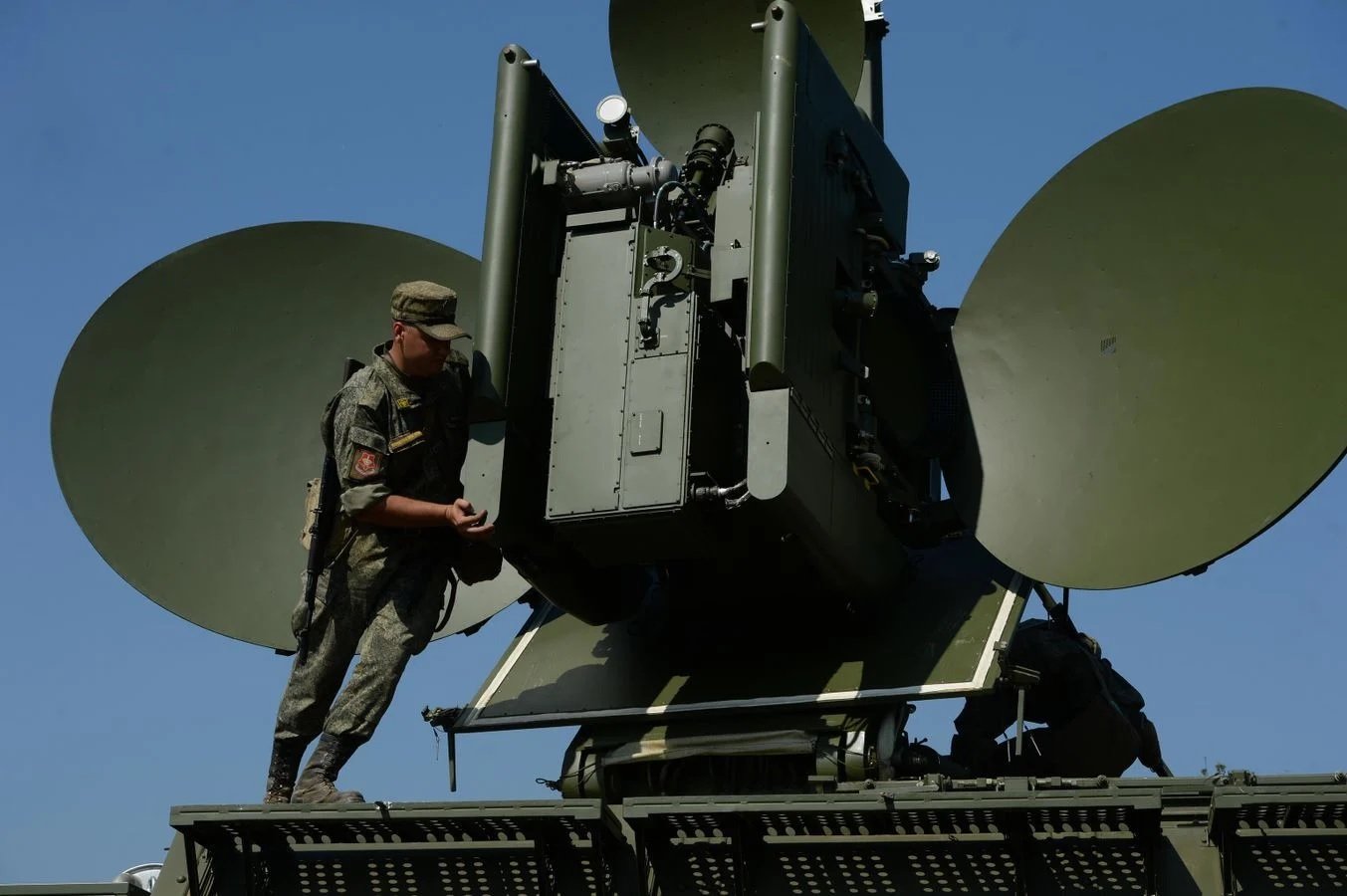
Beskrestnov identified one of the newly deployed Russian systems as the Volna Kupol Garant, which he said is designed to disrupt Starlink satellite communications rather than directly jamming the drone itself.
According to his description, the system was developed by the Simferopol-based company Russian Kupol and operates using eight satellite dishes pointed toward the sky. Each dish transmits interference on one of Starlink's communication channels within the 14 to 14.5 GHz frequency range, with the goal of preventing satellites from communicating with ground-based Starlink terminals.
Beskrestnov said a single Volna Kupol Garant complex is mounted on six trailers and can disrupt Starlink communications across an area of approximately 20 square kilometers.
The increased use of Starlink-equipped drones has become an important feature of the conflict because satellite communications allow operators to maintain control over UAVs across long distances, where conventional ground-based jamming systems have historically been less effective.
Battlefield Impact and Countermeasures
According to Beskrestnov, the new electronic warfare network, combined with interceptor drone patrols, has reduced the effectiveness of Ukrainian drone strikes along the Novorossiya highway, at least in the near term. He added that Ukrainian specialists are continuing to develop alternative approaches to overcome the new defensive measures.
He also noted that the Volna Kupol Garant system has a potential weakness. Because it emits strong radio-frequency signals and consists of multiple large antenna arrays, it is relatively easy to detect. Beskrestnov stated that Ukraine's 422nd Separate UAV Battalion has already located and destroyed at least two of these complexes in recent weeks.
Russian forces have also introduced other protective measures, including changes to convoy operating practices, alongside the deployment of electronic warfare systems. Some of the EW installations themselves have reportedly been targeted during Ukrainian operations.
The developments reflect the continuing technological competition between the two sides, with both adapting their tactics as electronic warfare, satellite communications, and unmanned systems play an increasingly important role in operations along the front.
——— End of Article ———