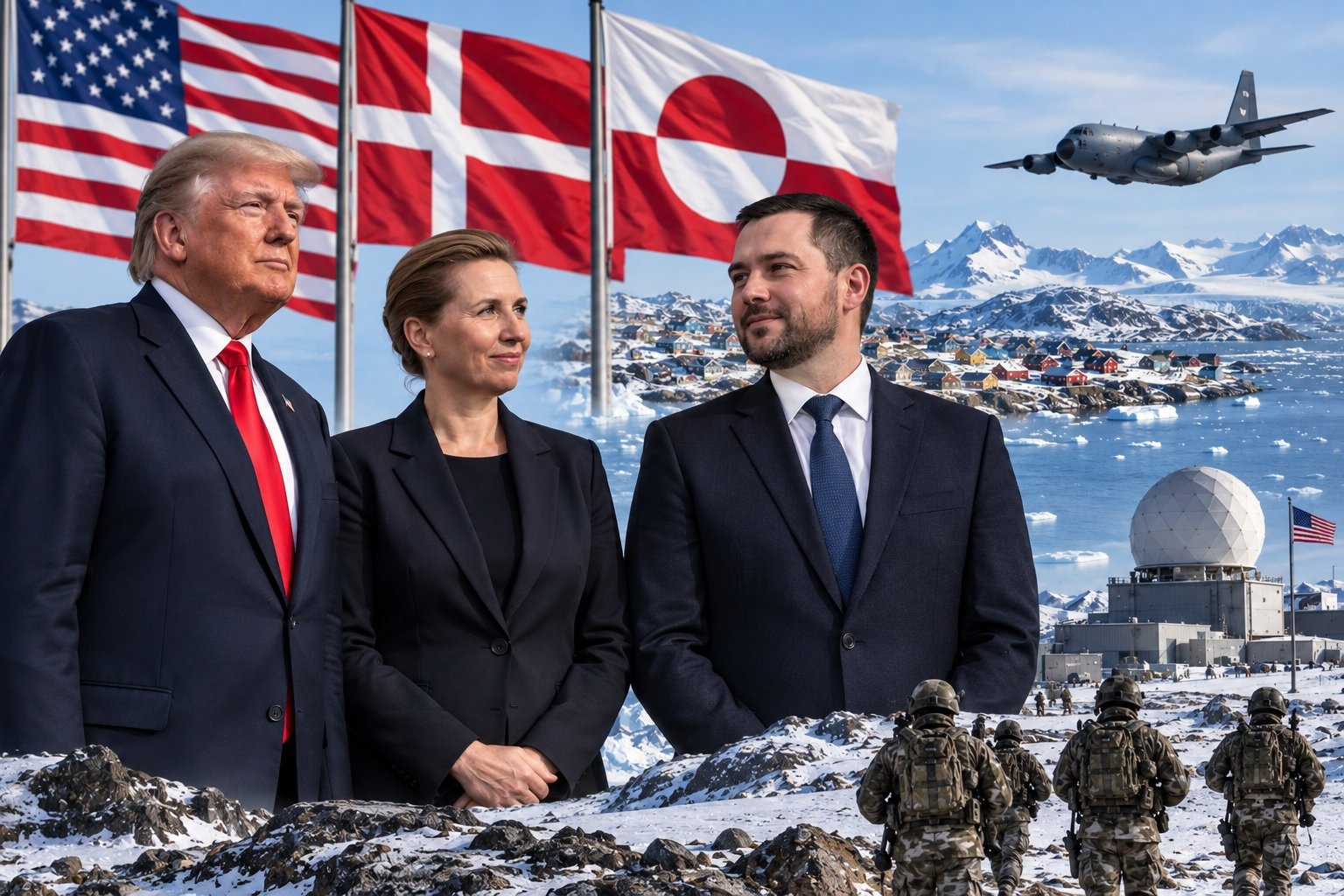
WASHINGTON — President Donald Trump announced on September 18 that the United States has reached a new security agreement with Denmark and Greenland that would give Washington permanent control over Greenland’s security and allow a larger U.S. military presence on the Arctic island.
The agreement does not transfer sovereignty over Greenland to the United States. Greenland remains a self-governing territory within the Kingdom of Denmark. Danish Prime Minister Mette Frederiksen said the planned agreement recognizes the sovereignty and territorial integrity of the Kingdom of Denmark and the Greenlandic people’s right to self-determination.
The full text of the agreement has not yet been publicly released. Denmark and Greenland said the three governments are expected to sign it during the United Nations General Assembly in New York next week, after which it will require the necessary parliamentary procedures before entering into force.
What the United States would gain
According to Trump’s announcement and reporting on the agreement, the United States would gain a much stronger and more permanent security position in Greenland.
The reported provisions include:
-
Permanent U.S. security authority: Trump said Washington would have permanent control over Greenland’s security and “all other needs” related to it.
-
Expanded military presence: Trump said the United States would immediately begin developing a larger military presence in appropriate parts of Greenland.
-
Military access: The arrangement is intended to secure long-term U.S. military access, including basing and overflight rights.
-
Additional installations: U.S. officials have indicated that the United States would be able to establish additional military facilities without Denmark or Greenland having the same approval authority over those installations, although the exact legal provisions remain unpublished.
-
Exclusion of adversaries: Trump said U.S. adversaries would not be allowed to establish bases, maintain military forces or make sensitive investments in Greenland without U.S. approval.
-
Protection of strategic infrastructure: The reported restrictions cover sensitive areas such as telecommunications, undersea cables, ports and critical infrastructure.
-
Long-term continuity: Trump described the agreement as having no end date and said it would remain applicable even if Greenland eventually became independent.
The United States already operates Pituffik Space Base in northern Greenland under the existing U.S.-Denmark defense relationship. The new arrangement would expand and make the American security role more permanent.
Secretary of State Marco Rubio described the agreement as permanently securing U.S. interests in the Arctic and said Greenland would remain part of the strategic defense area of North America.
Does the United States control Greenland?
No, not in the sense of owning or governing Greenland.
The agreement announced so far does not give the United States sovereignty over Greenland. Denmark retains sovereignty, while Greenland retains its existing self-government arrangements and its people’s right to self-determination. Denmark's prime minister specifically emphasized these points.
However, the announced arrangement would give Washington an unusually extensive role in Greenland's security and military affairs.
That distinction is important: territorial sovereignty and security control are not the same thing. The United States would not become Greenland's government or acquire ownership of the territory under the terms publicly described so far.
The exact limits of U.S. authority cannot yet be established because the complete agreement has not been released.
Who would control Greenland's minerals?
The agreement does not currently establish that the United States will own Greenland's underground minerals.
Greenland has significant mineral resources and has previously highlighted the importance of its critical minerals, but the publicly available descriptions of the new security agreement focus on preventing adversarial countries from making sensitive investments. They do not establish U.S. ownership of Greenland's mineral deposits.
Therefore, it would be incorrect to say that the United States has acquired Greenland's rare-earth minerals or received ownership of the resources beneath the island.
The agreement reportedly gives Washington a role in preventing certain adversaries from making sensitive investments in critical sectors, but who owns, develops and receives revenue from individual mineral projects will depend on Greenlandic and Danish law and the eventual investment arrangements. The final treaty text is needed to determine whether it contains additional provisions.
What does Denmark give up?
Denmark does not give up sovereignty over Greenland under the publicly announced framework.
However, Denmark and Greenland would accept a substantially expanded U.S. security role. The reported arrangement would reduce their ability to prevent or block certain U.S. military activities and would place restrictions on potentially sensitive investments by countries regarded as U.S. adversaries.
At the same time, Danish Prime Minister Mette Frederiksen said the agreement strengthens security in the Arctic and North Atlantic while recognizing Danish sovereignty and Greenlandic self-determination.
What did Trump say?
Trump used particularly strong language when announcing the agreement.
He said the United States would “FOREVER” have the ability to do what is necessary to secure and defend Greenland and the United States. He also said no U.S. adversary could “EVER” establish a base, maintain a military presence or make sensitive investments in Greenland without U.S. approval.
Trump called the arrangement an “Infinite Life” Agreement, saying that it has no end. He also said there would be “NO COST” to the United States and announced plans to develop a large U.S. military presence on the island.
Trump also said the agreement finally addressed what he described as longstanding U.S. concerns about Greenland's strategic importance.
Is this similar to U.S. control of Venezuela?
The publicly announced Greenland agreement is not the same type of arrangement as taking political control of another country.
There is no announced transfer of Greenland's sovereignty to Washington, and the Danish government continues to describe the arrangement as recognizing the Kingdom of Denmark's sovereignty and Greenland's right to self-determination.
The significance of the agreement is instead the extent of the proposed U.S. security and military role. If the final treaty contains the powers described by the Trump administration, Washington would have a permanent security role and substantial military access while Denmark retains sovereignty.
Because the treaty's complete text has not yet been released or ratified, the precise legal limits of U.S. authority remain uncertain.
Existing U.S. presence
The new agreement builds on a defense relationship that already allows the United States to operate in Greenland. The most important existing American facility is Pituffik Space Base in northern Greenland. A 1951 defense agreement, subsequently updated, already provides Washington with extensive military rights on the island.
The new agreement would therefore represent an expansion and permanentization of the U.S. security role rather than the beginning of an American military presence from zero.
The three governments are expected to sign the agreement during the upcoming UN General Assembly in New York. It will then face the required parliamentary procedures in Denmark and Greenland before it can enter into force.
——— End of Article ———