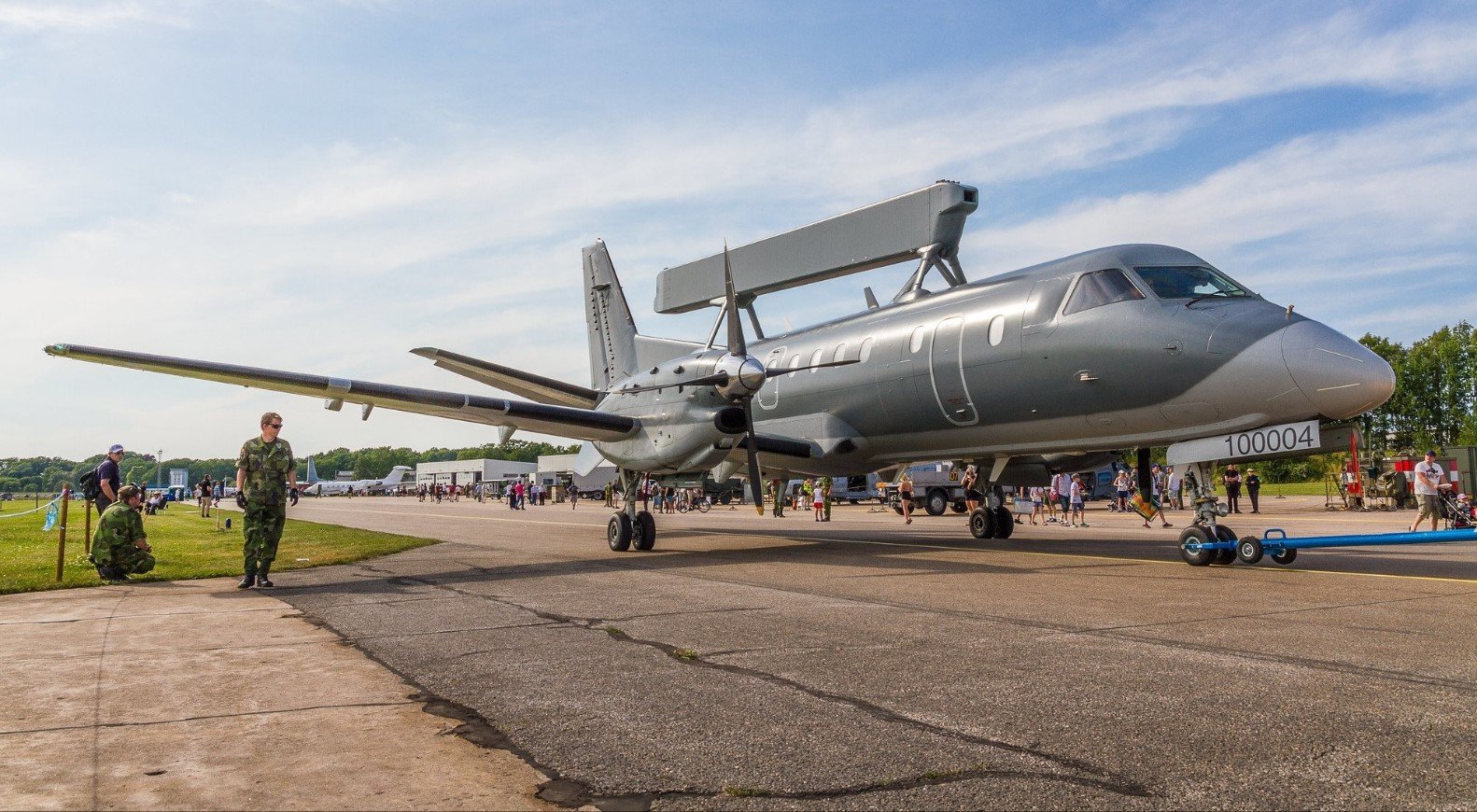
KYIV — Ukraine’s Ministry of Defence has officially confirmed that Swedish-supplied ASC 890 airborne early warning and control (AEW&C) aircraft have entered combat operations over Ukrainian airspace.
The confirmation appeared in a ministry publication titled “Air Force Capabilities Coalition: How Partners Are Helping Build the Future of the Ukrainian Air Force.” The ministry said Sweden announced the transfer in May 2024, formally confirmed the delivery in August 2025, and the aircraft began its first combat sorties over Ukraine in March 2026.
Sweden Supplied Two ASC 890 Aircraft
Sweden pledged two ASC 890 aircraft, also known as the Saab 340 AEW&C, as part of a military aid package worth approximately €1.16 billion ($1.25 billion). The package was announced in May 2024 and was Sweden’s largest military aid package to Ukraine at the time.
The ASC 890 is based on the Saab 340 airframe and is designed to provide airborne surveillance and command capabilities. Sweden said the aircraft would help Ukraine detect and identify targets at long range.
Erieye Radar Provides Long-Range Surveillance
The aircraft’s main sensor is the FSR 890 Erieye radar, installed in the distinctive rectangular “balance beam” fairing above the fuselage.
The radar is an active electronically scanned array (AESA) system operating in the S-band and incorporates gallium nitride (GaN) components.
According to the specifications provided in the supplied information, Erieye can track up to 1,000 air targets and 500 surface targets simultaneously. Its instrumental detection range is about 450 kilometres, while the range against fighter-sized aircraft is approximately 350 kilometres.
Operating at around 6,000 metres (20,000 feet) gives the aircraft an elevated view that can help detect low-flying cruise missiles and drones from several hundred kilometres away. Ground-based radars face limitations against such targets because of terrain and the radar horizon.
Flying Radar and Command Post
The ASC 890 does more than detect targets. It can also act as a flying command post, collecting surveillance information and passing tracking data to other aircraft and air-defence units.
Ukrainian F-16 fighters have been modified to exchange data with the ASC 890. This allows pilots to receive information from the airborne radar and can reduce the need to activate their own radars when engaging detected targets, helping limit the risk of revealing their positions.
The aircraft is operated by a crew of six or seven, including flight personnel and mission specialists such as mission control, combat control and surveillance operators. It typically operates at speeds of around 300 km/h and altitudes between 2,000 and 6,000 metres, with higher altitudes used when greater radar coverage is required.
The Erieye system uses fixed side-looking radar arrays, providing approximately 120–150 degrees of coverage on each side.
Part of Ukraine’s Network-Centric Air Force
Ukraine’s Defence Ministry said the ASC 890, together with F-16, Mirage 2000 and Gripen fighters, forms the foundation of a modern network-centric air combat system aligned with NATO standards.
The aircraft is part of the wider Air Force Capabilities Coalition, involving 14 partner nations and supporting Ukraine’s transition from Soviet-era aviation systems to Western standards.
Ukraine began receiving F-16s in 2024 from Denmark, the Netherlands, Norway and Belgium. France began delivering Mirage 2000 fighters in 2025, while Sweden has committed to transferring 16 Gripen C/D fighters. A newer Gripen E variant is planned for delivery by early 2029.
Sweden previously operated two ASC 890 aircraft, and both were transferred to Ukraine. The transfer also required preparations and data-sharing modifications to enable integration with Ukraine’s F-16 fleet.
A video that appeared on a Russian Telegram channel on 20 March 2026 appeared to show an ASC 890 in flight with Ukrainian voices in the background, but its exact date and location could not be independently verified at the time. The Ukrainian Ministry of Defence later officially confirmed that the aircraft had begun combat sorties in March 2026.
The ASC 890 now provides Ukraine with an airborne surveillance and command capability that can extend detection of low-altitude threats and support coordination between Western fighter aircraft and Ukraine’s wider air-defence network.
——— End of Article ———