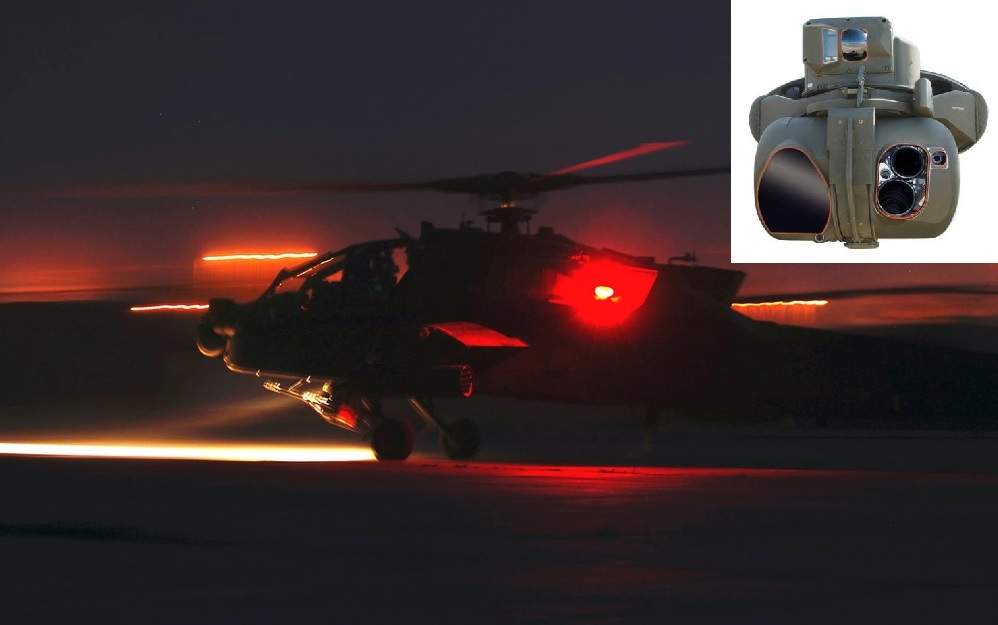
ORLANDO — The U.S. Army has awarded Lockheed Martin a $502.38 million contract to provide long-term sustainment and support for the Modernized Target Acquisition Designation Sight/Pilot Night Vision Sight (M-TADS/PNVS) system used on the AH-64 Apache attack helicopter fleet.
The contract, managed by the Army Contracting Command at Redstone Arsenal, Alabama, provides up to five years of post-production support for the M-TADS/PNVS system, commonly known as Arrowhead. The agreement runs through July 5, 2031, and covers both U.S. Army Apache helicopters and international Apache fleets operating under the U.S. Foreign Military Sales (FMS) program.
Rather than funding new production, the contract focuses on maintaining, repairing, refurbishing, and updating systems already in service to ensure they remain operational throughout their service life.
Arrowhead Sensor System
The M-TADS/PNVS is the Apache helicopter's primary targeting and night vision system. It enables crews to detect, identify, track, and engage targets during day and night operations and in adverse weather conditions such as smoke, rain, or low visibility by using forward-looking infrared (FLIR) technology that detects heat signatures instead of visible light.
The system consists of two major components.
The upper section contains the Pilot Night Vision Sight (PNVS), which links an infrared camera to the pilot's helmet movements. As the pilot turns their head, the camera follows the same direction, providing a natural view of the surroundings during night operations.
The lower section houses the Target Acquisition Designation Sight (TADS). It includes high-resolution sensors, a laser rangefinder, and a laser designator that allow Apache crews to accurately identify and designate targets for the helicopter's onboard weapons or for other friendly aircraft.
Contract Details
The Army awarded the contract as a sole-source acquisition, with Lockheed Martin submitting the only bid. The company originally developed the Arrowhead system and has supported its upgrades and sustainment since its introduction.
The agreement uses a combination of cost-no-fee, cost-plus-fixed-fee, and firm-fixed-price contract structures under contract number W58RGZ-26-D-0052. Individual task orders issued during the contract period will determine specific funding amounts and work locations.
Long Service History
The original Target Acquisition Designation Sight/Pilot Night Vision Sight system entered service with the Apache in 1983. Lockheed Martin later developed the modernized Arrowhead version to improve performance, reliability, and maintainability.
By 2011, the Army had completed fleet integration of the upgraded system and marked the delivery of its 1,000th Arrowhead unit. The system equips approximately 700 AH-64 Apache helicopters, and since 2005, more than 1,240 Arrowhead systems have been delivered to U.S. and international customers.
Upgrades and Sustainment
Over the years, the Arrowhead system has received several upgrades aimed at improving operational capability and reducing maintenance requirements.
The modernized design introduced modular, quick-replace components that allow faster repairs in the field. The Army has previously estimated that these improvements could reduce maintenance time and generate nearly $1 billion in savings over the system's planned service life.
Additional upgrades have included replacing monochrome cockpit displays with high-resolution color displays to improve long-range target identification, as well as replacing older spinning-mass gyroscopes with modern inertial measurement units to improve reliability and extend system life.
Lockheed Martin also continues to support the fleet through refurbishment of electro-optical components and other system enhancements as required.
Supporting Apache Readiness
The AH-64 Apache has served as the U.S. Army's primary attack helicopter since the 1991 Gulf War and remains a key platform for precision attack and reconnaissance missions.
Its effectiveness during day and night operations depends heavily on the performance of the M-TADS/PNVS system. By funding continued maintenance, repairs, and modernization of these sensors, the new contract is intended to help keep Apache helicopters mission-ready for U.S. and allied operators through the end of the decade.
Source: defence-blog / lockheedmartin
——— End of Article ———