WASHINGTON — U.S. officials are increasingly concerned about Iran’s improved missile technology after a series of ballistic missile attacks targeting U.S. Navy ships operating around the Gulf of Oman and Strait of Hormuz. Officials are also examining whether Russia or China may be helping Iran track the location of American warships.
The Wall Street Journal, citing U.S. officials, reported a previously undisclosed attack on U.S. Navy ships on Monday, following weekend ballistic missile launches directed at a U.S. aircraft carrier and a guided-missile destroyer.
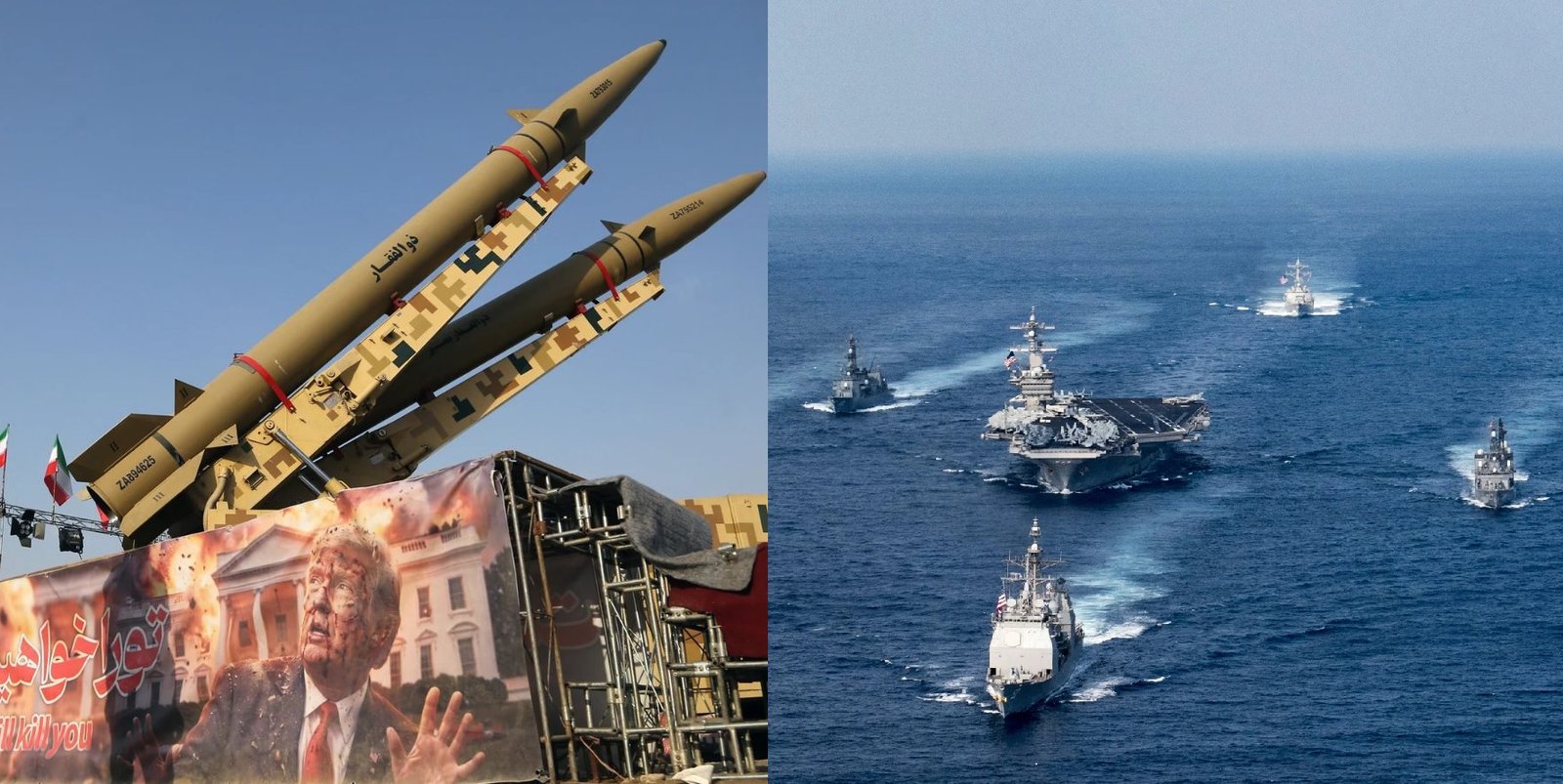
Iran’s Islamic Revolutionary Guard Corps (IRGC) publicly claimed to have inflicted significant damage on two Arleigh Burke-class destroyers, but U.S. Central Command rejected those claims. According to CENTCOM, the targeted warships successfully evaded the incoming ballistic missiles during multiple engagements. The vessels continued their regional patrols without suffering operational damage, and no American personnel were harmed.
Advanced Guidance Raises Questions
Iranian officials described the (Monday) recent launches as involving improved systems. Major General Mohsen Rezaei, secretary of Iran’s Supreme National Security Council, said a specialized ballistic missile had been tested against a U.S. warship.
Iran’s messaging in recent days has become more assertive, and a Monday report described the Qassem Basir as a “turning point in Iran’s defense strategy.” It described the missile as having greater range and accuracy and a half-ton warhead. The missile was unveiled last year, when it was described as having at least a 1,200-kilometer (745-mile) range.
Iranian state media has presented the Qassem Basir as having enhanced range, accuracy and guidance features, including thermal imaging and electro-optical seekers that allow terminal-phase adjustments.
Weapons analysts have noted that missiles fitted with electro-optical seekers can use imagery to adjust their flight path and maneuver toward a moving target, such as a ship at sea, during the final stage of flight. However, even with advanced terminal guidance, Iran would still generally need an approximate location of the target before launch.
Concerns about Iran’s ballistic missile program were among the stated reasons the United States and Israel attacked Iran earlier this year, sparking the war.
U.S. officials and intelligence assessments over the course of the conflict have pointed to Iran’s use of more sophisticated missile technology. Reports have described improved maneuverability, multi-system navigation that can draw on GPS along with China’s BeiDou and Russia’s GLONASS, and terminal guidance that is less vulnerable to certain forms of electronic jamming.
Questions Over Russian and Chinese Assistance
The requirement to locate a moving warship before launch has raised questions among U.S. officials and analysts about whether Russia or China may be providing Iran with satellite imagery, location information or other surveillance assistance.
Earlier U.S. intelligence reporting indicated that Russia has shared satellite imagery and location information on American ships and installations with Iran.
China has been linked to the provision of commercial satellite imagery of U.S. and allied positions, dual-use components useful for missile programs, and access to its BeiDou navigation system. Beijing has also faced U.S. sanctions related to companies supplying imagery that could aid targeting.
Russia maintains an advanced space surveillance network capable of providing optical and radar imagery. These developments have raised questions among analysts about whether external assistance has helped Iran obtain better location data on U.S. naval forces operating in the confined waters of the Gulf of Oman and Strait of Hormuz.
According to officials and analysts, such assistance could support more precise initial targeting information, even if the missile’s final guidance relies on Iranian-developed seekers.
U.S. Retaliation Against Iranian Tankers
In response to the weekend attacks on U.S. naval assets, the American military launched retaliatory strikes against several Iranian crude oil tankers.
CENTCOM said the targeted tankers were part of a “multibillion-dollar shadow network” used by Iran to fund the IRGC and its regional proxies. The operation resulted in the destruction or permanent disabling of multiple vessels off Kharg Island, near Jask, and in the Gulf of Oman.
The vessels included the M/T Downy, M/T Stark 1, M/T Kylo, M/T Kaviz and M/T Charminar. Before the strikes, U.S. forces directed the crews to abandon the ships to prevent casualties.
Admiral Brad Cooper, commander of U.S. Naval Forces Central Command, said the strikes were intended to impose a direct economic cost on Tehran.
Secretary of State Marco Rubio also stated that Iran continues to try to hit U.S. naval ships and that each such attempt would result in the loss of additional tankers.
U.S. Naval Operations in the Region
The United States currently has an estimated 19 warships supporting operations in the Middle East, according to a Navy official cited by The Wall Street Journal. The forces are operating in an environment centered on maintaining freedom of navigation in the Strait of Hormuz, a major maritime chokepoint for global oil and gas supplies.
The United States is also maintaining a blockade and economic pressure campaign against Iranian ports. The recent missile attacks and subsequent U.S. strikes on Iranian tankers have added to the confrontation between the two countries.
The latest developments have focused attention on both Iran’s improved missile guidance technology and its ability to obtain accurate information on the location of moving U.S. warships. U.S. officials are also examining whether foreign satellite and surveillance assistance could be contributing to Iran’s ability to obtain the initial targeting information required for such attacks.
——— End of Article ———