HEFEI, — Chinese researchers have developed a new catalyst capable of converting carbon dioxide from the Martian atmosphere into methanol, a liquid fuel that could support future human missions to Mars by reducing the need to transport fuel and other supplies from Earth.
The research was conducted by scientists at China’s state-funded Deep Space Exploration Laboratory in Hefei. The findings were published online in the Journal of Deep Space Exploration in 13 October 2026 in a paper titled “In-Situ Conversion of Martian Atmospheric Carbon Dioxide into Fuel (methanol).” Ling Lili is among the lead authors, while Zhang Zhe is the corresponding author.
New Catalyst Improves Methanol Production
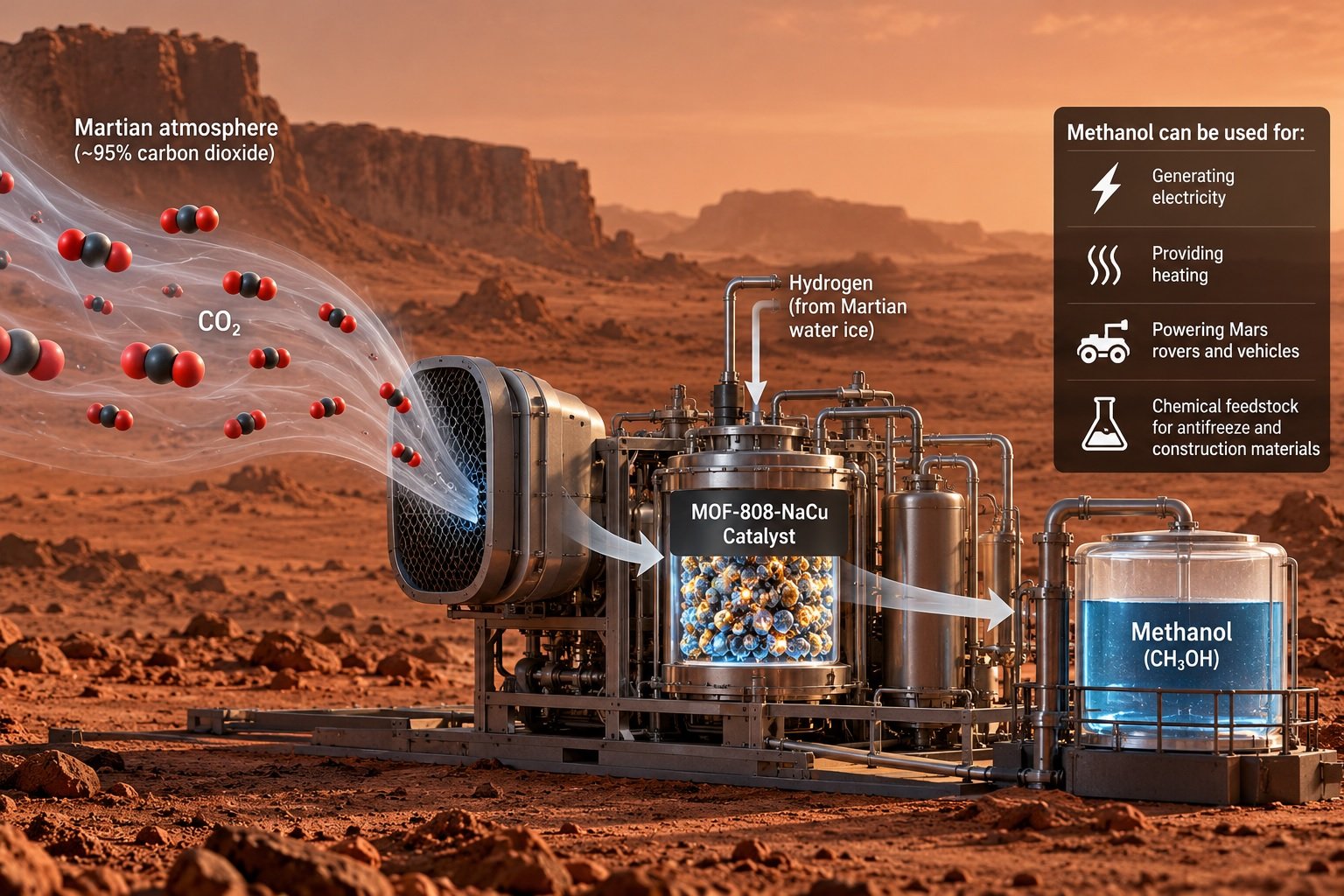
Mars’ atmosphere contains more than 95 percent carbon dioxide, providing a potential raw material for fuel production. However, carbon dioxide is chemically stable, making it difficult to convert into other substances.
To address this challenge, researchers developed a dual-site catalyst called MOF-808-NaCu, which uses a porous metal-organic framework known as MOF-808 as its support.
The catalyst combines sodium and copper atoms. Sodium sites help attract and activate carbon dioxide molecules, while nearby copper sites facilitate the hydrogenation process that converts carbon dioxide into methanol. Hydrogen for the reaction could be obtained from water ice available on Mars.
The researchers tested sodium, potassium and cesium as alkali-metal components, with sodium delivering the best performance.
In laboratory tests conducted at 275°C and 3.2 MPa, the sodium-copper catalyst produced approximately 245 grams of methanol per kilogram of catalyst per hour. This was around 11 times higher than the 22 grams per kilogram per hour achieved by the copper-only catalyst.
The catalyst maintained steady performance during a 12-hour continuous test and reduced unwanted by-products, including carbon monoxide.
Methanol Could Support Future Mars Operations
Methanol offers several potential advantages for future Mars missions. Unlike methane, which requires cooling to approximately −161°C to remain liquid under standard pressure, methanol remains liquid at ordinary temperatures and pressures, making it easier to store and handle.
The researchers identified several potential applications for methanol produced on Mars, including:
-
Generating electricity and providing heating for a Martian base.
-
Powering Mars rovers and other surface vehicles.
-
Serving as a chemical feedstock for producing antifreeze and construction materials.
The technology is part of the broader concept of in-situ resource utilization (ISRU), which involves producing essential materials using resources available on Mars rather than transporting everything from Earth.
However, several engineering challenges remain. Mars has less than 1 percent of Earth's atmospheric pressure, meaning engineers would need lightweight compressors to collect and process its thin atmosphere. A reliable method of extracting hydrogen from Martian water ice would also be required.
The researchers described the process as technically feasible to a certain extent, while noting that further engineering development is needed before it can be used on Mars.
Connection to China's Tianwen-3 Mars Mission
The research comes as China prepares for its Tianwen-3 Mars sample-return mission, which is currently planned for launch around 2028.
The mission aims to collect at least 500 grams of Martian surface samples and return them to Earth around 2031. If successful, it would achieve the first return of samples from Mars to Earth.
Although the methanol-production technology is not identified as part of the Tianwen-3 mission, the research supports China's broader efforts to develop technologies for future Mars exploration.
Producing fuel from Martian resources could eventually reduce the amount of material that missions need to carry from Earth and support longer-duration robotic and human exploration.
——— End of Article ———