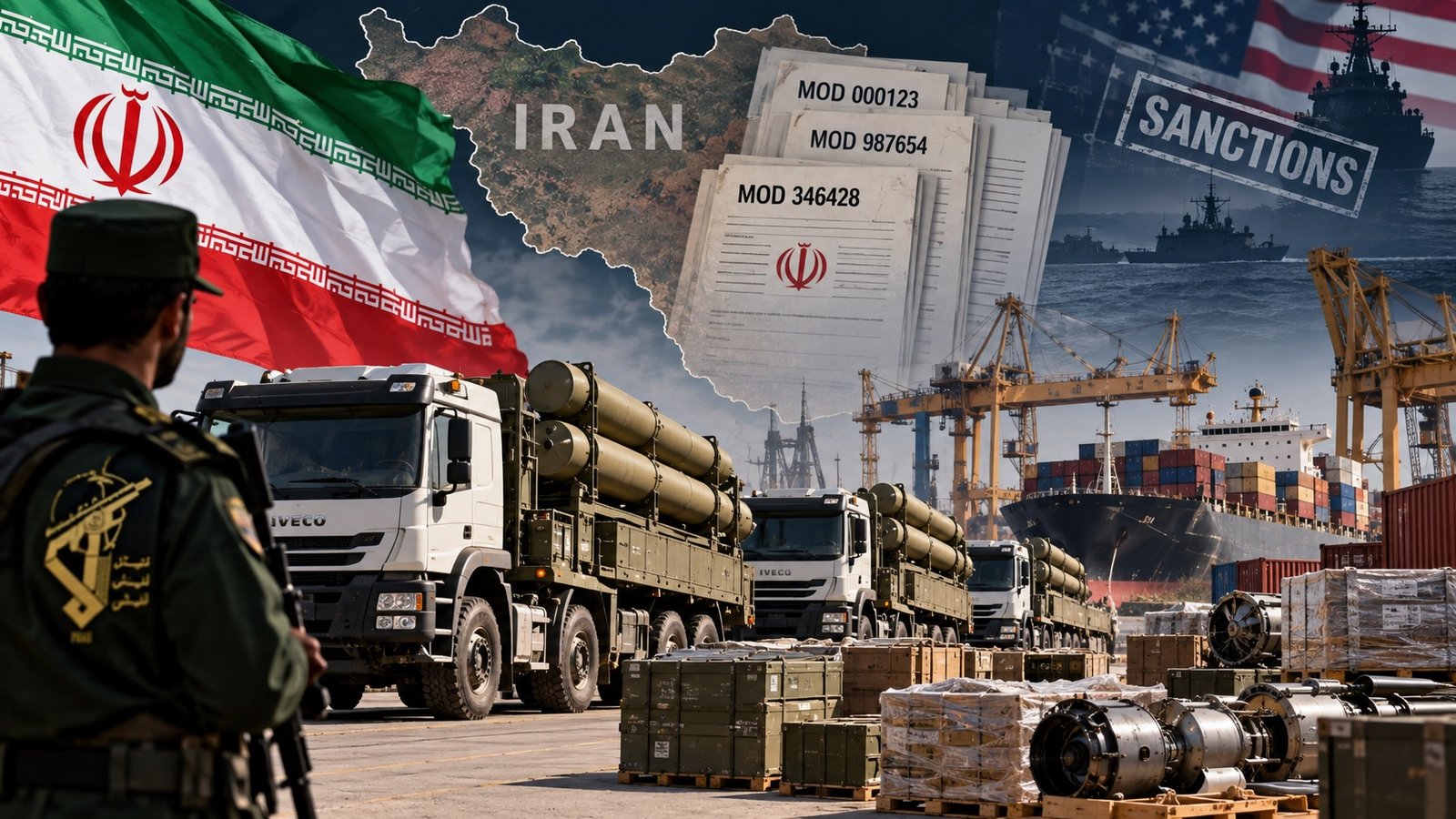
TEHRAN, — Iran has used a network of more than 5,000 defense-linked agencies to import billions of dollars in military hardware, explosives and heavy-duty trucks despite Western sanctions and a U.S. naval blockade, according to a Reuters investigation published on October 29.
The investigation, conducted with Israeli-American risk consultancy 240 Analytics, analysed thousands of Iranian government and banking documents, corporate filings and approximately 19,000 import records. It found that the network imported at least $2 billion in military-related goods since January 2025.
Iran's MOD Procurement Network
The agencies operate under names beginning with MOD, representing the Ministry of Defense, followed by five- or six-digit numbers. All share a registered address in Tehran belonging to Iran’s Ministry of Defense and Armed Forces Logistics (MODAFL).
Although registration documents list February 11, 1979, as their establishment date, most agencies were reportedly established in 2013 as Iran faced increasing international sanctions.
The investigation identified links between some agencies, the Islamic Revolutionary Guard Corps (IRGC) and major Iranian foundations known as bonyads. Phone numbers associated with 91 agencies matched Bank Sepah records connected to IRGC personnel.
Noam Binstok, a senior analyst at 240 Analytics, first identified the numbered agencies in June 2025 while reviewing leaked Bank Sepah documents circulated on Telegram and the opposition website WikiIran. Reuters found no evidence that the numbered agencies had been individually designated under Western sanctions lists.
MOD 346428 Imported $2.3 Billion in Military Hardware
One agency, MOD 346428, accounted for $2.3 billion in military-related imports between January 2025 and June 2026. The goods included rocket fuel chemicals, explosives, drone and missile components, aircraft parts, industrial machinery and heavy-duty trucks. Shipments originated from China, Russia, Germany and other countries and reached Iran by land, sea and air.
Between January and April 2025, the agency imported 886 tonnes of chemicals through the Bandar Abbas port complex. Customs records identified sodium chlorates and other perchlorates, which are key precursors for solid rocket fuel.
Three days after the final shipment, a major explosion occurred at the port. Two people familiar with the incident told Reuters that sodium perchlorate ignited in dockside shipping containers.
In February 2026, Iran also imported 93 metric tonnes of Chinese titanium and hundreds of tonnes of additional chemicals that can be used in rocket propellants and explosives. The investigation also recorded approximately $7.6 million in Russian detonator imports since January 2025, including a $1.9 million delivery in June.
Trucks, Weapon Components and Foreign Suppliers
MOD 346428 imported 435 Iveco heavy-duty trucks between January 2025 and June 2026. These vehicles can be adapted for military transport or mobile missile-launching platforms.
Satellite imagery, social media posts and import records tracked some trucks to a customs lot outside Tehran in February 2025. Vehicle identification numbers helped match several vehicles to import records.
UK-based defence intelligence firm Janes confirmed that certain trucks matched models previously associated with Iranian military use as launchers or transport platforms.
Iveco said the presence of its vehicles in Iran occurred beyond its control and that the trucks had originally been destined for Central Asia. The company also said its official distributors must ensure products are not used for prohibited military purposes.
Other imports included components for drones, missiles and aircraft engines, largely originating from China, Russia and Germany. Hundreds of millions of dollars in trucks, aircraft engine parts and electronics were also recorded as originating in Germany and other European Union countries.
The identified end-users included the military unit responsible for Iran’s ballistic missile programme and Sahara Thunder, a U.S.-sanctioned entity accused of manufacturing and supplying drones to Russia.
Financial Network and U.S. Blockade
Financial records showed that 97 percent of the reviewed shipments were settled without conventional cross-border currency transfers. Foreign intermediaries and shell companies, sometimes described as trustees, used funds held abroad, often linked to Iranian oil sales, to purchase and ship the goods.
Miad Maleki, a former U.S. Treasury official who helped design American sanctions on Iran, reviewed the network’s structure and described it as an integrated military procurement system.
The U.S. naval blockade of Iranian ports was suspended in mid-June 2026 and reinstated in mid-July. It remained in effect at the time of the Reuters report, while deliveries continued during the conflict period covered by the investigation.
The investigation identified the numbered agencies as a major part of Iran’s military procurement and sanctions-evasion infrastructure, enabling continued imports through domestic entities, foreign intermediaries and international suppliers.
——— End of Article ———