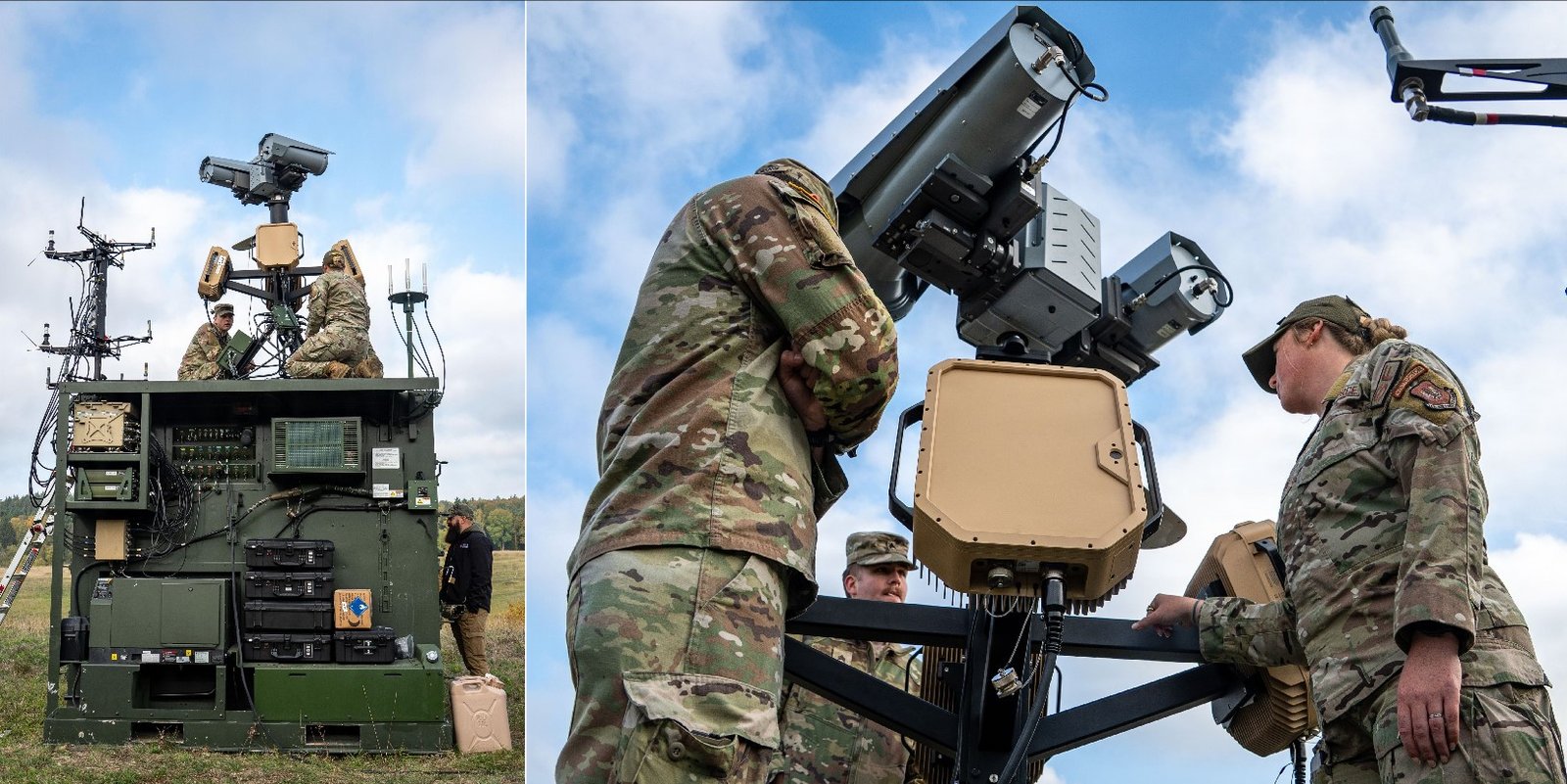
GRAFENWOEHR, Germany, — U.S. Army soldiers and U.S. Air Force airmen are conducting joint training at the Grafenwoehr Training Area in Germany, focusing on the Rapidly Deployable Small-Unmanned Air Defense System (RD-SUADS) to improve responses to small drone threats.
The system is developed by Trust Automation, a defense manufacturer based in San Luis Obispo, California. According to U.S. Army Europe and Africa, the training is designed to test how different military services can integrate their counter-drone operations.
The participating units, duration of the exercises and any plans for deployment in Europe have not been disclosed.
The training builds on an earlier effort at Grafenwoehr in February 2026, when U.S. Air Forces in Europe and Air Forces Africa conducted a Joint Multi-Domain Counter Unmanned Aircraft Systems Operator Course. The course brought together soldiers, airmen and Marines to assess the feasibility of a unified, multi-service training programme.
RD-SUADS Capabilities and Deployment
RD-SUADS is the air-transportable variant of Trust Automation’s Small-Unmanned Air Defense System (SUADS) family. It is designed to detect, track, identify and neutralize small uncrewed aerial systems (sUAS) using electronic attack rather than kinetic munitions.
The system integrates electronic warfare tools, including the NINJA and DroneBuster electronic attack systems, to defeat incoming drone threats.
RD-SUADS is self-contained and designed to fit on a standard 463L cargo pallet, allowing it to be transported by military cargo aircraft such as the C-130 and C-17.
It includes a built-in diesel generator capable of supporting four continuous days of operation before refueling. A shore power interface also allows the system to connect to standard Department of Defense generator connections or existing base power grids.
The SUADS family also includes a fixed-site variant for permanent military installations and an expeditionary version compact enough to fit inside a large SUV or be transported as standard checked baggage. The systems are listed in the U.S. Department of War’s Joint Interagency Task Force 401 counter-small drone quick reference guide for 2026.
Radar Integration and U.S. Army Testing
Radar is a central component of the RD-SUADS sensor suite. The system uses Echodyne’s EchoShield radar, with the rapidly deployable variant capable of carrying up to four radar units simultaneously.
In April 2026, the U.S. Air Force awarded Trust Automation a $490 million indefinite-delivery, indefinite-quantity (IDIQ) contract to develop, prototype and produce counter-drone systems through 2030. The contract allows the military to order systems in different quantities and configurations over the coming years.
The system also underwent a U.S. Army operational assessment during a rotation at the National Training Center at Fort Irwin, California, in October 2026.
During the assessment, SUADS detected and engaged drones at distances ranging from approximately 2 to 6 kilometers, with radar coverage reaching up to 7 kilometers under favorable weather conditions. The evaluation used radar, electro-optical and infrared sensors to track targets before neutralizing them through electronic attack.
The SUADS family is designed under a modular open systems approach, allowing sensors and electronic attack components to be added or upgraded as requirements change. Trust Automation is also developing a mobile variant for tactical units that frequently change positions.
——— End of Article ———