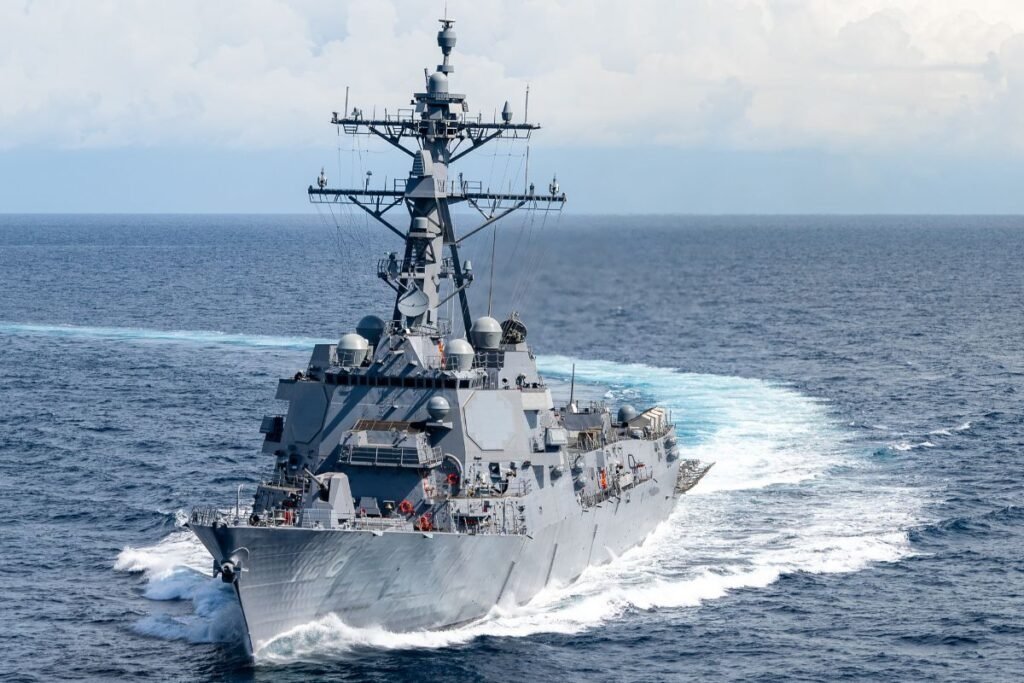
WASHINGTON, — The U.S. Navy says a single Flight III Arleigh Burke-class destroyer can perform air and ballistic missile defense missions that previously required two Flight IIA destroyers. Two Flight III ships have been delivered, while another 23 are under contract or under construction at Huntington Ingalls Industries’ Ingalls Shipbuilding and General Dynamics Bath Iron Works.
The Navy considers Flight III a new type-model warship rather than a minor upgrade. The variant is designed to protect carrier strike groups and operate in more contested environments.
SPY-6 Radar and Aegis Baseline 10
The main upgrade is the AN/SPY-6(V)1 Air and Missile Defense Radar, integrated with the Aegis Baseline 10 combat system. The Navy says the combination can detect, track and engage more complex threats at greater distances and in less time than older destroyers.
Aegis Baseline 10 processes the larger amount of data produced by SPY-6 and allows Flight III ships to conduct air defense and ballistic missile defense simultaneously without losing performance.
The SPY-6 uses gallium-nitride technology and modular assemblies, providing greater sensitivity and longer detection ranges than the earlier SPY-1 radar. It is designed to help track smaller, faster and more complex threats.
Major Power and Cooling Changes
The larger radar required major changes to the ship’s electrical and cooling systems. Flight III uses a 4,160-volt electrical grid, compared with 450 volts on Flight IIA ships. The increased capacity also supports future systems such as directed-energy weapons.
The ships have upgraded air-conditioning systems, a larger chilled-water supply and updated gas-turbine generators producing 4 megawatts each. A modified steel hull supports the additional equipment.
These changes increase displacement to more than 9,500 tons, compared with about 9,300 tons for a Flight IIA destroyer. The ships retain the standard Arleigh Burke-class armament, including 96 vertical-launch cells.
USS Jack H. Lucas Leads the Class
USS Jack H. Lucas (DDG 125), commissioned in October 2023, is the lead Flight III ship and currently the only one in operational service. It is completing initial operational test and evaluation before taking the air and missile defense commander role for a carrier strike group.
The destroyer participated in Pacific Dragon 2026, a U.S. 3rd Fleet-led missile-defense exercise around Hawaii involving the Missile Defense Agency and allied forces. Testing will continue during a busy underway schedule for the next 13 months.
Capt. Rob Niemeyer, the ship’s commanding officer, said Jack H. Lucas represents a major advance in surface warfare capability and highlighted the performance of its sailors during Pacific Dragon 2026.
Ted Stevens and Louis H. Wilson Jr.
The future USS Ted Stevens (DDG 128) is nearing commissioning and will become the second Flight III destroyer. It recently completed Full Ship Shock Trials, using live ordnance to test whether the ship can continue operating after combat-related shock.
The Navy has scheduled its commissioning for October 3, 2026, in Whittier, Alaska. It will then be homeported in Norfolk, Virginia.
Capt. Mary Katey Hays, commanding officer of Ted Stevens, said Flight III ships represent the future of integrated air and missile defense and provide an upgrade needed by carrier strike groups.
The future USS Louis H. Wilson Jr. (DDG 126) is also expected to join the surface force as additional Flight III ships enter service. Yeoman 1st Class Kristha Hernandez, assigned to the ship, said serving aboard the next class of DDGs provides an opportunity to contribute to the Navy’s future mission and maintain maritime superiority.
Flight III production is continuing at Ingalls Shipbuilding and Bath Iron Works, as the Navy expands a destroyer variant built around SPY-6, Aegis Baseline 10 and substantially increased power and cooling capacity.
——— End of Article ———