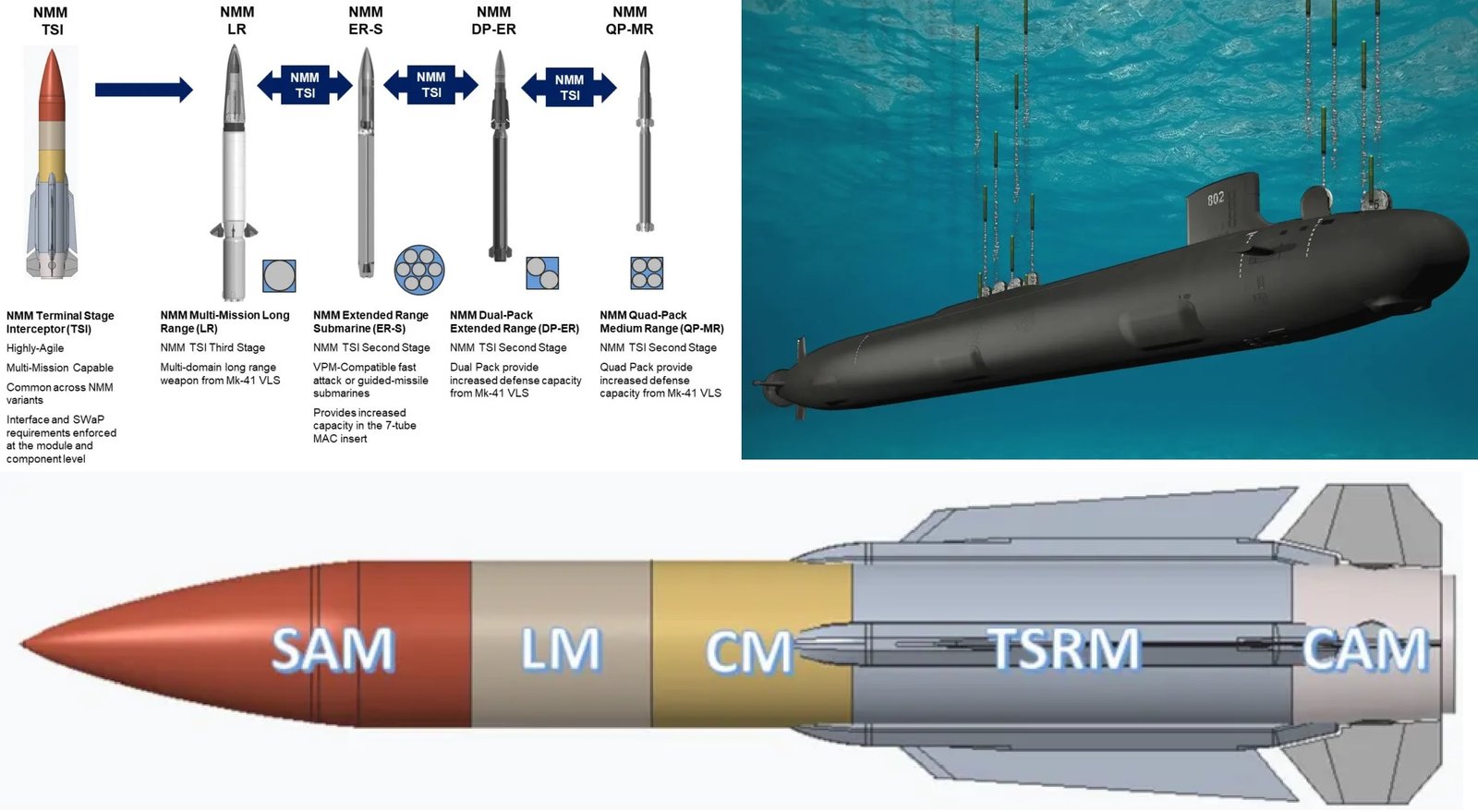
WASHINGTON — The U.S. Navy has outlined new details of its Naval Modular Missile (NMM) program, a next-generation family of modular surface-to-air interceptors designed to improve fleet air defense, increase missile capacity aboard warships, and introduce a submarine-launched air-defense capability for future attack submarines.
The program is built around a common Terminal Stage Interceptor (TSI) that can be combined with different rocket boosters and launch canisters to create multiple missile variants for different missions and platforms. The Navy says the modular approach is intended to simplify production, improve logistics, and provide greater flexibility across the fleet.
Information on the program comes from a draft Request for Solutions contracting notice issued by Naval Sea Systems Command (NAVSEA), which was first reported by Aviation Week. NAVSEA also held an industry day earlier this year to gather feedback from potential suppliers. While the effort has existed since at least 2021, only limited information had previously been made public.
The U.S. Navy has requested $311 million in its Fiscal Year 2027 budget as a new-start effort to begin NMM development. Budget documents state that the long-term objective is to eventually replace the Navy's existing inventory of Standard missiles with the new modular missile family while providing advanced defensive and offensive capabilities for the U.S. Navy, the Joint Force, allies, and partners.
Modular Terminal Stage Interceptor Forms the Core of the Program
At the center of the NMM program is the 10-inch diameter Terminal Stage Interceptor (TSI), which serves as a common front-end section for all missile variants.
According to NAVSEA contracting documents, the interceptor consists of five modules:
- Seeker Assembly Module (SAM)
- Lethality Module (LM)
- Command Module (CM)
- Terminal-Stage Rocket Motor (TSRM)
- Control Actuation Module (CAM)
The Navy describes the TSI as a highly agile, multi-mission interceptor built using current technologies. While detailed performance requirements have not been publicly released, the contracting notice indicates the missile is intended to counter advanced aerial threats, including maneuvering supersonic and hypersonic weapons.
The Navy has not finalized seeker requirements. However, potential seeker options mentioned in the documents include active radar, imaging infrared, and passive radiofrequency systems. A multi-mode seeker could improve performance against increasingly sophisticated electronic countermeasures.
The focus on advanced missile defense reflects operational experience from recent conflicts in the Middle East and observations from the war in Ukraine, as well as the continued development of high-speed anti-ship missiles by countries including China and Russia.
Four Missile Variants Planned
Using the common TSI, the Navy plans to develop four primary All-Up-Round (AUR) variants for different operational requirements.
Long-Range (LR)
The Long-Range (LR) variant is intended for launch from the Mk 41 Vertical Launching System (VLS) installed on U.S. Navy surface combatants.
The missile uses a 21-inch rocket motor, leveraging existing Navy investments in propulsion technology already associated with the Standard Missile-3 (SM-3) Block IIA and the developing SM-6 Block IB.
According to Navy documents, the LR missile is designed to provide multi-mission hypersonic capability, allowing faster engagement of long-range aerial threats and supporting future long-range kill chains. One LR missile will occupy a single Mk 41 VLS cell.
Dual-Pack Extended Range (DP-ER) and Quad-Pack Medium Range (QP-MR)
To increase the number of interceptors carried aboard surface ships, the Navy also plans two slimmer missile variants:
- Dual-Pack Extended Range (DP-ER)
- Quad-Pack Medium Range (QP-MR)
These missiles are designed to fit two or four missiles, respectively, into a single Mk 41 VLS cell.
Currently, the Evolved Sea Sparrow Missile (ESSM) is the primary Navy surface-to-air interceptor that can be multi-packed into Mk 41 launch cells. Increasing magazine depth would allow warships to conduct more defensive engagements before needing to return to port for reloading.
The Navy is also developing methods for reloading vertical launch systems at sea to further improve operational flexibility.
Submarine-Launched ER-S Variant
One of the most significant elements of the NMM program is the Extended-Range Submarine (ER-S) variant, which is planned for deployment aboard future Block V Virginia-class nuclear-powered attack submarines equipped with the Virginia Payload Module (VPM).
The VPM adds four large vertical launch tubes to Block V submarines. Under current plans, the ER-S missiles would be loaded using a seven-cell Multiple All-Up-Round Canister (MAC) adapter previously used on Ohio-class guided-missile submarines.
The U.S. Navy does not currently operate a dedicated submarine-launched surface-to-air missile capability.
According to program documents, the ER-S missile is expected to provide submarines with localized defense against airborne threats such as anti-submarine warfare aircraft while also expanding their contribution to wider fleet air-defense operations.
【P1】 The submarine currently under construction appears to be USS Arizona (SSN-803), the second Block V Virginia-class attack submarine. 【P2】 is likely the Virginia Payload Module (VPM), a key feature of the Block V variant.
— 笑脸男人 (@lfx160219) July 30, 2026
USS Arizona will be the first Virginia-class… https://t.co/lNVxk5TZfe pic.twitter.com/oUJLZEMkGd
Submarine multiple all-up-round canister (MAC) evolution:
— 🇺🇸𝗢𝗹𝗱 𝗦𝘂𝗯𝗺𝗮𝗿𝗶𝗻𝗲𝗿⚓️ (@USN_Submariner) August 6, 2024
1⃣Ohio-class SSGN: 7-round MAC backfit into each Trident missile tube
2⃣Block III Virginia: two VPTs on the bow with 6-round MAC
3⃣Block V Virginia (starting w/803): keep Block II VPT, add four 7-round MAC amidships pic.twitter.com/5oAVbKbZEK
Potential Role in Networked Air Defense
Navy planning documents describe how submarines equipped with ER-S missiles could operate as part of a wider networked air-defense architecture.
Using targeting information provided by offboard sensors—including Aegis-equipped surface ships, space-based tracking systems, or aircraft—a submarine could contribute to engagements against airborne threats while remaining integrated into broader fleet operations.
The Navy also notes that the LR and ER-S variants are planned to achieve hypersonic speeds, allowing faster engagement of distant threats and potentially improving response against time-sensitive targets.
Military planners also recognize operational considerations associated with the submarine-launched concept. Launching a large interceptor generates infrared, radar, and acoustic signatures that could reveal a submarine's position, requiring commanders to balance defensive benefits with stealth requirements.
Production Strategy Focuses on Modular Manufacturing
A major objective of the NMM program is to improve production capacity and strengthen the defense industrial base.
Rather than relying on a single supplier, the Navy's modular open-architecture approach is intended to allow multiple contractors to manufacture TSI components and rocket motors, increasing competition and reducing supply chain constraints.
According to contracting documents, the Navy is targeting production of 1,000 TSI interceptors per year within five years of contract award.
Budget documents also indicate the Navy plans to use multiple acquisition approaches, including Other Transaction Authorities (OTA), marketplace platforms, and alternatives to traditional Federal Acquisition Regulation (FAR) procurement methods to expand the supplier base.
Program Supports Future Fleet Air Defense
The Fiscal Year 2027 budget request states that the Naval Modular Missile (NMM) program is intended to address increasingly capable anti-access and area-denial (A2/AD) threats while providing greater magazine capacity and more adaptable missile options across the fleet.
If developed as planned, the NMM family would introduce a standardized interceptor architecture for surface ships while adding a new submarine-launched air-defense capability for future Virginia-class submarines equipped with the Virginia Payload Module (VPM), expanding the Navy's options for defending against advanced aerial threats.
——— End of Article ———