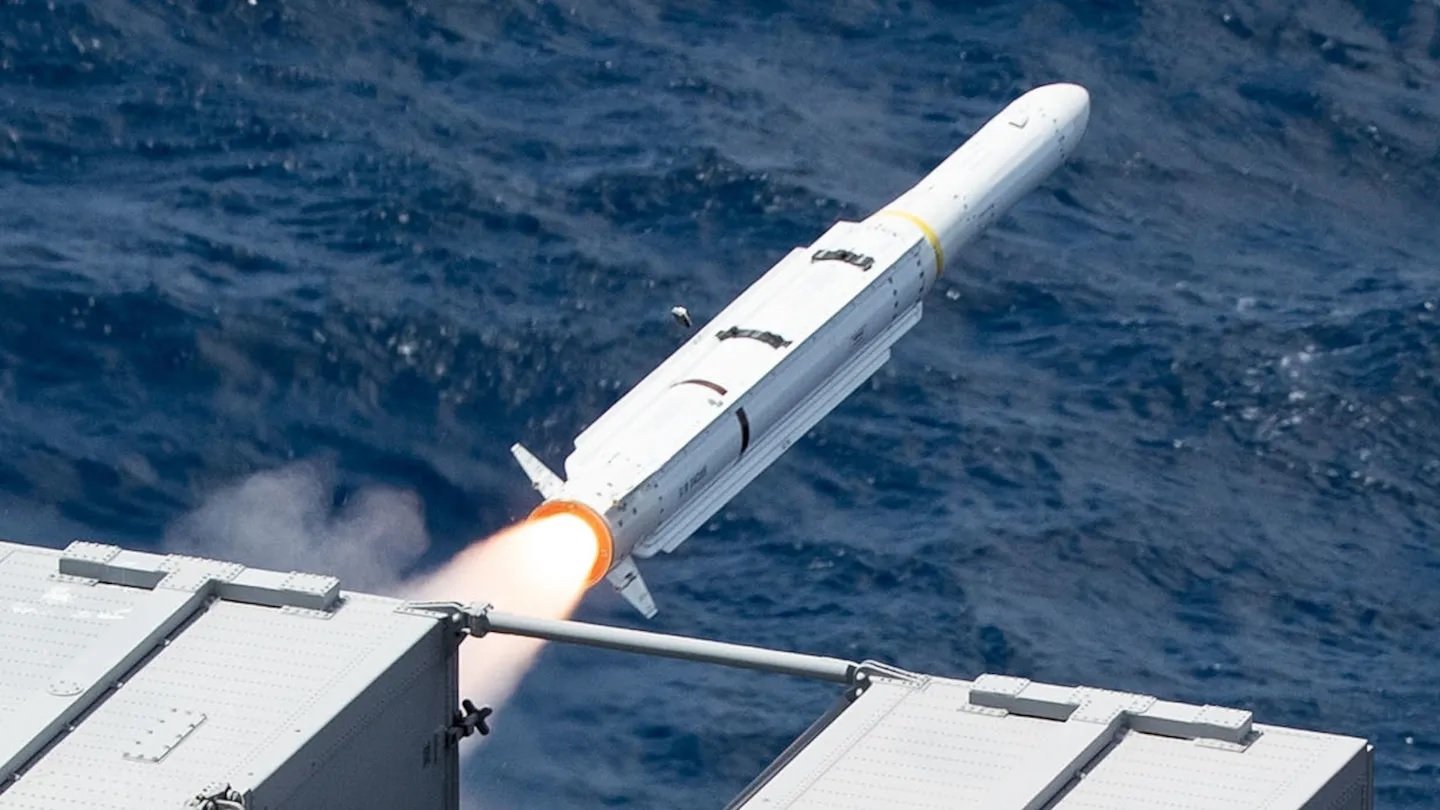
WASHINGTON — The U.S. Navy is seeking industry concepts for a potential new version of the Evolved SeaSparrow Missile (ESSM) as NATO partners look to develop a Next Significant Variant (NSV) with improved capabilities against evolving aerial threats.
Naval Sea Systems Command (NAVSEA) issued a sources-sought notice on August 20, 2026, seeking companies able to design, build and support the NSV. Responses are due October 19, 2026. The notice is for market research only, carries no funding commitment and does not guarantee a future contract or prototype award.
The ESSM is used by a 12-nation NATO consortium comprising Australia, Belgium, Canada, Denmark, Germany, Greece, the Netherlands, Norway, Portugal, Spain, Türkiye and the United States. The NATO SEASPARROW Project Office manages the program and is transitioning from Program Executive Office Integrated Warfare Systems 12.0 to Program Acquisition Executive Munitions NSPO.
10-Inch Missile and Mk 41 Compatibility
The Navy wants the NSV to retain the current 10-inch diameter of ESSM Block 2. This is important because the missile can be quad-packed in Mk 41 Vertical Launching System cells, allowing four interceptors to be carried in one cell.
The existing ESSM Block 2 uses the larger 10-inch body compared with the 8-inch Block 1, providing space for its dual-mode X-band radar seeker. The Navy wants the new variant to retain this physical limit so existing ship launcher and magazine arrangements do not require redesign.
ESSM Block 2 has a stated range of about 50 kilometers (31 miles) and a speed exceeding Mach 4. Its dual-mode seeker can use the missile's onboard radar or rely on a launching ship's illumination radar.
Wider Threat Requirements
NAVSEA wants the NSV to handle targets with different speeds, altitudes and maneuverability, including low-speed to high-speed, sea-skimming to high-diving and non-maneuvering to high-G targets.
The missile must also be able to track and discriminate between closely spaced targets and operate in contested environments involving radar, electro-optical and infrared countermeasures, as well as enemy jamming and decoys.
Companies can submit complete missile designs or proposals for individual components such as seekers, propulsion systems, guidance electronics or warheads.
Open Architecture and Technology Rights
The proposed missile must use a Modular Open Systems Approach (MOSA), allowing adaptable and interoperable systems based on severable, standards-based components.
The U.S. government is seeking at least Government Purpose Rights to technical data, source code and design documentation. The requirement is intended to provide the consortium with greater flexibility to support, upgrade or manufacture the missile without being dependent on a single supplier.
All proposed technologies and data must be legally releasable to all 12 consortium members. Companies must also explain compliance with U.S. export controls, including ITAR, and domestic sourcing requirements such as the Buy American Act. Firms requesting detailed ESSM requirements must sign a non-disclosure agreement.
Current ESSM Production and NSV Development
Raytheon, an RTX business, is the prime contractor and design agent for ESSM Block 2. The company delivered its 500th Block 2 missile to the U.S. Navy in October 2025 and has increased production to more than 350 missiles annually, with plans to roughly double production again by mid-2026.
The NATO SEASPARROW Project Office held an NSV industry day in January 2026 and previously sought industry information on a releasable seeker assembly for the same 10-inch missile body. Official program material identifies a goal of reaching Milestone B by September 2029, with modeling and simulation, model-based systems engineering and other studies continuing.
The ESSM program has been a multinational NATO weapons effort for more than five decades.
NAVSEA has not yet announced a formal follow-on solicitation timeline, estimated program cost, or whether the NSV will replace ESSM Block 2 or operate alongside it. The current notice may or may not lead to a future Federal Acquisition Regulation-based contract or prototype award under Other Transaction authority.
——— End of Article ———