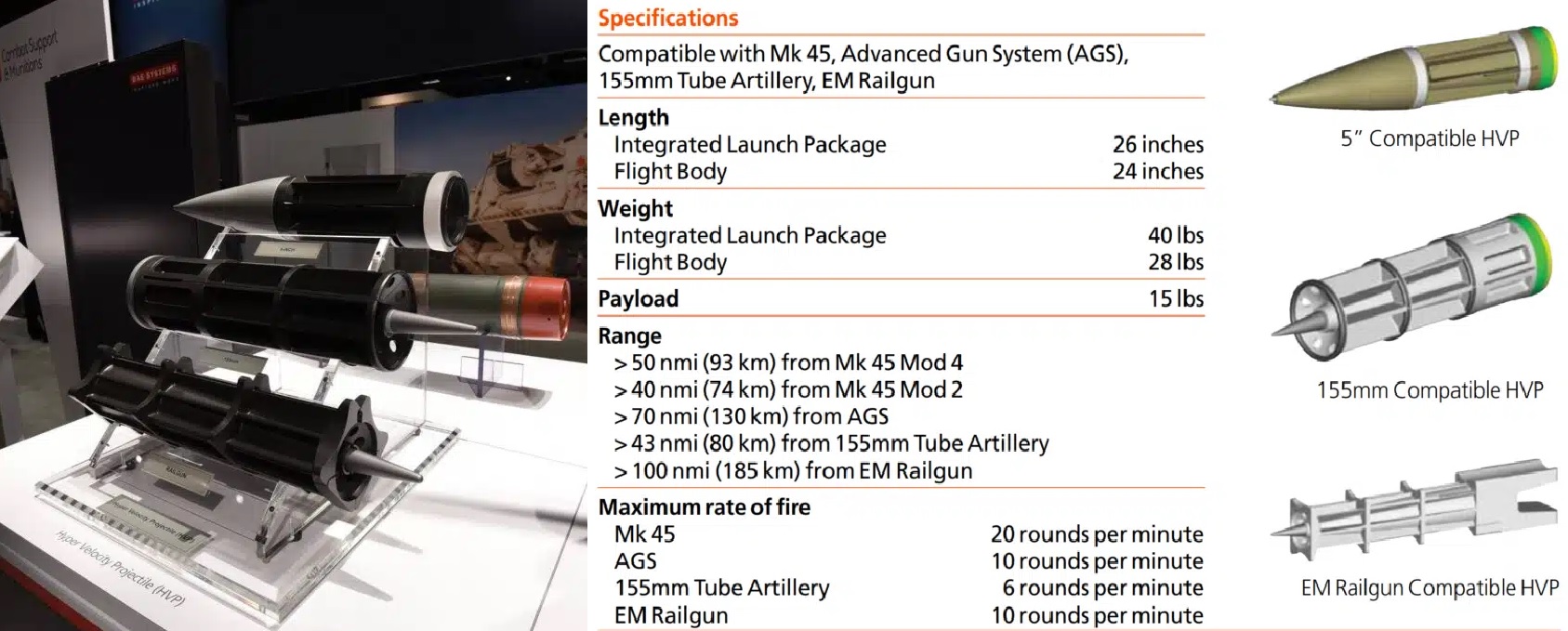
The U.S. Navy has revived its testing of BAE Systems’ Hypervelocity Projectile (HVP), a cutting-edge round that could revolutionize naval air defense. Originally developed as part of the now-canceled electromagnetic railgun program, the HVP has found new life aboard existing naval destroyers, with promising results that could enhance both air and missile defense capabilities for the U.S. military.
At the 2024 Association of the U.S. Army (AUSA) Conference, BAE Systems revealed key developments in artillery and cannon ammunition, particularly surrounding the HVP. Despite the cancellation of the U.S. Navy’s railgun project in 2022 due to budget cuts, the HVP continues to evolve. BAE’s HVP project, initially designed for the railgun, has adapted to conventional naval guns, such as the Navy’s 5-inch Mark 45 cannons, as well as Army and Marine Corps 155mm howitzers. The projectile is part of a broader shift towards long-range cannon rounds with enhanced accuracy and speed.
One of the standout features of the HVP is its velocity. Designed to travel at extreme speeds, the round has demonstrated the ability to intercept airborne targets such as cruise missiles and drones. It was first tested aboard the USS Dewey in 2018 during the RIMPAC exercise, where it successfully engaged cruise missiles. Though the program faced setbacks and a brief cancellation, recent reports indicate that the U.S. Navy has resumed testing at sea, marking a significant step toward integrating this technology into the fleet.
According to Jim Miller, Vice President of Business Development at BAE Systems Combat Mission Systems, the Navy is conducting ongoing tests that involve deploying HVPs on destroyers. This testing aims to enhance the air defense systems of these warships, particularly against massed missile and drone attacks. The HVP’s ability to provide high-speed intercepts can supplement traditional missile defense systems, offering a cost-effective way to deal with lower-tier threats like unmanned aerial systems (UAS) and cruise missiles.
The HVP's compact design allows destroyers to significantly increase their magazine depth. Typically, an Arleigh Burke-class destroyer carries around 600 rounds for its Mark 45 gun. The introduction of HVP rounds enables the firing of an additional 16-20 projectiles per minute, making it a powerful deterrent against overwhelming air and missile attacks. This capability not only enhances a ship’s defensive posture but also reduces the dependency on more expensive missile systems, such as the Navy’s RIM-174 or the Army’s PAC-3 interceptors, which are better suited for higher-priority threats.
BAE Systems has also indicated that the HVP is equipped with a seeker, enabling it to track and hit moving targets. The current seeker allows the projectile to engage airborne threats, but future upgrades aim to enhance its ability to track and destroy moving targets at sea and on land. These modifications are expected to play a crucial role in the U.S. Navy's ongoing efforts to build a more versatile and cost-effective air defense system.
The Navy’s Fiscal Year 2024 budget outlines a continued commitment to developing and testing the HVP, particularly focusing on the Precision Fire Control (PFC) architecture. The PFC effort is aimed at creating a guidance system that will allow ships to launch multiple interceptors, both missile-based and projectile-based, in a coordinated defense against cruise missiles and drones. This layered defense would greatly enhance the Navy's capability to deal with swarming UAS and other airborne threats, deepening magazine capacity without adding significant cost.
The HVP's ability to be used across different branches of the U.S. military, including the Navy, Army, and Air Force, highlights its versatility. For instance, Army howitzers have successfully fired HVP rounds in recent tests, demonstrating the projectile’s adaptability to a range of platforms. The continued development of this system indicates that the military sees a future where hypervelocity projectiles play a central role in multi-layered defense strategies.
As the Navy continues to refine its testing and deployment of the HVP, it’s clear that this projectile could significantly impact future naval warfare. With the ability to intercept missiles and drones more efficiently and at a lower cost than traditional missile systems, the HVP represents a leap forward in naval defense technology. This revival of the project may well ensure that future destroyers and other warships are better equipped to handle the increasingly complex threats posed by modern warfare.
BAE Systems’ vision for the HVP extends beyond just the Navy. The projectiles have the potential to revolutionize base defense by providing a powerful, cost-effective means to intercept incoming aerial threats. Whether on land or at sea, the hypervelocity projectile stands poised to become a key element of U.S. military defense systems for years to come.
As the testing progresses, the Navy’s push to integrate HVP into its destroyers signals a future where high-speed, precise cannon rounds complement traditional missile defense systems, providing a faster and more flexible response to threats. The return of at-sea testing marks a pivotal moment in the development of the HVP, as the U.S. Navy looks to finalize its integration by the mid-2020s.
——— End of Article ———