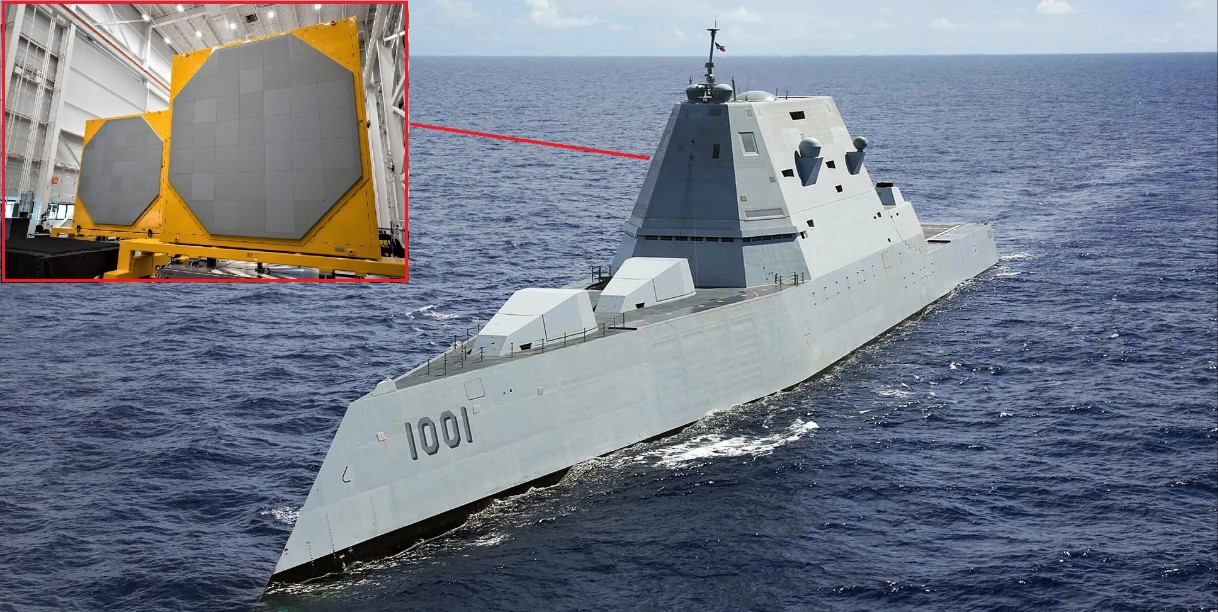
WASHINGTON — May 1, 2026 : The United States Navy is assessing a proposal to replace the existing AN/SPY-3 radar systems on its three Zumwalt-class guided-missile destroyers with the newer AN/SPY-6 radar, utilizing systems originally produced for the cancelled Constellation-class frigate program. The evaluation reflects a broader effort to modernize the Zumwalt class while improving system commonality across the fleet.
Radar Replacement Proposal and Industry Involvement
The AN/SPY-6 radars under consideration were manufactured for the Constellation-class frigates before the program’s cancellation on November 25, 2025. Discussions between the Navy and Raytheon Technologies are ongoing regarding the feasibility of adapting these systems for Zumwalt-class integration.
Jennifer Gauthier, Vice President of Naval Systems and Sustainment at Raytheon, confirmed that the company has received Navy funding to support development work tied to the Zumwalt-class combat management system. This effort is intended to enable compatibility with the AN/SPY-6 radar architecture. She also noted that Raytheon has established a certified software development environment for the Zumwalt program, allowing direct deployment of software updates to the ships.
Gauthier stated that development work on the platform is continuing and that the company is allocating resources toward enabling a potential radar backfit decision.
John Tobin, Associate Director for International SPY Radar Programs at Raytheon, indicated that the most likely configuration for the Zumwalt class would be the AN/SPY-6(V)3 variant. This version consists of nine Radar Modular Assemblies (RMAs) arranged in a 3×3 configuration and is comparable in size to the currently installed AN/SPY-3 system, reducing the need for major structural modifications. Tobin also confirmed that completed SPY-6(V)3 radar units from the cancelled frigate program remain available and could be repurposed.
Constellation-Class Cancellation and Available Systems
The availability of SPY-6(V)3 radar systems is a direct result of the termination of the Constellation-class frigate program. The cancellation followed challenges including schedule delays, increasing costs, and design changes. While initial ships remain under construction, radar systems and other components produced for subsequent vessels are no longer assigned to a platform.
The Navy has since shifted focus toward a new frigate initiative, referred to as the FF(X) program, which is based on a smaller design and does not require the SPY-6 radar in the same configuration. This transition has created an inventory of advanced radar systems suitable for reassignment.
Zumwalt-Class Design and Mission Evolution
The Zumwalt-class destroyers—USS Zumwalt (DDG-1000), USS Michael Monsoor (DDG-1001), and USS Lyndon B. Johnson (DDG-1002)—were originally designed with a stealth-focused hull and intended to provide naval surface fire support in littoral environments. Each ship was equipped with two 155 mm Advanced Gun Systems (AGS).
However, the program was reduced from 32 planned ships to three, and the cancellation of long-range guided munitions for the AGS due to cost constraints led to a reassessment of the ships’ operational role.
The Navy is currently modifying the class to support Conventional Prompt Strike (CPS) hypersonic weapons. USS Zumwalt has completed this conversion, which involved removing one of the forward gun systems and installing vertical launch system (VLS) cells for hypersonic glide vehicles. The ship completed builder’s sea trials in January 2026 and is expected to return to operational service later in the year.
USS Lyndon B. Johnson is undergoing similar modifications at Ingalls Shipbuilding, while USS Michael Monsoor is scheduled to receive the upgrade during its next maintenance period.
ZEUS Modernization Framework
The radar replacement proposal is part of a broader modernization effort known as the Zumwalt Enterprise Upgrade Solution (ZEUS), first outlined in a Request for Information (RFI) issued in November 2022. The ZEUS initiative is designed to align Zumwalt-class systems with those used across the wider Navy surface fleet.
In addition to replacing the AN/SPY-3 radar with AN/SPY-6, the program includes integration of the Surface Electronic Warfare Improvement Program (SEWIP), the SQQ-89 undersea warfare combat system, and the Cooperative Engagement Capability (CEC). The upgrade also requires modifications to the Total Ship Computing Environment infrastructure to support new systems.
AN/SPY-6 Radar Capabilities and Fleet Integration
The AN/SPY-6 is a modular S-band radar system composed of individual Radar Modular Assemblies (RMAs), each approximately two feet in size. These modules function as scalable building blocks, allowing the radar to be configured for different ship classes and mission requirements.
The system is already being deployed across multiple U.S. Navy platforms, including Arleigh Burke-class Flight III destroyers, Ford-class aircraft carriers, amphibious assault ships, and upgraded Flight IIA destroyers. The SPY-6(V)3 configuration was originally intended for the Constellation-class frigates and certain carrier applications.
Contract Activity and Next Steps
On April 20, 2026, the Navy awarded Raytheon a $213.4 million contract modification to continue work on Zumwalt-class combat system integration, modernization, installation, testing, and sustainment through 2027. This contract supports ongoing efforts to prepare the platform for future upgrades, including potential radar replacement.
The Navy has not yet made a final decision regarding the AN/SPY-6 backfit. However, development activities and system integration work are continuing as part of the broader modernization strategy. The three Zumwalt-class destroyers remain the only ships of their type in service and are expected to play a role in the Navy’s evolving surface warfare and strike capabilities.
——— End of Article ———