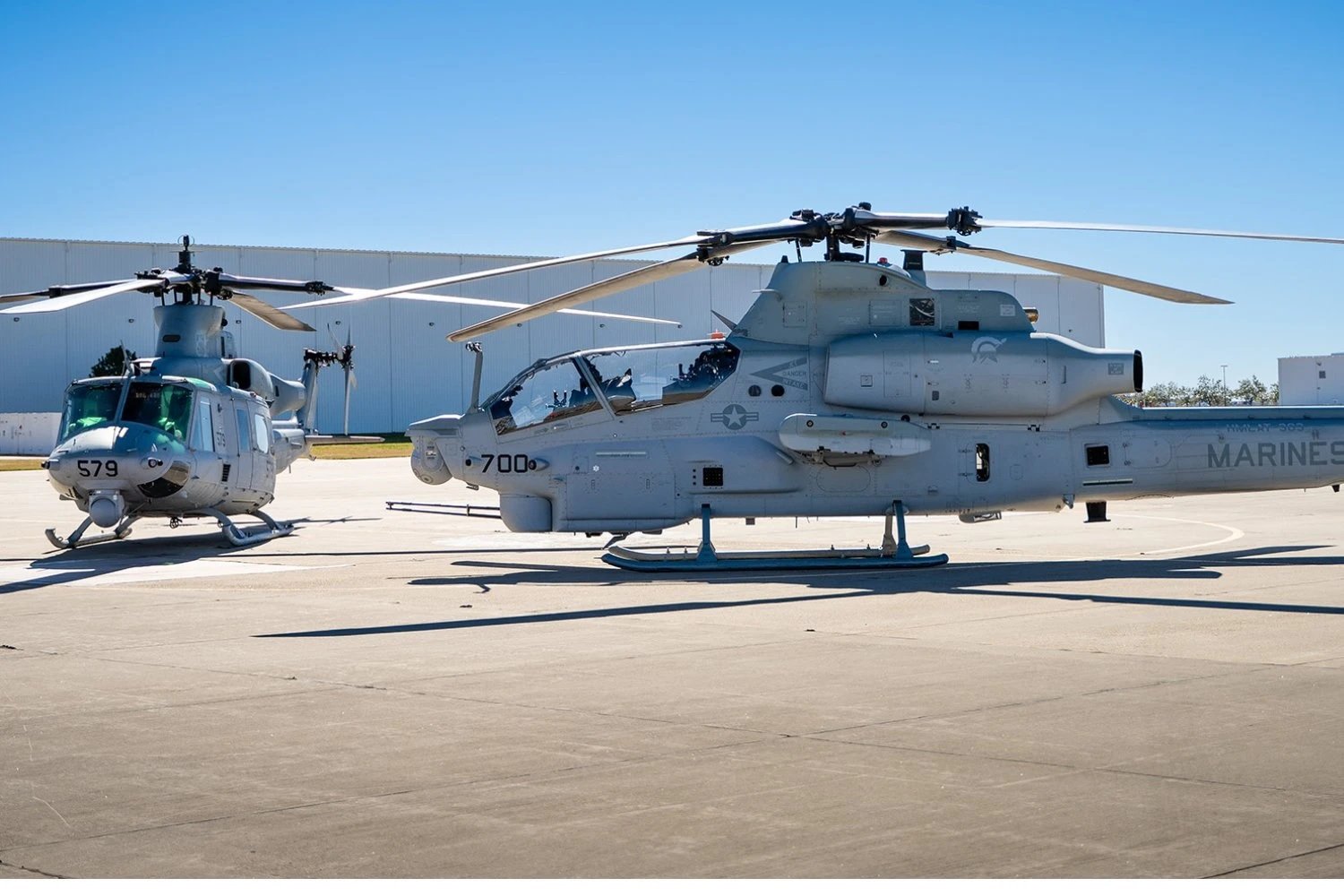
WASHINGTON — The U.S. Department of War has awarded Bell Textron a $33.64 million contract to continue modernization of the U.S. Marine Corps' AH-1Z Viper and UH-1Y Venom helicopter fleet under the Structural and Power Improvements for Next-Generation Effects (SPINE) program.
Awarded on July 24, 2026 through Naval Air Systems Command (NAVAIR), the contract supports upgrades that increase the helicopters' structural strength, electrical power generation and digital architecture. These improvements are intended to provide the foundation for integrating future mission systems, advanced sensors, secure communications and networked combat capabilities.
Contract Covers Aircraft Kits and Critical Components
The contract, valued at $33,642,332, includes:
- Nine aircraft installation A-kits
- Two D-kits designated as mission kits
- Associated hardware, labor, materials and spares
- 12 rotorcraft station control units
- 12 alternating-current generators
- 12 generator control units
- 12 tube assemblies
- Seven combining gearboxes
The contract combines fixed-price incentive, firm-fixed-price and cost-plus-fixed-fee elements and is scheduled for completion by July 2028.
SPINE Program Builds Foundation for Future Upgrades
The SPINE program, previously known as the Structural Improvement and Electrical Power Upgrade (SIEPU), is designed to improve the H-1 fleet's structural integrity, electrical capacity and onboard digital systems.
Rather than introducing new weapons under this contract, the program provides the infrastructure needed to support future integration of advanced sensors, processors, encrypted radios, electronic warfare equipment, weapon interfaces and mission systems.
Bell completed the first fully modified AH-1Z Viper and UH-1Y Venom helicopters in March 2026 at its Amarillo Assembly Center following a 19-month modification effort. The aircraft were subsequently transferred to Naval Air Station Patuxent River for final configuration work and flight testing.
Improved Electrical and Digital Architecture
The modernization package increases available electrical power for onboard systems while enabling advanced digital capabilities, including:
- Link 16 connectivity
- Advanced data buses
- Improved mission computers
- Enhanced defensive systems
The Marine Corps has already demonstrated two-way Link 16 and Advanced Networking Wideband Waveform connectivity between the AH-1Z, UH-1Y and a portable ground station.
These upgrades are intended to support future networking with other military platforms while handling increased data and power demands from modern mission equipment.
AH-1Z Viper Remains the Primary Focus
The AH-1Z Viper is the main platform being modernized under the SPINE program.
The attack helicopter currently features:
- Third-generation Target Sight System
- Helmet-mounted cueing system
- Six wing stations
- Three-barrel 20 mm cannon
- Precision-guided rockets
- Air-to-ground missiles
- Air-to-air capability
The UH-1Y Venom will receive the same electrical and digital improvements to enhance its performance in armed utility, escort, command-and-control and sensor relay missions.
The Marine Corps currently operates 186 AH-1Z Viper helicopters and 131 UH-1Y Venom helicopters. The two aircraft share approximately 85 percent component commonality, reducing maintenance requirements, spare parts and logistics support for mixed H-1 detachments.
Supporting Future Weapons Integration
A major objective of SPINE is to prepare the H-1 fleet for future weapons and mission systems by providing sufficient electrical power and digital capacity.
One capability associated with the broader H-1 modernization roadmap is the Precision Attack Strike Munition (PASM), identified as the L3Harris Red Wolf launched effect.
According to L3Harris, Red Wolf has completed dozens of flight tests, including a low-altitude launch from an AH-1Z helicopter. The company states the system has demonstrated ranges of up to 200 nautical miles while supporting beyond-line-of-sight communications and autonomous over-the-horizon engagement functions. Operational range depends on factors including launch altitude, payload, flight profile, target geometry and communications availability.
The July 24 contract does not procure Red Wolf or any other new weapon systems. Instead, it upgrades the aircraft so future systems can be integrated.
The AH-1Z will continue operating with existing weapons, including:
- 20 mm cannon
- Advanced Precision Kill Weapon System (APKWS) rockets
- AGM-179 Joint Air-to-Ground Missile (JAGM)
The Marine Corps has previously demonstrated JAGM employment against a moving vessel in the Philippine Sea. Planned AIM-9X integration and future counter-unmanned aircraft system capabilities remain part of the helicopter's longer-term modernization roadmap.
Supporting Distributed Operations
The SPINE program aligns with the Marine Corps' distributed operations concept, particularly in the Indo-Pacific region.
Marine aviation units increasingly operate from:
- Amphibious assault ships
- Expeditionary sea bases
- Forward arming and refueling points
- Temporary island locations
Operations from the expeditionary sea base USS Miguel Keith have demonstrated the ability of mixed AH-1Z and UH-1Y detachments to operate beyond traditional amphibious formations.
The upgraded aircraft are expected to receive targeting information from platforms including F-35B aircraft, MQ-9A drones, surface ships and ground units while operating at low altitude or behind terrain, expanding their role in networked operations.
Modernization Focused on Future Growth
Although the SPINE program improves the H-1 fleet's electrical capacity, connectivity and digital architecture, it does not eliminate the operational challenges of rotary-wing missions in contested environments. Aircraft deployed from dispersed locations will continue to require fuel, maintenance, munitions, secure communications and force protection while remaining vulnerable to air defenses, electronic warfare, fighters and long-range fires.
The program's primary objective is to ensure the Marine Corps' existing H-1 fleet has the structural, electrical and digital capacity needed to integrate future technologies and mission systems as they become available.
——— End of Article ———