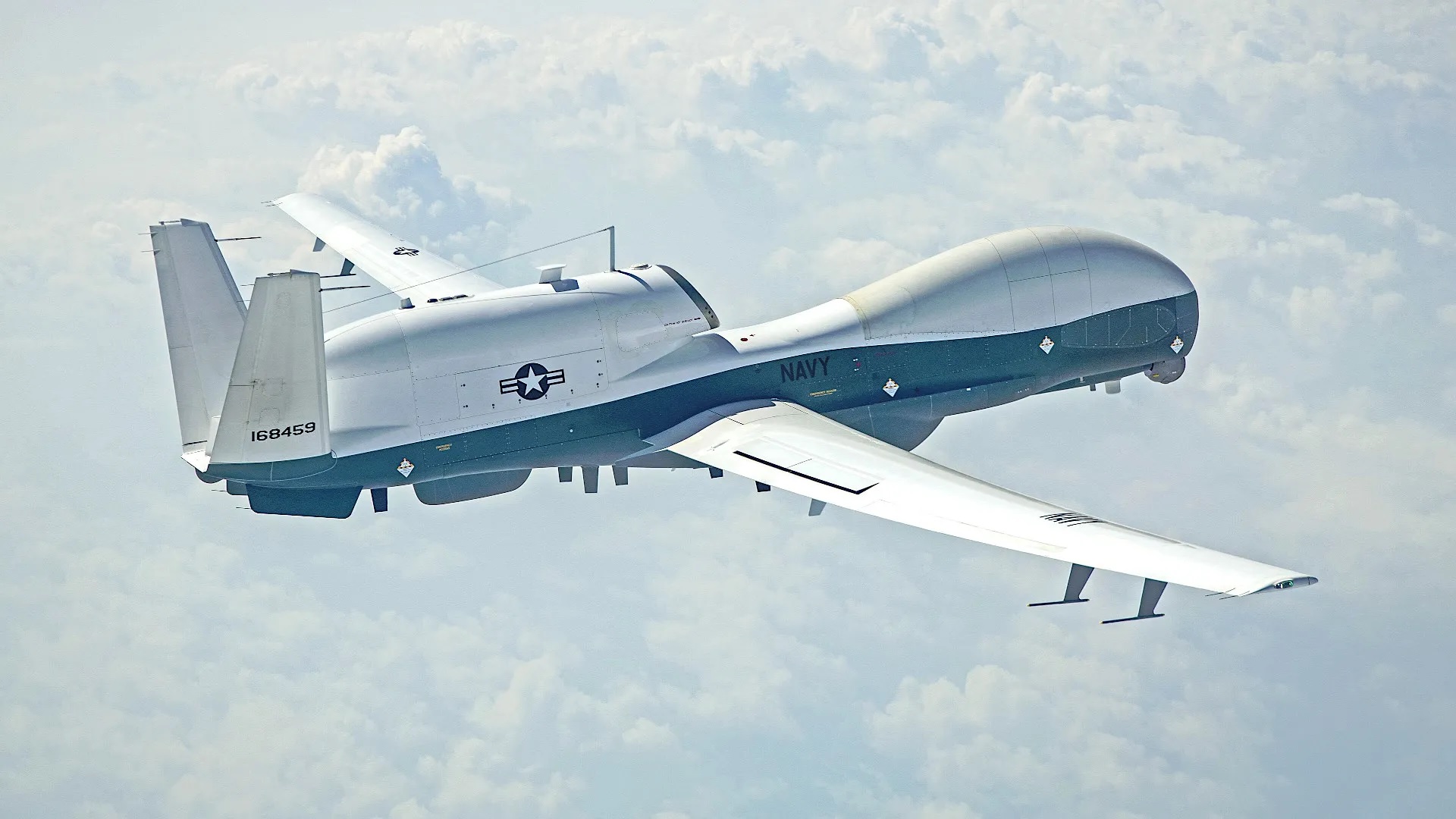
WASHINGTON, — April 15, 2026 : The United States Navy has confirmed the loss of an MQ-4C Triton high-altitude, long-endurance unmanned aerial vehicle following a mishap over the Persian Gulf on April 9, 2026. The aircraft, bearing registration number 169804 and valued between $238 million and $243 million, was one of the Navy’s primary maritime intelligence, surveillance, and reconnaissance (ISR) platforms.
Incident Overview and Flight Timeline
The MQ-4C Triton departed from its forward operating location at Naval Air Station Sigonella in Sicily, Italy, to conduct a routine surveillance mission over the Persian Gulf and the Strait of Hormuz. The platform had previously operated from Sigonella in support of high-altitude monitoring missions related to the Ukraine conflict, including observation of Russian naval activity in the Black Sea region.
After approximately three hours of standard patrol operations at a cruising altitude between 50,000 and 52,000 feet, the aircraft transmitted emergency transponder signals. It first squawked code 7400, indicating a loss of communication link with ground control operators, followed shortly by code 7700, signaling a general in-flight emergency.
Flight tracking data indicates that the UAV then entered a rapid and continuous descent, dropping from above 50,000 feet to below 10,000 feet within roughly 15 minutes before disappearing from radar coverage over the Gulf.
The U.S. Naval Safety Command formally classified the incident as a mishap and confirmed that the aircraft crashed at a location withheld for operational security reasons. The event has been categorized as a Class A mishap, a Department of Defense classification used for incidents involving damage exceeding $2.5 million or total loss of an aircraft. No personnel were injured, as the platform is unmanned.
Operational Context and Security Considerations
The incident occurred during a period of fragile ceasefire between the United States and Iran, adding strategic sensitivity to operations in the region. While some unverified reports initially suggested the possibility of hostile action or electronic interference, including GPS spoofing or communications jamming, the U.S. Navy has not confirmed any such involvement and continues to describe the event strictly as an operational mishap.
The precise crash location has not been disclosed, and recovery of debris remains a priority due to the sensitive nature of the Triton’s onboard systems. The aircraft carries advanced sensor technologies and signals intelligence equipment, and securing wreckage is considered essential to prevent potential exploitation by foreign actors.
Platform Capabilities and Role
Developed by Northrop Grumman as a naval variant of the RQ-4 Global Hawk, the MQ-4C Triton is a high-altitude, long-endurance (HALE) unmanned system designed for persistent maritime surveillance.
The aircraft is equipped with the AN/ZPY-3 Multi-Function Active Sensor radar, which provides 360-degree coverage for tracking and classifying vessels across large ocean areas. Its sensor suite also includes electro-optical and infrared imaging systems, as well as signals intelligence payloads for passive data collection.
The Triton is capable of remaining airborne for up to 30 hours, operating at altitudes above 50,000 feet, and covering ranges exceeding 9,400 miles. It can monitor more than 2 million square miles in a single mission. The platform includes de-icing and lightning protection systems, enabling operations in varied and adverse weather conditions, including controlled descents for closer target identification.
In addition to surveillance, the aircraft functions as an airborne communications relay, supporting networked operations across maritime theaters.
Integration with U.S. Navy Operations
The MQ-4C Triton operates from land-based installations and supports theater-level tasking for combatant commanders. It is designed to complement crewed maritime patrol aircraft, particularly the Boeing P-8A Poseidon, by extending ISR coverage over areas where continuous manned presence may not be feasible.
The system has been deployed in multiple regions, with initial operational detachments in Guam and Naval Air Station Sigonella, followed by expanded operations within U.S. Central Command.
Two operational squadrons manage Triton missions: Unmanned Patrol Squadron 19 (VUP-19) and Unmanned Patrol Squadron 11 (VUP-11), the latter being more recently established to support growing operational demand.
Fleet Size, Procurement, and Program Status
As of 2025, the U.S. Navy maintained approximately 20 MQ-4C Triton aircraft in active service. The program’s total acquisition objective was revised from an earlier plan of 68 to 70 aircraft down to 27 units, aligning with updated joint operational requirements.
In March 2025, the Navy awarded a $267 million contract for the procurement of two additional Triton aircraft, supporting ongoing production and planned fleet completion by 2028.
Due to the limited fleet size and high unit cost, the loss of a single airframe represents a measurable reduction in available ISR capacity.
Strategic Role and Ongoing Investigation
The MQ-4C Triton forms a central component of the U.S. Navy’s strategy to enhance maritime domain awareness and improve sensor-to-shooter integration through the use of unmanned systems. Its ability to provide persistent, wide-area surveillance is particularly relevant for monitoring strategic chokepoints such as the Strait of Hormuz.
The U.S. Navy has not released further details regarding the cause of the mishap. Investigation efforts remain ongoing, and no additional information on recovery operations or system failures has been disclosed as of April 15, 2026.
——— End of Article ———