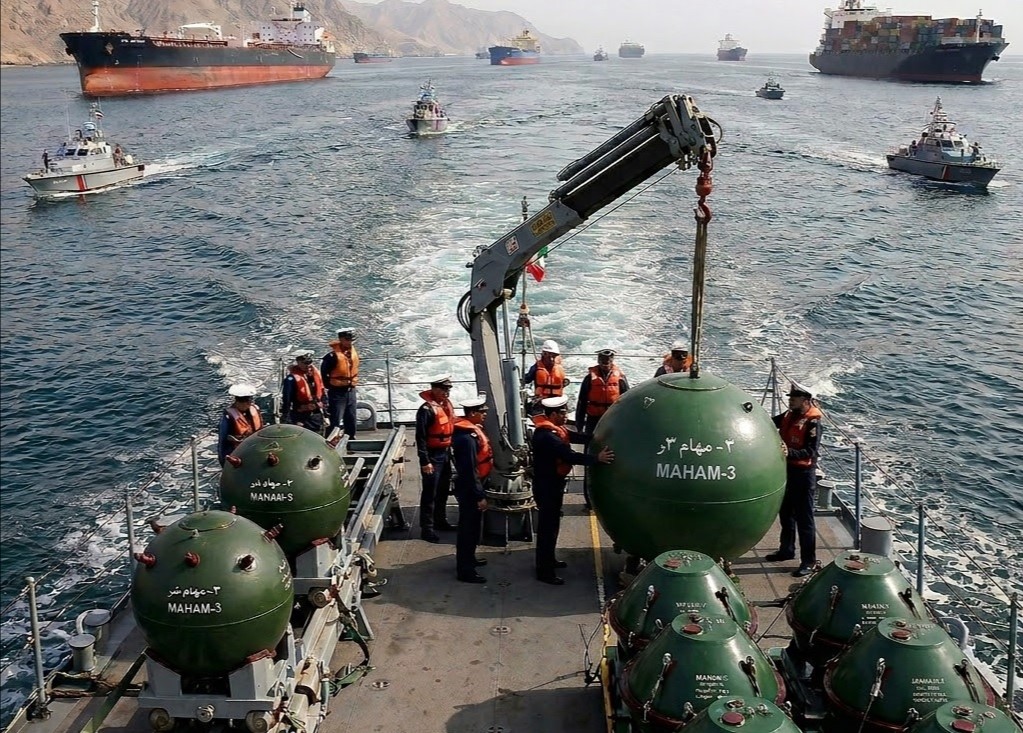
WASHINGTON, — March 24, 2026 : U.S. intelligence assessments indicate that Iran has deployed a limited number of advanced underwater naval mines in the Strait of Hormuz, according to American officials who spoke to CBS News. The mines, identified as Iranian-manufactured Maham-3 and Maham-7 models, are assessed to pose a potential risk to commercial and military shipping in one of the world’s most strategically important maritime corridors.
U.S. officials said at least a dozen mines have been placed in the waterway, although one official indicated the total number could be slightly lower. The devices are believed to be distributed across sections of the strait, which connects the Persian Gulf to the Gulf of Oman and handles roughly 20 percent of global oil and liquefied natural gas shipments under normal conditions.
The reported deployment comes amid ongoing regional tensions and follows direct demands from the Trump administration for Iran to ensure the continued flow of maritime commerce through the strait.
Technical Characteristics of Maham-Series Naval Mines
Defense intelligence assessments and unexploded ordnance databases describe the Maham series as among Iran’s more advanced naval mining systems. Unlike traditional contact mines, both the Maham-3 and Maham-7 rely on influence-based triggering mechanisms, allowing detonation without physical contact with a vessel.
The Maham-3 is a moored deep-water mine designed for deployment at depths of up to 100 meters. Anchored to the seabed, it rises along a cable to position itself below the keel of passing ships. The system uses one magnetic sensor and two passive acoustic sensors to detect vessel signatures. It analyzes target movement to determine the optimal detonation point and is capable of engaging ships within approximately 10 feet (3 meters).
The mine weighs about 383 kilograms and carries an explosive charge of roughly 120 kilograms. It measures approximately 0.8 meters in diameter and 1.324 meters in height. The Maham-3 includes an electronic timer to regulate activation periods and can be configured through coded inputs, allowing operators to control arming sequences and operational parameters. Its primary triggering mechanism is based on low-frequency acoustic signatures.
The Maham-7, first publicly displayed in 2015, is a bottom-placed mine that can also function as a limpet-type device. It is designed to rest on the seabed or attach to targets and is optimized for use in shallow and intermediate waters. The system operates at depths ranging from 3 to 25 meters against surface vessels and 25 to 100 meters against submarines.
The Maham-7 is equipped with a combination of three acoustic sensors, including subsonic detection capability, and a three-axis magnetic sensor. It is intended to engage medium-tonnage ships, landing craft, and smaller submarines. The mine has a height of approximately 440 millimeters, a maximum diameter of 980 millimeters, and a total weight of about 220 kilograms (±15 kg). It carries an explosive payload of approximately 150 kilograms (±10 kg), typically using TORPEX or TNT.
Its casing is constructed from glass-reinforced plastic (GRP) composite material and shaped to reduce sonar visibility by scattering incoming acoustic waves. Safety features include a transport lock, hydrostatic activation switch, and separation of the primer from the booster until deployment is complete. The system has an arming delay of 20 to 25 minutes, adjustable activation windows ranging from immediate use up to 127 days, and an operational life of up to one year, with programmable engagement settings for between 1 and 99 targets. The mine’s storage life is estimated at up to 20 years.
The Maham-7 can be deployed from small surface vessels, as well as by aircraft or helicopters using parachute delivery systems.
Strategic Context and Military Developments
The Strait of Hormuz remains a critical chokepoint for global energy flows, and the presence of naval mines introduces additional operational risks for commercial shipping and naval forces operating in the region.
U.S. Central Command (CENTCOM) has undertaken operations targeting Iran’s mine-laying capabilities. Gen. Dan Caine stated that U.S. forces have neutralized more than 120 vessels and 44 dedicated minelayers in recent operations. In addition, CENTCOM has conducted over 90 precision strikes against Iranian naval ammunition depots and mine storage infrastructure, including facilities located on Kharg Island.
Historical assessments from the U.S. Defense Intelligence Agency estimate that Iran maintains a stockpile of between 2,000 and 6,000 naval mines of various types. Other estimates place the inventory at approximately 5,000 to 6,000 units, including moored, bottom, and limpet configurations. These systems can be deployed using a range of platforms, including small civilian-disguised craft and high-speed boats, enabling rapid emplacement in contested waters.
Iranian Response
Iranian officials have publicly rejected the U.S. intelligence assessments. Ebrahim Zolfaqari, spokesperson for Iran’s Khatam al-Anbiya Central Headquarters, stated that Iranian forces maintain operational control over the Persian Gulf and the Gulf of Oman. He added that, in Iran’s view, existing capabilities provide sufficient maritime dominance, making the deployment of naval mines unnecessary.
Maritime Security Implications
The reported presence of influence-triggered naval mines adds complexity to maritime security operations in the Strait of Hormuz. Such systems are designed to complicate detection and clearance efforts, particularly due to their sensor-based activation and reduced acoustic signatures.
Shipping activity in the region has already been affected by broader regional tensions. The introduction of advanced naval mines, even in limited numbers, increases the requirement for sustained mine countermeasure operations and naval patrols to ensure safe passage through the waterway.
——— End of Article ———