BOISE, Idaho — April 10, 2026 : U.S.-based defense technology firm Talon Avionics has developed a new autonomous counter-unmanned aerial system (C-UAS) platform, designated SECTR, designed to detect and neutralize low-cost aerial threats using artificial intelligence-driven acoustic targeting.
The SECTR system introduces a multi-layered sensing approach that combines proprietary passive acoustic detection with conventional radar. According to the company, the acoustic subsystem can identify drone motor sound signatures at distances of up to 100 meters, often before the target becomes visible to radar. The integrated radar component provides broader airspace awareness at ranges between 200 and 1,000 meters, with the extended 1,000-meter capability expected by Q2 2027.
A multi-modal sensor fusion engine processes data from both acoustic and radar inputs to classify drone types and assess threat levels. Talon Avionics stated that the system is capable of completing the full detection-to-engagement cycle in under one second.
Passive Acoustic Detection and AI Processing
At the core of the SECTR platform is a fully passive acoustic detection layer that does not emit radar or radio-frequency signals. Each interceptor drone is equipped with an array of 16 microphones. Using beamforming algorithms, the system scans the surrounding airspace and forms a narrow acoustic beam to isolate specific sound signatures.
Onboard artificial intelligence enables the system to distinguish between hostile drone sounds, the interceptor’s own motor noise, and environmental interference such as wind. This capability allows SECTR to detect “sleeper drones”, which remain stationary with motors off and activate only shortly before engagement.
Michael Mayer-Rosa, co-founder and strategic executive at Talon Avionics, stated that the passive acoustic approach allows forces to detect and track aerial threats without revealing their own position. He noted that traditional counter-UAS systems relying on radar or radio-frequency emissions can face operational limitations and typically require trained personnel.
Interceptor Drone Design and Performance
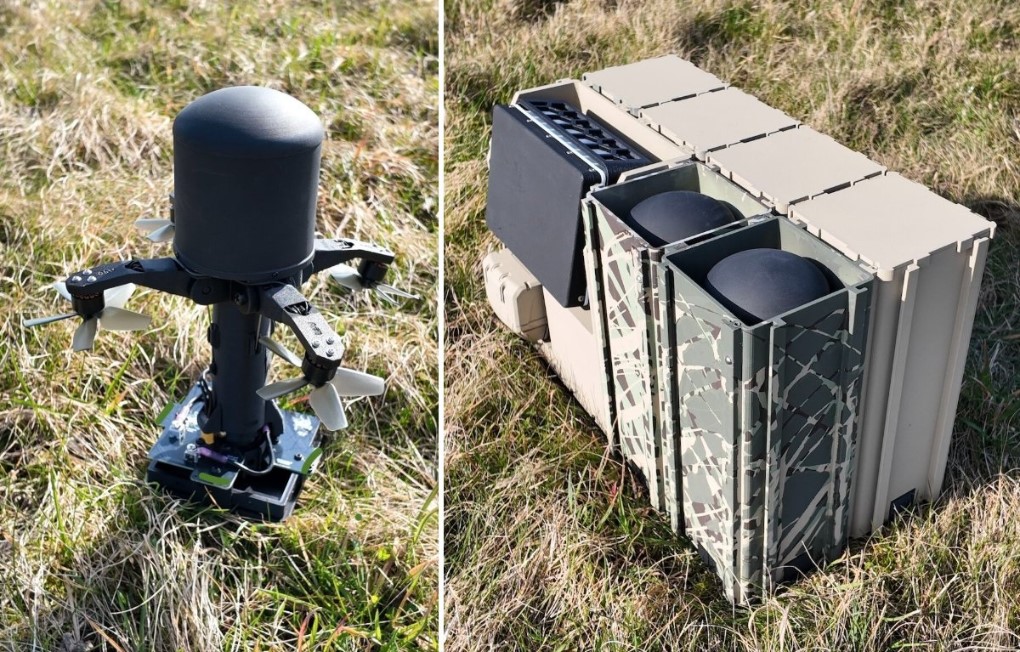
The SECTR interceptor is a kinetic, non-explosive platform designed for direct impact engagement. The system is optimized for countering small drones, including first-person view (FPV) and camera-equipped platforms weighing up to 1 kilogram.
Key specifications include a weight of 700 grams per interceptor, including the launch tube, and dimensions of 100 mm × 100 mm × 250 mm. The interceptor can reach a maximum speed of 135 km/h (85 mph) and has a flight endurance of up to 5 minutes per engagement.
Talon Avionics reports a hit probability of 95 percent or greater using a single interceptor unit.
Launch System and Operational Configuration
The interceptors are deployed from a modular launch platform designated the SECTR-IK-02 interceptor station. The base configuration features a 10×10 grid layout, scalable to a total of 100 launch tubes. The system is operated from a single control station and can be deployed in both vehicle-mounted and fixed-site configurations.
When fully equipped with 100 interceptors, the platform can sustain continuous operations for up to 24 hours on a single battery charge. The system is designed to function across a wide environmental range, operating in temperatures from −40°C to +85°C.
Autonomous Operation and Deployment Roles
SECTR has been developed with what the company describes as “zero-expertise autonomy,” enabling fully automated detection, tracking, and engagement without the need for specialized operators or manual control during interception. The system uses a software-defined architecture that supports field updates to detection and engagement algorithms.
Intended deployment scenarios include convoy escort, forward operating base protection, border security, law enforcement missions, and the defense of critical infrastructure.
Strategic Context and Production Plans
The development of SECTR reflects the increasing use of low-cost FPV and loitering drones in modern conflicts. Talon Avionics stated that the system’s kinetic interception approach is designed to maintain cost symmetry when countering inexpensive aerial threats. The lightweight and compact design of the interceptors also supports stockpiling and ease of transport.
The platform is currently manufactured in the United States for domestic and allied use. The company has indicated plans for regional production expansion to support international partners.
Talon Avionics has not disclosed unit pricing, production timelines, or confirmed customer contracts. Development of the SECTR platform is ongoing, with continued focus on military, law enforcement, and infrastructure protection applications.
——— End of Article ———