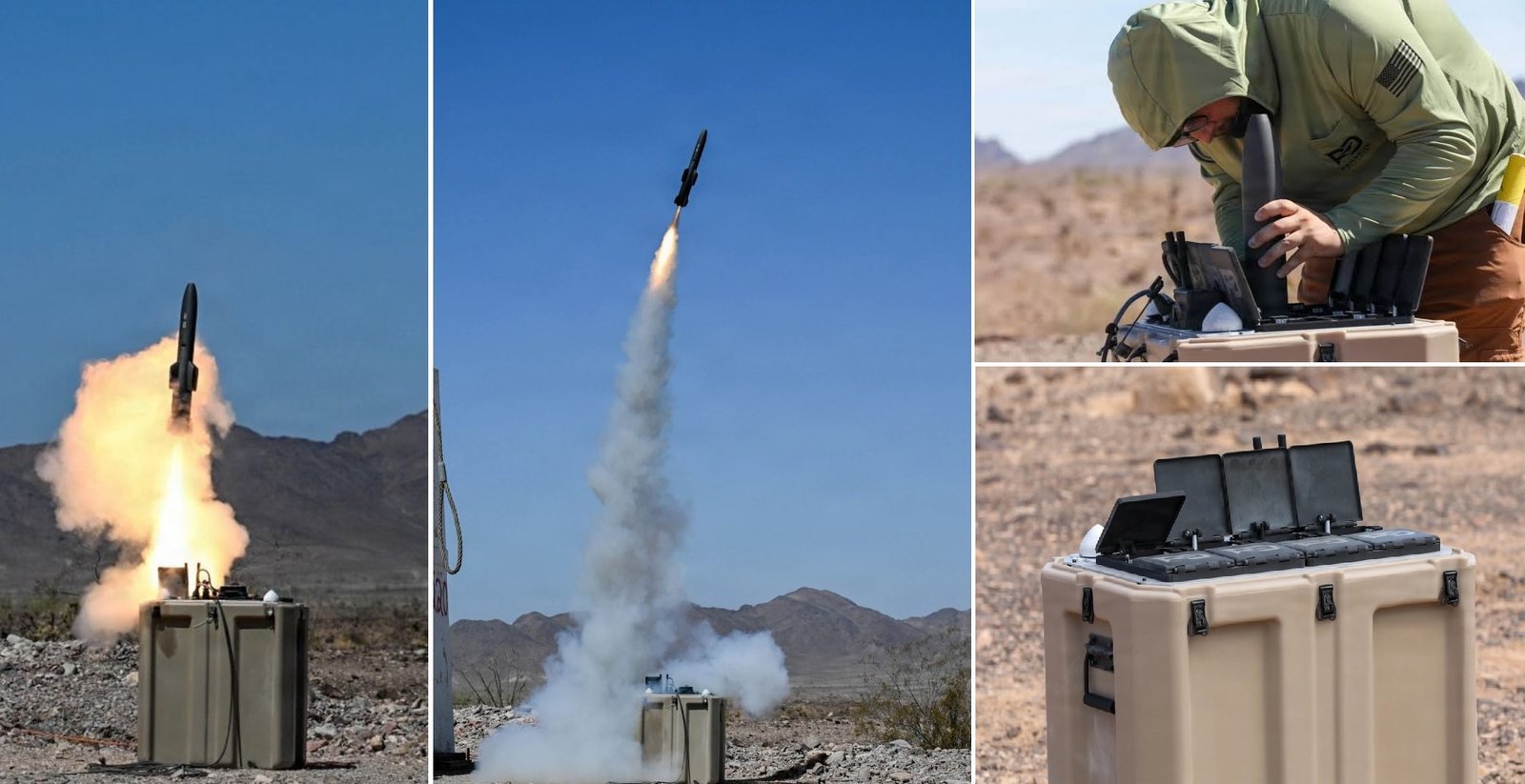
YUMA, Ariz. — U.S. counter-drone startup Perseus Defense has tested its low-cost Mk-III interceptor, also known as the Harpe, during the Falcon Peak 26.2 homeland-defense experiment at the U.S. Army’s Yuma Proving Ground in Arizona.
The live-fire demonstration took place at Cibola Range Site 17 and involved U.S. Northern Command (NORTHCOM), the North American Aerospace Defense Command (NORAD), and Joint Interagency Task Force 401 (JIATF-401).
Low-cost kinetic interceptor
The Harpe is designed as a hit-to-kill kinetic interceptor that physically strikes small drones instead of relying on electronic jamming or spoofing.
Perseus said the Mk-III costs approximately $2,500 to manufacture. The company is targeting a cost per engagement well below the $100,000-plus cost of some existing kinetic interceptors.
The interceptor is approximately 61 centimeters (24 inches) long and has a stated 2-kilometer engagement range. It is designed to engage Group 1 and Group 2 small unmanned aircraft systems.
The missile is launched from an eight-shot portable launcher weighing less than 36 kilograms (about 79–80 pounds). The launcher can receive external target-track data, allowing it to operate separately from the radar or sensor providing the track.
Designed for difficult-to-jam drones
The kinetic approach is intended to address drones that can be difficult to defeat through electronic warfare. Perseus specifically points to drones using fiber-optic links or preprogrammed waypoints, which do not depend on radio signals that can be jammed.
During the Yuma demonstration, Perseus operated the launcher with what it described as Lattice-level integration, referring to Anduril Industries’ Lattice command-and-control software. The company previously demonstrated this capability during Operation Jailbreak at Fort Carson.
Falcon Peak 26.2
Falcon Peak 26.2 is the fourth event in the Falcon Peak series and the first to be held at Yuma Proving Ground. The experiment runs from August 31 through September 25, 2026, following earlier events at locations including Eglin Air Force Base.
The exercise brings together 21 defense industry participants and covers technologies for sensing, detection and tracking, artificial intelligence, command and control, semi-autonomous systems, airborne platforms and low-collateral defeat.
The current iteration is also examining counter-small-UAS challenges relevant to the Southern Border. Military officials are evaluating systems based on factors including mobility, cost per shot, magazine depth and low-collateral defeat options for use around U.S. installations and populated areas.
Growing focus on domestic counter-drone defense
The U.S. military's focus on affordable counter-drone capabilities increased following a series of unauthorized drone sightings over U.S. installations.
In December 2023, dozens of unidentified drones flew over Joint Base Langley-Eustis in Virginia, prompting the temporary relocation of F-22 fighter aircraft. Similar sightings were reported at other installations during 2024 and 2025.
The Department of War established JIATF-401 in 2025 to accelerate counter-drone capabilities for U.S. forces and domestic installations.
Perseus Defense
Perseus Defense was founded in 2025 by Jason Cornelius and Steve Messinger, who studied aerospace engineering together at Penn State University. The company participated in Y Combinator's 2025 batch and has raised approximately $6.5 million in seed funding.
The company is based in the Austin, Texas, area, with headquarters in Buda. Cornelius has experience with NASA programs, including work related to the Titan Dragonfly helicopter concept.
Perseus previously demonstrated the Harpe during the 1st Cavalry Division's Golden Shield exercise at Fort Hood in April 2026, where it achieved radar-cued launches and fully active-guidance intercepts.
The Yuma test forms part of the broader U.S. effort to evaluate lower-cost kinetic options for defending installations and border areas against small drones.
Source : defence-blog
——— End of Article ———