WASHINGTON, D.C. — Interest payments on the U.S. federal debt reached a record share of government revenue in fiscal year 2025, highlighting the growing cost of servicing the national debt.
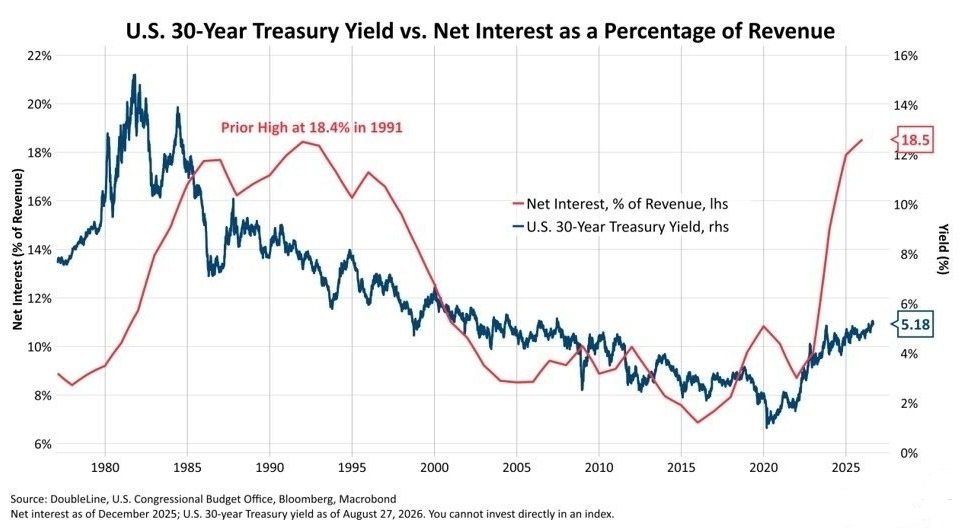
Net interest payments totaled about $970 billion in fiscal 2025, while federal receipts were approximately $5.24 trillion. That meant interest payments consumed about 18.5% of federal revenue, the highest share since the federal data series began in 1940. The previous high was about 18.4% in 1991.
The increase has been driven by the combination of a larger federal debt balance and higher interest rates than those seen during much of the 2010s and early 2020s.
Interest Costs Have Risen Rapidly
The increase in interest costs has been particularly pronounced since fiscal 2021. Net interest was about $352 billion in 2021, before rising to roughly $970 billion in 2025. Over the same period, interest as a share of federal revenue increased from about 8.7% to 18.5%.
The federal government must borrow when its spending exceeds its revenue. As the amount of debt grows, the government must make interest payments on that accumulated borrowing.
Higher Treasury yields have also increased the cost of refinancing existing debt and issuing new debt. As Treasury securities mature, they are replaced with new securities at prevailing market rates.
Debt Is Adding Pressure to the Federal Budget
The Congressional Budget Office expects the federal government's debt and interest costs to continue increasing under current law.
In its February 2026 budget outlook, the CBO projected that net interest costs would rise from $970 billion in fiscal 2025 to about $1.0 trillion in fiscal 2026. The agency expects net interest costs to reach about $2.1 trillion by 2036, or 4.6% of GDP.
The CBO also projects that debt held by the public will increase from about 101% of GDP in 2026 to 120% in 2036. In its long-term projections, debt held by the public could reach 175% of GDP by 2056 if current laws remain generally unchanged.
Interest Costs Are Becoming a Larger Budget Item
The rising interest bill is increasingly significant compared with other federal spending categories.
In fiscal 2025, the government's approximately $970 billion in net interest costs exceeded federal spending on national defense in that year, according to budget comparisons using federal data. The interest bill also ranks among the largest individual categories of federal spending.
The issue is not only the size of the current payment. Higher interest costs can also contribute to larger future deficits when the government continues to borrow to finance budget shortfalls.
Long-Term Outlook
The CBO's projections show that interest costs are expected to continue rising over the next decade.
By 2036, CBO projects net interest payments of about $2.1 trillion, more than twice the 2025 level. The Committee for a Responsible Federal Budget estimates that interest could account for roughly one-quarter of federal revenue by that point.
CBO's longer-term projections are also significant. By 2056, net interest costs are projected to reach 6.9% of GDP, while debt held by the public could rise to 175% of GDP under current law.
The 2025 figures therefore mark an important change in the federal budget. Interest payments have become a much larger claim on federal revenue, while the government's debt and borrowing costs remain on an upward path under current fiscal projections.
——— End of Article ———