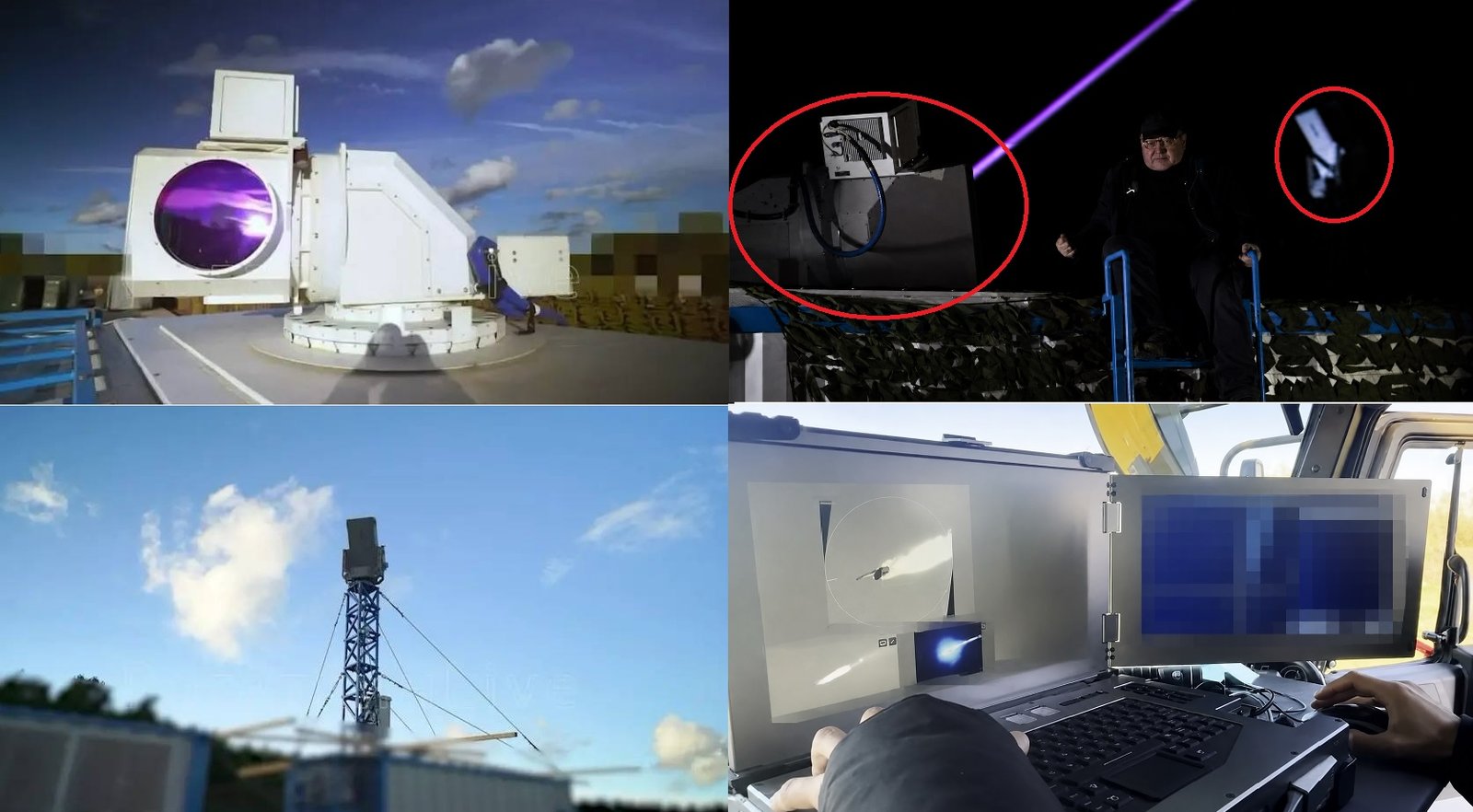
MOSCOW, — Footage circulating this week on Russian pro-military channels appears to show a Russian combat laser system engaging aerial drones. A Russian military blogger described the footage as an “exclusive” and claimed that several systems are deployed to protect strategic facilities in southwestern Russia.
The blogger also claimed that the systems have destroyed several hundred Ukrainian drones. These claims, including the deployment locations and combat record, have not been independently verified. No Russian government or military agency has publicly confirmed them.
Containerized Laser System
Based on descriptions of the footage, the system is mounted on a containerized platform and combines a laser weapon, targeting and guidance equipment, and a command post operated by a single person. It reportedly has its own detection equipment, using radar and optical sensors to detect and track aerial threats.
The blogger said Russian developers are preparing a second-generation system designed to engage faster targets, including tactical aircraft and cruise missiles. This claim has also not been independently confirmed.
The post said the technology should not be overestimated on its own but could be useful when combined with conventional air-defense systems. It also claimed that the systems have demonstrated effectiveness and should continue to be developed.
Russia's Laser Counter-Drone Development
Russia has previously reported large-scale testing of laser systems against UAVs. In June 2025, the government said eight systems, ranging from compact mobile units to high-power stationary platforms, were tested. First Deputy Prime Minister Denis Manturov attended the trials.
According to Russian officials, the tests examined guidance accuracy, engagement range, reaction speed against moving targets and performance in different weather conditions. The systems were developed with involvement from subsidiaries of Rostec and Rosatom. Officials said the results supported further development toward serial production and integration with broader air-defense systems.
Separate Russian industry reports in late 2025 and 2026 described testing of the LazerBuzz system under Project Posokh. The developer reported a 1-kilometer engagement against an FPV drone in 2025, followed by reported tests at 1.5 kilometers against an aircraft-type drone in 2026. These results are based on developer statements and have not been independently verified.
Limitations of Laser Weapons
Directed-energy weapons are being developed by several militaries for counter-drone missions. Their potential advantages include engaging targets without using conventional interceptor ammunition, but operational effectiveness can be affected by rain, fog, dust and smoke. Atmospheric effects can also reduce beam performance over longer distances, while high-power systems require significant power and thermal management for sustained operation.
Russia's Peresvet is another known directed-energy system, although it is primarily associated with disabling or blinding optical sensors rather than physically destroying drones.
The latest footage therefore provides no independent confirmation of the reported number of drones destroyed, the systems' deployment locations, or the planned second-generation capabilities. Those claims remain unverified, while Russia's previous government-announced tests and industry-reported trials confirm continued development of laser-based counter-drone technology.
Source : Defence-Blog
——— End of Article ———