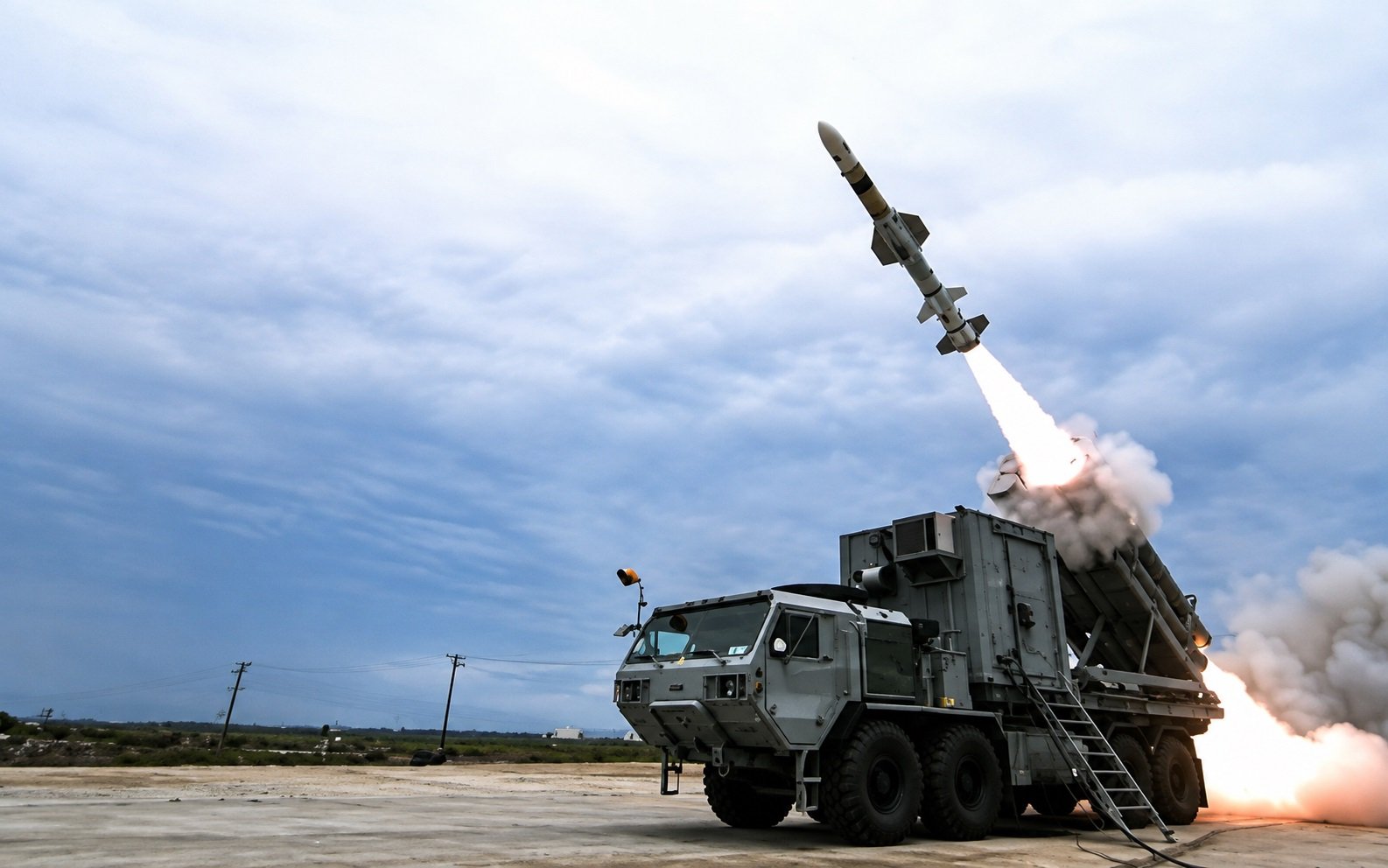
TAIPEI — Taiwan has begun deploying its newly acquired U.S.-made Harpoon Coastal Defense Systems (HCDS), with the first launchers, command vehicles and radar systems arriving on the island. The equipment is being prepared for operational use by units under the Navy’s Littoral Combat Command, which began force generation in July 2026.
Taiwan ordered 100 Harpoon Coastal Defense Systems under a procurement program valued at more than NT$90.2 billion (about US$2.85 billion). The package includes 400 RGM-84L-4 Harpoon Block II anti-ship missiles, 100 transport and launch vehicles, 25 radar vehicles, four training missiles, storage containers, spare parts, maintenance equipment, training equipment and related support.
The program runs from 2021 to 2030, while full delivery of the Harpoon equipment is scheduled for completion by the end of 2028. Reports indicate that 32 systems are expected to be delivered by the end of 2026, with the remainder arriving in subsequent years.
The Taiwanese configuration uses Oshkosh Heavy Expanded Mobility Tactical Trucks (HEMTTs). The eight-wheel-drive vehicles have armored cabs and carry four missile canisters, providing a mobile launcher configuration that differs from older trailer-mounted Harpoon systems supplied to some other countries.
The RGM-84L-4 Harpoon Block II uses GPS-assisted guidance and an active radar seeker. The Harpoon family is designed for over-the-horizon anti-ship operations and uses a sea-skimming flight profile.
The system recently completed an important developmental test in the United States. In July 2026, the U.S. Navy and Boeing conducted Developmental Test 1 at the Point Mugu Sea Range in California, where a land-launched Harpoon successfully engaged a maritime target. The U.S. Navy reported the test on August 28.
Taiwan is also preparing infrastructure for the new coastal missile units, including positions and bases in areas such as Tainan, Kaohsiung and Pingtung, with some facilities expected to be completed in 2027.
The Harpoon systems will operate alongside Taiwan’s domestically produced Hsiung Feng II and Hsiung Feng III anti-ship missiles. Together, they will form part of Taiwan’s broader land-based coastal defense network.
The deployment is continuing in phases, with training and support activities followed by delivery and integration of launch vehicles, radar systems and missiles.
——— End of Article ———