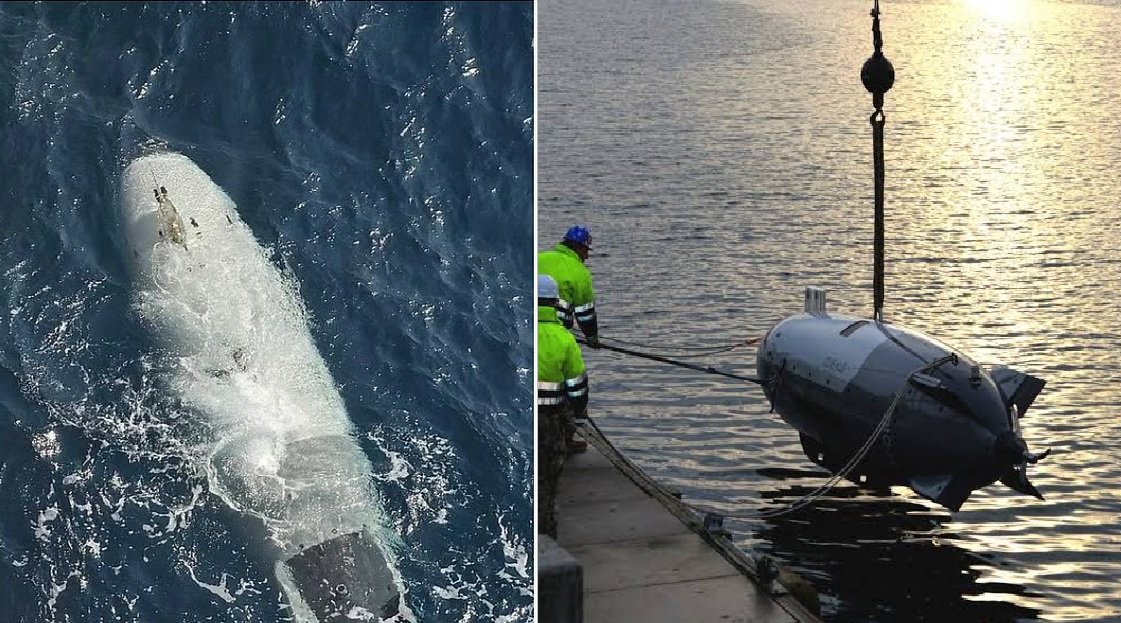
WASHINGTON — The U.S. military has confirmed the loss of an uncrewed underwater vehicle in the Strait of Hormuz area, but said the vehicle had malfunctioned more than a day before Iranian forces recovered it.
Iran’s Islamic Revolutionary Guard Corps (IRGC) Navy announced on September 8 that it had captured a U.S. autonomous underwater vehicle near the entrance to the Strait of Hormuz. Iranian state media described it as one of the most modern and intelligent unmanned submarines operated by the United States and released footage of its recovery.
U.S. Central Command (CENTCOM) said the vehicle was an older model that suffered a mechanical failure while surveying regional waters in support of ongoing operations. Navy Capt. Tim Hawkins, a CENTCOM spokesperson, said it did not collect sensitive data or carry classified sonar or radar equipment. He added that U.S. operations in the area are continuing.
Vehicle Identified as Anduril Dive-LD
Images released by Iranian sources show a vehicle consistent with the Dive-LD, a large autonomous underwater vehicle made by California-based Anduril Industries. Open-source analysis found matching features including the hull shape, flood holes, transparent mast, fastening points, seam lines and X-shaped rudders. Reuters and other defense publications also identified it as a Dive-LD.
Anduril confirmed that one of its Dive-LD vehicles had been lost and described the system as an attritable autonomous system, designed for dangerous operations where loss of the vehicle is an expected possibility. The U.S. Navy received Dive-LD systems in 2025 for units operating unmanned underwater vehicles.
Dive-LD Capabilities
According to Anduril specifications, the Dive-LD is approximately 5.8 meters (19 feet) long, about 1.2 meters (4 feet) in diameter, weighs roughly three tons, and can operate autonomously for up to 10 days. Its maximum advertised operating depth is approximately 6,000 meters.
Its modular design allows different payloads and sensors to be integrated. Listed missions include intelligence, surveillance and reconnaissance, mine warfare, seabed mapping, hydrographic surveying, environmental monitoring, and inspection of underwater infrastructure such as cables and pipelines. The system uses direct-drive electric propulsion and can be launched and recovered from vessels and shore facilities.
Different Accounts From Iran and the U.S.
The IRGC described the recovery as a complex intelligence and operational action and called the vehicle advanced U.S. underwater technology. Iranian officials also said the system had been delivered to the U.S. military in 2025.
The U.S. and Pentagon accounts differ, saying the vehicle had malfunctioned more than a day earlier and was an older model without sensitive data or classified sonar or radar equipment.
The incident provides a public example of U.S. use of large autonomous underwater vehicles around the Strait of Hormuz. Iran says the vehicle is now in its possession, while U.S. officials maintain that the particular vehicle carried no classified equipment and that U.S. operations continue.
——— End of Article ———