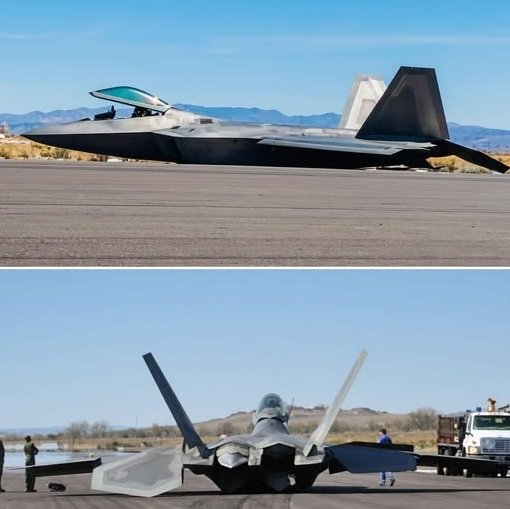
WASHINGTON — U.S. Air Force Capt. Michael “Wax” Cloninger, an F-22 Raptor pilot assigned to the 90th Fighter Squadron, 3rd Operations Group, at Joint Base Elmendorf-Richardson, Alaska, has received the Air Force’s highest flight-safety award after safely landing a fully armed F-22 that had lost its right main wheel assembly.
Air Force Chief of Staff Gen. Ken Wilsbach presented Cloninger with the 2025 Koren Kolligian Jr. Trophy during a ceremony at the Pentagon on Sept. 8, 2026. Cloninger was recognized for the technical discipline and decision-making that saved a $156 million aircraft and prevented serious injury or loss of life.
Right Main Wheel Assembly Detached After Takeoff
The emergency occurred on Sept. 18, 2024, while Cloninger was deployed to the U.S. Central Command area of responsibility. He was flying as the number-two aircraft in a four-ship formation scheduled to conduct a memorial flyover marking the anniversary of the Battle of Britain.
Immediately after takeoff, the F-22’s entire right main wheel assembly detached. Cloninger received no cockpit warning indicating that the wheel had separated.
He and his flight lead canceled the flyover and remained near the airfield to assess the aircraft. Cloninger took responsibility for navigation and communications, slowed below the maximum landing-gear extension speed and lowered the gear. His flight lead then flew alongside the F-22 and confirmed that the complete right main wheel assembly was missing.
Pilot Selects Gear-Up Landing
The F-22’s flight manuals contained no specific procedure for landing after losing a complete wheel assembly. Using crew resource management, Cloninger consulted with his flight lead and chose the landing-with-gear-up procedure rather than attempting an asymmetric landing with the remaining gear extended.
Before landing, Cloninger stayed airborne for about one hour to burn excess fuel, reducing the aircraft’s landing weight and the risk of a post-impact fire. He coordinated preparations with the air traffic control tower, crash-response units and the operations supervisor.
He also conducted a low approach over the runway to assess the aircraft’s handling using the emergency alternate-flap flight-control mode.
F-22 Safely Recovered
For the final landing, Cloninger used a shallow glide path and calculated on-speed descent before touching down on the runway centerline. The F-22 slid to a stop without catching fire.
Cloninger immediately shut down both engines and safely exited the aircraft.
Maintenance personnel later completed diagnostic checks and structural repairs, allowing the F-22 to return to flying condition and be flown out of the theater. The Air Force described the recovery as an unprecedented recovery for an F-22 after a belly landing.
Cloninger Credits His Teammates
During the Pentagon ceremony, Wilsbach praised Cloninger’s discipline, teamwork and decision-making during the emergency.
Cloninger credited the personnel who supported him throughout the incident, particularly those who assisted with communications and checklists.
“Without my teammates assisting with communication and walking through the checklists, I truly believe I wouldn’t be standing here today,” Cloninger said.
About the Koren Kolligian Jr. Trophy
Established in 1957, the Koren Kolligian Jr. Trophy is the Air Force’s premier flight-safety award and the only one personally presented by the Chief of Staff. It recognizes aircrew members whose situational awareness, technical judgment or piloting skill prevents an aircraft accident or significantly limits its consequences.
The award honors 1st Lt. Koren Kolligian Jr., whose Lockheed T-33 Shooting Star disappeared off the California coast on Sept. 14, 1955. He was later declared missing in the line of duty. Kris Kolligian, the nephew of the trophy’s namesake, attended the Pentagon ceremony.
——— End of Article ———