ROLLING MEADOWS, Ill. — Northrop Grumman Systems Corporation has received a $60.4 million U.S. Air Force contract to develop an advanced sensor for the Large Aircraft Infrared Countermeasures (LAIRCM) system, expanding the defensive capabilities of military aircraft against evolving airborne and battlefield threats.
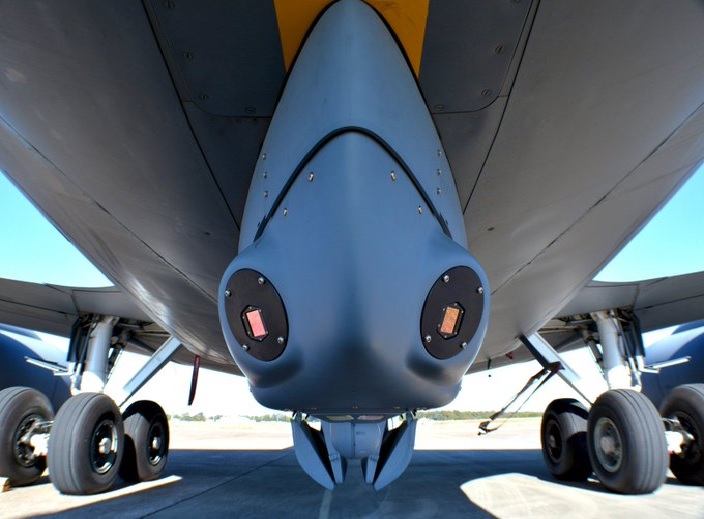
The $60,438,241 cost-plus-fixed-fee task order was awarded by the Air Force Life Cycle Management Center (AFLCMC) at Wright-Patterson Air Force Base, Ohio. Under the contract, Northrop Grumman will develop the Optical Detection and Identification Node (ODIN), an upgraded sensor designed for the AN/AAQ-24(V) LAIRCM system.
The development, integration, and testing work will be carried out at the company's facility in Rolling Meadows, Illinois, with the project scheduled for completion by April 30, 2029.
ODIN to Expand LAIRCM Defensive Capabilities
The AN/AAQ-24(V) LAIRCM is a Directional Infrared Countermeasure (DIRCM) system used on large transport aircraft and rotary-wing platforms. It combines an Infrared Missile Warning System (MWS) with an infrared laser jammer to automatically detect, track, and defeat incoming infrared-guided missiles, improving aircraft survivability in hostile environments.
Under the new contract, Northrop Grumman will upgrade the existing infrared missile warning sensor into the production-ready Optical Detection and Identification Node (ODIN). The upgraded sensor will add three new capabilities to the current system:
- Hostile Fire Indication (HFI): Detects and alerts aircrews to incoming small-arms fire and anti-aircraft artillery.
- Laser Warning (LW): Detects when an aircraft is being illuminated or targeted by laser-guided weapon systems.
- Counter Small Unmanned Aerial Systems (C-SUAS) Detection: Identifies and tracks small unmanned aerial systems, including drone threats.
These additions are intended to improve situational awareness and provide aircrews with earlier warning against a broader range of threats beyond infrared-guided missiles.
Cost-Type Contract Selected for Development Work
The U.S. Air Force awarded the program as a cost-plus-fixed-fee contract because of the engineering complexity involved in integrating the new capabilities into the existing LAIRCM sensor architecture. Government contracting documents stated that uncertainties associated with the development process made it difficult to accurately estimate costs under a fixed-price arrangement.
The award was issued as a sole-source acquisition, reflecting Northrop Grumman's long-standing role as the developer and manufacturer of the LAIRCM system.
At the time of contract award, the U.S. Air Force obligated $11.2 million in Fiscal Year 2026 Research, Development, Test and Evaluation (RDT&E) funding to begin the project.
Long-Service Aircraft Protection System
Northrop Grumman has supported the LAIRCM program for many years. According to the company, its DIRCM systems protect more than 1,500 aircraft across fixed-wing, rotary-wing, and tilt-rotor platforms.
The LAIRCM system is installed on several U.S. military aircraft, including the C-17 Globemaster III, C-130 Hercules, C-5 Galaxy, and various military helicopters. Its modular design allows integration across different aircraft types while providing protection against infrared-guided missile threats. In many configurations, the system uses directed infrared laser energy to defeat incoming missiles without relying on pyrotechnic flares.
The new ODIN sensor development is expected to further strengthen the LAIRCM system by expanding its ability to detect missile launches, hostile gunfire, laser targeting, and small unmanned aerial threats, supporting aircraft survivability in increasingly complex operational environments.
——— End of Article ———