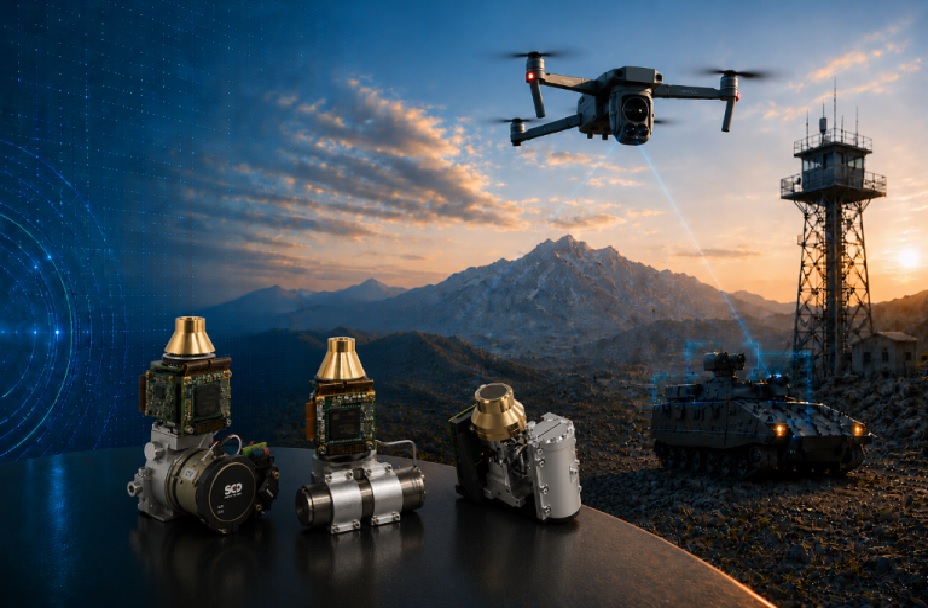
Haifa, Israel — Israeli infrared technology company Semi Conductor Devices (SCD) has secured three multi-million-dollar contracts from international defense customers for the supply of its High Operating Temperature (HOT) High-Definition (HD) Mid-Wave Infrared (MWIR) detectors.
The detectors will be integrated into a range of defense and security systems, including next-generation counter-unmanned aerial systems (C-UAS), long-range surveillance platforms, border protection networks, homeland security systems, armored fighting vehicles (AFVs), and critical infrastructure protection.
The new contracts reflect growing demand for advanced infrared sensing technologies that support continuous operation, long-range target detection, and reliable performance in demanding environments.
HOT MWIR Technology Reduces Cooling Requirements
SCD's fourth-generation HOT MWIR technology enables infrared detectors to operate at higher temperatures while maintaining high thermal sensitivity and image quality. Operating at higher temperatures reduces the cooling requirements of the detector, allowing system designers to develop lighter and more efficient payloads while improving overall reliability and operational availability.
When combined with long-life cooling systems and integrated detector assemblies, the technology provides a longer mean time between failures and lowers maintenance requirements. These advantages are particularly important for platforms that require continuous operation, such as counter-drone systems, armored vehicles, border surveillance networks, and infrastructure protection systems.
The high-definition MWIR detectors also provide improved capability to detect, classify, and track small or distant targets under challenging operating conditions, supporting faster and more accurate situational awareness.
Vertically Integrated Manufacturing Supports Large Programs
SCD manufactures its infrared detectors through a fully integrated production process that includes semiconductor manufacturing, detector fabrication, Dewar packaging, optical integration, cooled detector assembly, and long-life cooling technologies.
According to the company, this manufacturing approach enables it to produce and deliver thousands of cooled MWIR detectors every month, providing the production capacity required for large-scale defense programs while maintaining supply continuity.
SCD, headquartered at Leshem Industrial Park near Misgav in northern Israel, has more than four decades of experience in infrared detector technology and serves defense, homeland security, and industrial customers worldwide. The company also operates a U.S. subsidiary in Colorado Springs.
CEO Highlights Demand for Reliable Production
Kobi Zaushnizer, Chief Executive Officer of SCD, said customers are increasingly evaluating manufacturers not only on technical performance but also on their ability to provide stable, long-term production.
"These orders reflect the growing demand for mature, production-ready HOT MWIR technology. Today's customers are looking beyond detector performance. They need a trusted partner with the proven ability to deliver advanced technology at scale, while maintaining the quality, reliability, and supply continuity required for long-term defense programs."
Zaushnizer added that the new contracts strengthen SCD's position as a technology and manufacturing leader in the global infrared detector market.
Recent Business Activity
The latest contracts follow several recent developments for the company. Earlier this month, SCD signed a separate multi-million-dollar agreement with an Asian government space agency to supply space-qualified short-wave infrared (SWIR) and MWIR detectors for satellite imaging payloads.
In June 2026, the company also expanded its infrared sensing portfolio with new modules designed for guided weapons, autonomous systems, and loitering munitions operating in highly dynamic environments.
The latest orders further expand SCD's role in supplying infrared detector technologies for defense, surveillance, border security, and homeland security applications worldwide.
Source : edrmagazine
——— End of Article ———