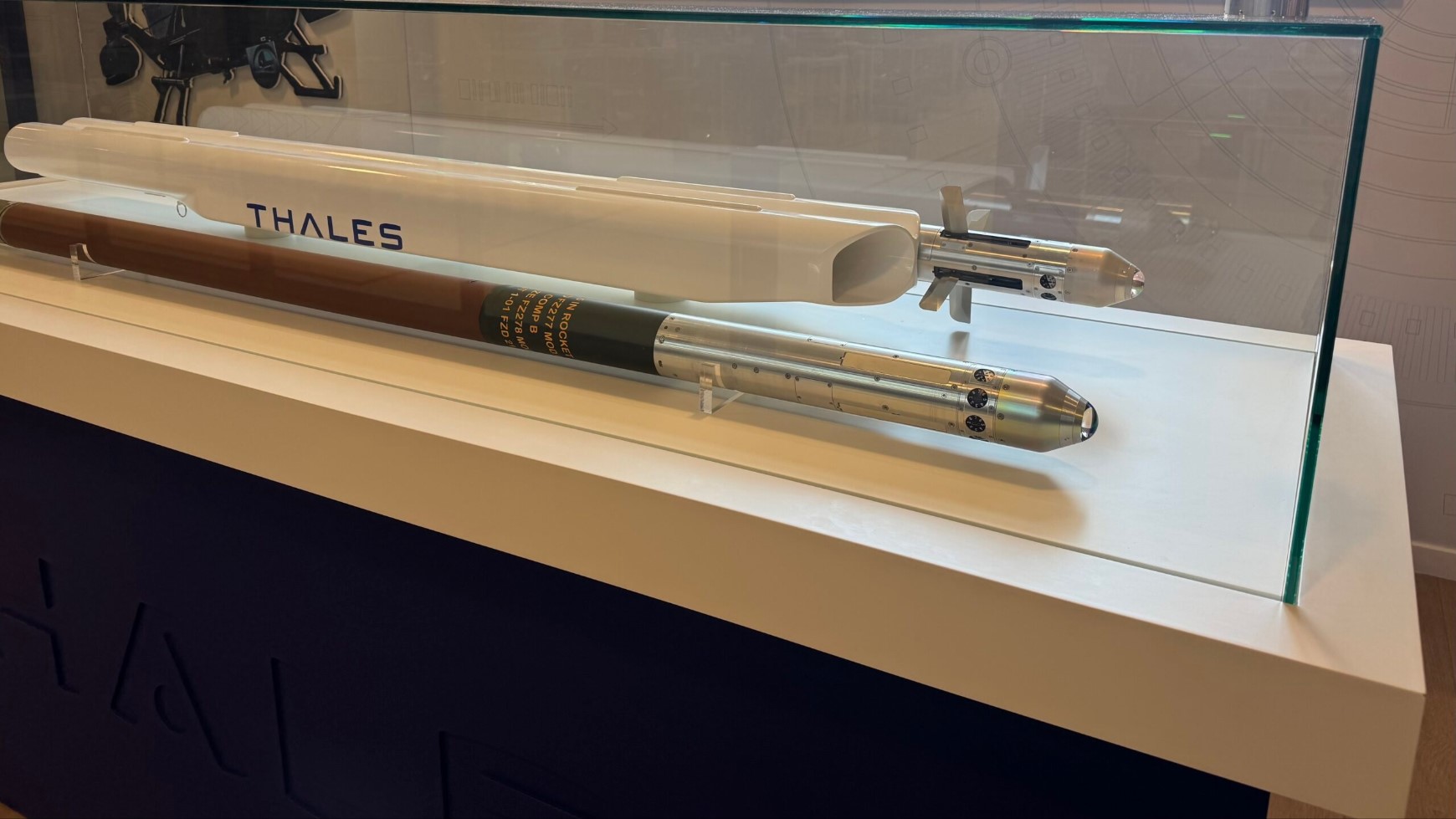
PARIS, — June 15, 2026 : Thales has unveiled the LGR275 Proxy, a new 70 mm laser-guided rocket specifically developed to counter unmanned aerial systems (UAS), marking the latest addition to the company’s expanding air defense portfolio. The system was officially introduced on the opening day of the Eurosatory 2026 defense exhibition and is intended to provide armed forces with a cost-effective solution for engaging increasingly common drone threats.
Addressing the Growing Drone Challenge
The introduction of the LGR275 Proxy comes as militaries worldwide face a rapid increase in the use of Class 1 and Class 2 drones across both conventional and asymmetric conflicts. Recent battlefield experience has demonstrated that low-cost drones can pose significant operational challenges while forcing defenders to rely on expensive missile systems for interception.
According to Thales, the widespread deployment of unmanned systems has exposed limitations in traditional air defense architectures, particularly in terms of cost-effectiveness and sustainability. Using high-value surface-to-air missiles against inexpensive drones can quickly deplete stockpiles and increase operational costs during prolonged engagements.
To address this imbalance, Thales developed the LGR275 Proxy as an affordable precision-guided interceptor that bridges the gap between unguided rockets and more expensive missile systems. The company says the rocket is designed to restore a more favorable economic balance in air defense operations while maintaining high engagement effectiveness against drone targets.
Built on Proven Rocket Technology
The LGR275 Proxy is derived from Thales’ established FZ275 Laser-Guided Rocket (LGR) family, which has already demonstrated precision engagement capabilities at ranges of up to seven kilometers. While retaining the core guidance architecture of the existing system, the new variant incorporates several enhancements specifically tailored for counter-UAS missions.
At the center of the upgrade is a newly integrated LiDAR-based proximity sensor, which enables the rocket to detonate near a target rather than requiring a direct impact. This capability significantly improves effectiveness against small, agile, and fast-moving drones that can be difficult to hit directly.
The rocket is also equipped with a military-grade warhead optimized for aerial targets. Upon activation, the warhead generates a fragmentation effect designed to neutralize or destroy unmanned aircraft in flight, increasing the probability of a successful intercept.
Key Technical Features
The LGR275 Proxy combines several technologies intended to enhance counter-drone performance:
- Guidance System: Semi-active laser (SAL) guidance compatible with standard laser designators.
- Proximity Sensor: LiDAR-based proximity fuze optimized for engaging unmanned aerial targets.
- Warhead: Fragmentation warhead specifically designed for aerial threats.
- Engagement Method: Proximity detonation to improve effectiveness against maneuvering drones.
- Operational Role: Designed for counter-UAS missions in both air-to-air and surface-to-air engagements.
These features allow the system to provide precision engagement capability while maintaining lower interception costs compared to traditional missile-based solutions.
Flexible Platform Integration
One of the key advantages of the LGR275 Proxy is its compatibility with a wide range of existing launch platforms. The rocket can be employed from helicopters, fixed-wing aircraft, ground vehicles, and fixed launcher systems, providing operators with flexibility across different operational environments.
Because the system remains compatible with existing 70 mm rocket infrastructure already in service with armed forces in more than 50 countries, integration requirements are expected to be relatively limited. This compatibility enables users to enhance counter-drone capabilities without investing in entirely new launcher networks or support systems.
Part of the SkyDefender Air Defense Architecture
Thales has positioned the LGR275 Proxy within its broader SkyDefender layered air defense approach. The company describes the rocket as an intermediate solution that complements both gun-based defenses and higher-end missile interceptors.
The system is designed to work alongside SkyDefender’s integrated command-and-control architecture, which combines sensors, effectors, and decision-support tools to counter a variety of aerial threats. By providing a lower-cost precision engagement option, the LGR275 Proxy strengthens the overall effectiveness of layered air defense networks against drone attacks.
Production Expansion Planned
To support anticipated demand, Thales Belgium announced plans to significantly expand production of its 70 mm rocket systems. The company intends to triple manufacturing output between 2026 and 2028, reflecting growing international interest in counter-drone capabilities and precision-guided munitions.
Production expansion efforts are being carried out at Thales’ facility in Herstal, Belgium, where manufacturing capacity is being increased to ensure reliable deliveries to customers. The company said the investment is intended to meet operational requirements observed in recent conflicts, where ammunition availability and industrial resilience have become increasingly important.
Thales Highlights Defense Readiness Benefits
Commenting on the launch, Alain Quevrin, Country Director for Thales Belgium and Luxembourg, emphasized the importance of providing armed forces with practical and sustainable solutions for emerging drone threats.
“Building on our already proven laser-guided rocket solutions, Thales provides a solution to strengthen nations’ defence readiness against drone threats, one of the key challenges of our times. Thales Belgium is the leader in NATO standard rockets and our solid production ramp-up allows us to meet the needs of the armed forces,” Quevrin said.
Expanding Counter-UAS Capabilities
The launch of the LGR275 Proxy reflects Thales’ continuing efforts to expand its counter-UAS portfolio as drone technology becomes more widespread and accessible. The company views the system as a practical response to evolving battlefield requirements, offering a balance of precision, affordability, and operational flexibility.
By combining proven laser-guided rocket technology with a dedicated proximity sensor and drone-optimized warhead, the LGR275 Proxy provides armed forces with an additional option for defending airspace, critical infrastructure, and military formations against rapidly evolving unmanned threats.
Further information regarding operational deployment, platform integration, and customer availability is expected to be released by Thales in the coming months.
——— End of Article ———