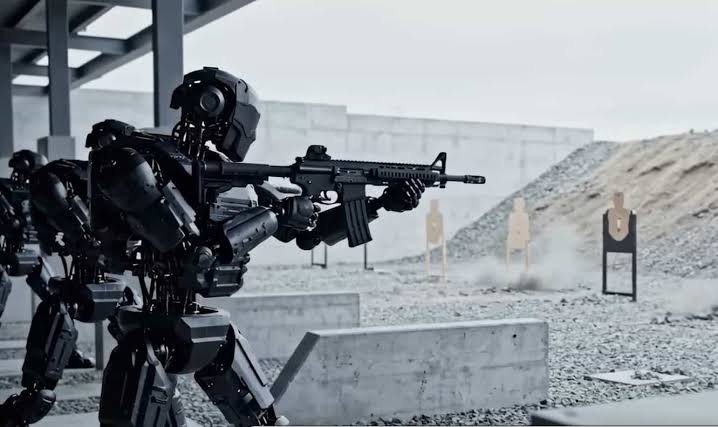
SAN FRANCISCO — U.S.-based robotics startup Foundation Future Industries has tested its humanoid robots in Ukraine for logistics and reconnaissance missions, marking an early step in evaluating the technology for potential military support roles while continuing development for industrial applications.
Founded in 2024, the San Francisco company, also known as Foundation Robotics, developed the Phantom humanoid robot, which stands about 5 feet 9 inches tall, weighs approximately 180 pounds, and can carry a 44-pound payload. The company has secured approximately $24 million in research contracts from the U.S. Army, Navy, and Air Force to study the use of humanoid robots for inspection, logistics, and weapons handling.
Earlier this year, Foundation deployed two unarmed Phantom MK-1 robots to Ukraine for logistics and scouting tasks. According to the company, this was the first known use of humanoid robots in an active combat zone. The robots were used for supply pickup operations and movement through hazardous areas, helping perform tasks that normally expose soldiers to risk.
Foundation plans to send an upgraded Phantom 2 later this year. The company says the new model is expected to offer roughly double the payload capacity along with improved water and dust resistance.
Focus on Military Support
CEO and co-founder Sankaet Pathak said the company's current focus is on logistics and reconnaissance, not combat operations. He said humanoid robots could reduce risks to military personnel by operating in dangerous areas before soldiers.
Pathak also said Foundation would build armed versions of the Phantom if requested by the U.S. military. The company said any use of force is intended to remain under human control in most situations, although Pathak noted that fully autonomous decisions could be required in some time-sensitive scenarios. Foundation is also exploring "kinetic" systems, referring to weapons-related capabilities, and may present related developments in the coming months.
The U.S. military has not publicly deployed humanoid robots in combat roles, and Pentagon policy continues to emphasize human judgment in decisions involving the use of force. Foundation's military agreements remain at the research and testing stage.
Dual-Use Platform and Expansion Plans
Foundation says the Phantom is designed as a dual-use platform for both military and commercial applications. The robots have also been tested in logistics and manufacturing environments.
The company says the humanoid design enables the robot to work with existing tools, equipment, buildings, and stairways without requiring changes to current infrastructure.
Foundation has partnered with AMD on processors for future models and plans to lease its robots rather than sell them outright.
The company plans to build around 40 robots in the near term, increase production to 10,000 units the following year, and reach tens of thousands of robots by the end of 2027, with reports citing targets between 40,000 and 50,000 units.
Government Contracts and Future Plans
Eric Trump, son of the U.S. president, is an investor and the company's chief strategy adviser. Foundation and Trump's representatives have said he has no role in day-to-day management or decisions involving government contracts.
Foundation says its work supports U.S. manufacturing and competitiveness with China in the robotics sector.
The company expects lessons from the Ukraine deployment to support future work with the U.S. military and aims to begin broader deployment discussions within the next 12 to 18 months. It has also reported discussions with the Department of Homeland Security on possible non-combat applications, including border-related tasks.
Debate Over Autonomous Weapons
The development of humanoid military robots continues to draw debate among governments, human rights organizations, and technology experts.
The United Nations Secretary-General has called for international rules to restrict or ban lethal autonomous weapons systems, while the Catholic Church has also expressed opposition to autonomous weapons.
Critics warn that greater autonomy in military systems could increase the risk of targeting errors, reduced accountability, and faster conflict escalation. Supporters, including Pathak, argue that robots could improve operational precision and reduce risks to both soldiers and civilians by performing the most dangerous tasks.
Experts also note ongoing technical challenges, including reliable navigation, object manipulation, and performance in damaged or complex terrain, while questioning whether humanoid robots will ultimately prove more practical than other robotic systems already in service.
As of August 2026, the Phantom remains unarmed in all reported field deployments. Foundation continues developing the platform for industrial and defense applications as debate over the future role of humanoid robots in military operations continues.
——— End of Article ———