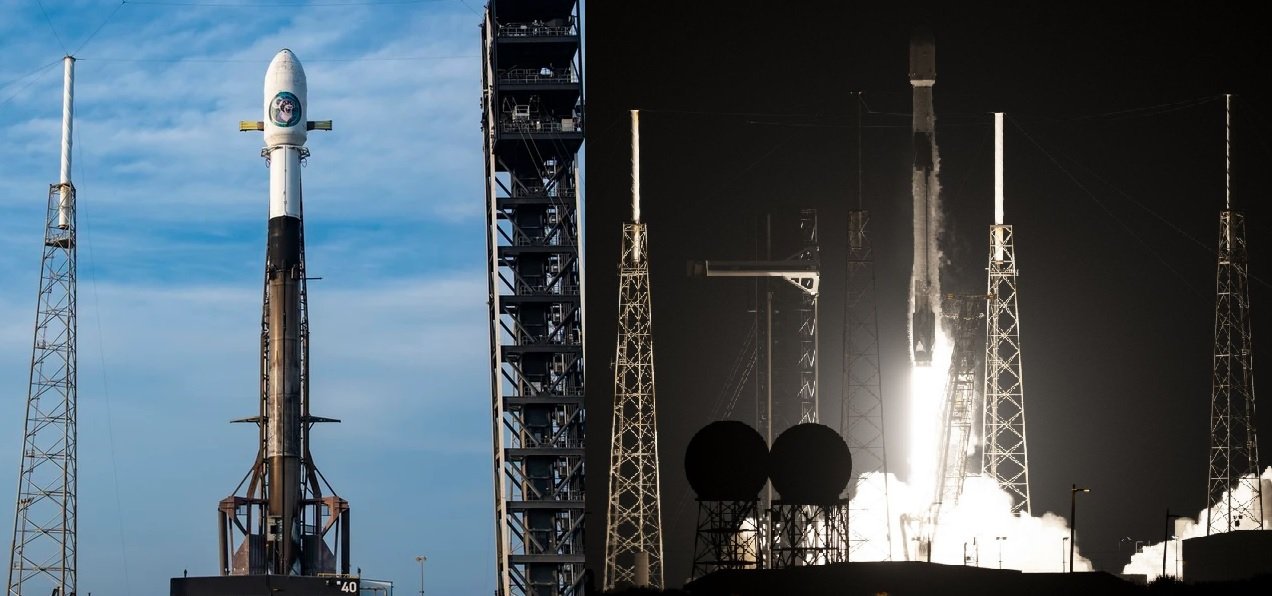
CAPE CANAVERAL, Fla. — SpaceX successfully launched the classified NROL-95 mission for the U.S. National Reconnaissance Office (NRO) early Thursday, marking the agency's fourth national security space launch of 2026 and continuing the deployment of its next-generation intelligence satellite constellation.
The mission lifted off aboard a Falcon 9 rocket from Space Launch Complex 40 at Cape Canaveral Space Force Station in Florida at 3:10 a.m. EDT on July 30, 2026. The launch was carried out in partnership with the U.S. Space Force Space Systems Command's System Delta 80 and Space Launch Delta 45.
Successful Booster Recovery
Following stage separation, the Falcon 9's first-stage booster successfully returned to Earth, landing at Landing Zone 2 at Cape Canaveral Space Force Station.
The booster, designated B1096, completed its seventh flight and flew after a 75-day turnaround. It had previously supported the KF-01 satellite, the Interstellar Mapping and Acceleration Probe (IMAP) solar wind mission, the classified NROL-77 mission, the GPS III-9 navigation satellite launch, the CRS-34 cargo resupply mission to the International Space Station (ISS), and one Starlink mission.
The recovery and reuse of Falcon 9 first-stage boosters is part of SpaceX's standard launch operations, helping lower the cost of reaching orbit compared with traditional expendable launch vehicles.
Fourth National Security Launch of 2026
The NROL-95 mission is the National Reconnaissance Office's fourth national security space launch this year.
Earlier NRO missions in 2026 included:
- NROL-105 — January 16
- NROL-172 — May 11
- NROL-179 — June 19
All three previous missions were launched aboard Falcon 9 rockets from Vandenberg Space Force Base in California.
According to the NRO, the increased launch cadence is part of its long-term proliferated architecture initiative.
Shift to a Distributed Satellite Network
Historically, U.S. reconnaissance relied on a relatively small number of large, highly expensive satellites. The NRO's proliferated architecture represents a shift toward deploying hundreds of smaller, lower-cost satellites across multiple orbital planes.
According to the agency, this approach is designed to:
- Reduce single points of failure.
- Maintain intelligence coverage if individual satellites are lost.
- Increase revisit rates over locations on Earth.
- Speed the delivery of intelligence data to military and government users.
The NRO began deploying this architecture with the NROL-146 mission on May 22, 2024. By April 2025, the constellation had grown to more than 150 satellites.
NRO officials have stated that the network supports missions including ground moving target indication (GMTI), which tracks vehicles and other moving objects from orbit, while also contributing to a broader space-based sensing and targeting architecture for the U.S. intelligence community and the Department of Defense.
Role of the National Reconnaissance Office
The National Reconnaissance Office develops, launches, and operates U.S. intelligence and reconnaissance satellites that provide imagery and signals intelligence to military commanders, the intelligence community, and civilian government agencies.
The NROL-95 mission is also the third NRO launch conducted by SpaceX under the National Security Space Launch (NSSL) Phase 2 contract. Officials from the NRO and Space Systems Command said the partnership supports reliable access to space for national security payloads.
Mission Details Remain Classified
Consistent with standard NRO practice, officials have not disclosed the number of satellites carried by NROL-95, their capabilities, or their final orbital parameters.
While the payload remains classified, publicly released information confirms the mission's successful launch, booster recovery, and its role in expanding the NRO's next-generation distributed reconnaissance satellite network.
——— End of Article ———