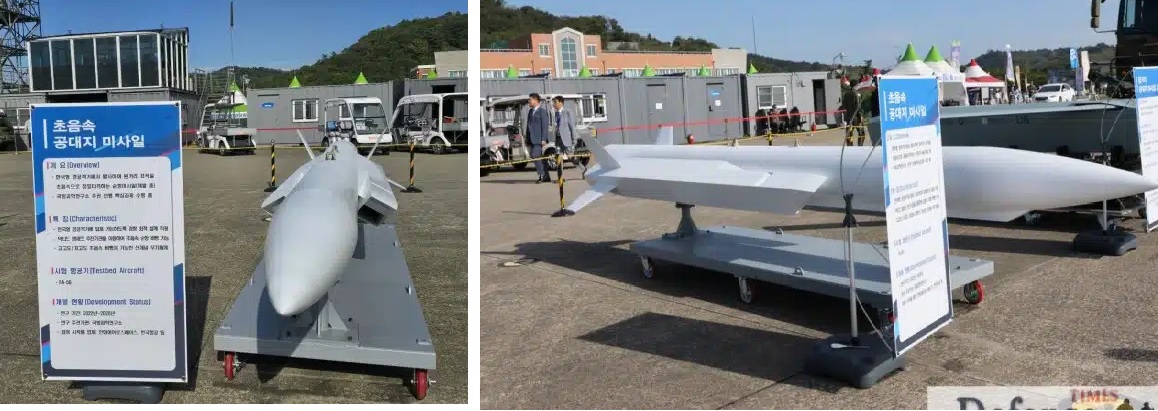
South Korea recently unveiled its newest military asset, a supersonic anti-ship missile known as the “Air-to-Ship Guided Missile-II,” which promises to elevate the strike capabilities of the Republic of Korea Air Force. First displayed at the 2024 Sacheon Airshow, this advanced missile is the result of ongoing research and development by South Korea’s Agency for Defense Development (ADD). Designed to operate in both high- and low-altitude environments, the missile stands out as a formidable new addition to South Korea's arsenal, boosting both air-to-ship and air-to-ground attack capacities.
The missile, which is part of the ADD’s 2022-2026 development program, is a 400mm-class air-to-ship weapon tailored for South Korea’s new KF-X fighter aircraft, officially known as the KF-21 Boramae. Its introduction underscores South Korea’s ambitions to develop indigenous defense technologies that can operate in varied mission profiles. Equipped with a dual seeker system combining radar and electro-optical (EO/IR) capabilities, the missile is prepared to navigate through challenging weather conditions and execute high-precision strikes with minimal delay.
High Speed, Long Range
One of the standout features of this missile is its supersonic speed. Traveling at approximately Mach 2.5, or around 3,000 km/h, it covers significant distances in just minutes. This speed is critical, as it limits an enemy’s reaction time. Compared to slower, subsonic missiles that travel around 1,000 km/h, this missile’s supersonic speed makes interception extremely challenging. Capable of hitting targets at a range exceeding 300 km, the missile can quickly close in on targets, providing a unique advantage over many current anti-ship weapons.
Ramjet Technology: Key to Supersonic Capability
The missile’s high speed is made possible by its ducted ramjet propulsion system. This propulsion technology, which is shared by other advanced missile systems such as France’s ASMPA, allows the missile to maintain supersonic speed while using ambient atmospheric air as the oxidizer. By drawing in atmospheric oxygen rather than carrying an onboard oxidizer, the missile can achieve extended combustion times, allowing it to reach higher speeds over long distances. This streamlined design not only reduces weight but also enables a simpler structure that supports stable, high-maneuverability flight at both high and low altitudes.
Modular, Multirole Design
A notable feature of the missile is its modular design, which makes it adaptable for various mission profiles. With this modular system, it can be configured for either anti-ship or air-to-ground missions, providing flexibility in combat scenarios. South Korea’s FA-50 light combat aircraft, which is already popular with international buyers, and the KF-21 Boramae fighter will be outfitted to carry this new weapon. This dual compatibility could increase the missile’s export potential, as countries interested in either aircraft can gain enhanced strike capabilities.
Stealth and Precision with Dual Seeker System
To improve targeting accuracy, the missile incorporates a dual seeker system with radar and EO/IR sensors. This combination ensures reliable target detection even in adverse weather conditions, enhancing the missile’s effectiveness. The dual seeker system also increases its flexibility in different mission scenarios, whether it needs to strike moving naval targets or ground-based assets.
Development and Testing Timeline
ADD’s development plan includes prototype testing on the FA-50, with Korea Aerospace Industries (KAI) assisting in system integration. By 2025, ADD intends to begin flight tests, with three flights planned before mass production. Hanwha Aerospace and other domestic defense companies are participating in prototype manufacturing, ensuring that this is a homegrown weapon. The Defense Acquisition Program Administration (DAPA) expects full-scale production to occur from 2026 to 2035, with a substantial investment of approximately 564.1 billion KRW dedicated to this project.
Potential Impact on South Korea’s Defense Exports
The success of this missile, coupled with its integration into the FA-50 and KF-21, could open up export opportunities. South Korea’s FA-50 is already in service with the Polish Air Force, and the Philippines has shown interest in the KF-21. A supersonic anti-ship missile of this caliber could increase the attractiveness of these aircraft to potential buyers, offering them a robust and versatile strike capability.
In sum, South Korea’s Air-to-Ship Guided Missile-II is set to redefine the nation's air and maritime defense capabilities. By marrying speed, flexibility, and high precision, it serves as a modern solution to emerging regional threats and positions South Korea as a significant player in the supersonic missile space. As it progresses through testing and development, this missile may well become a mainstay not only in the Republic of Korea Air Force’s arsenal but also in allied forces around the globe.
——— End of Article ———