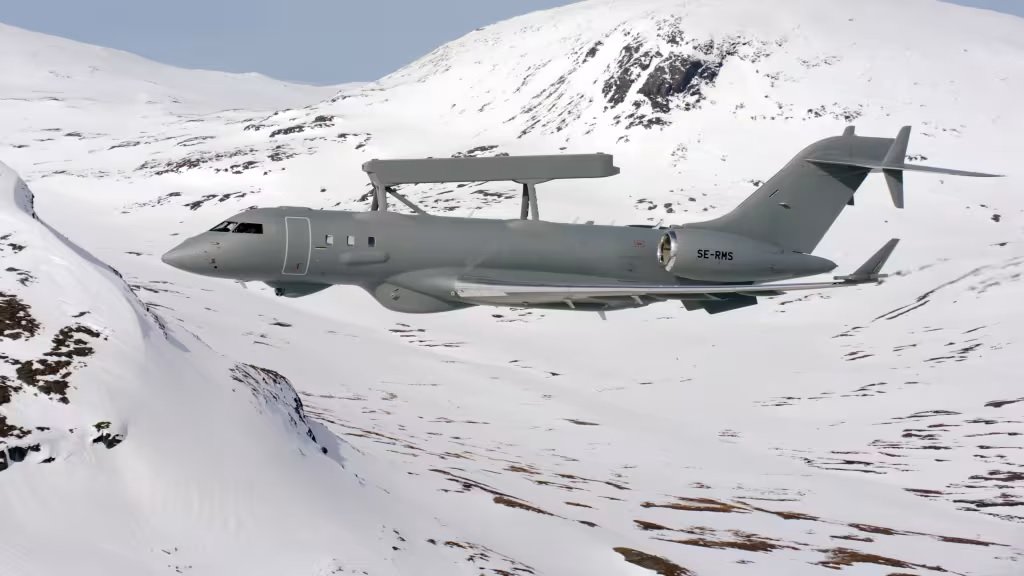
STOCKHOLM — Swedish defence company Saab plans to increase annual production of its GlobalEye airborne surveillance aircraft from about two aircraft per year to six by around 2030, following recent selections of the platform by NATO and Canada that have significantly expanded the programme's international order outlook.
Saab President and Chief Executive Officer Micael Johansson announced the higher production target during the company's second-quarter 2026 earnings call. The new goal represents an increase from Saab's earlier plan to produce four GlobalEye aircraft annually.
Johansson said the company is preparing additional manufacturing capacity to maintain delivery schedules as expected orders extend well into the next decade.
“I would rather say that we go from two a year now and should aim for six a year in the 2030 timeframe,” Johansson said.
He added that Saab prefers to build capacity for a higher production rate because output can be reduced later if demand is lower than expected.
NATO and Canada Drive Growing Demand
The planned production expansion is largely supported by recent international decisions to acquire the GlobalEye airborne early warning and surveillance system.
Earlier in 2026, Canada selected GlobalEye as its preferred solution and is currently negotiating with Saab for the purchase of six aircraft.
NATO has also selected GlobalEye to replace the alliance's ageing E-3A Airborne Warning and Control System (AWACS) fleet based at Geilenkirchen, Germany. The requirement covers up to 10 aircraft, which will operate as a shared NATO capability.
According to Saab, the NATO programme is backed by 11 member countries: Belgium, Canada, Denmark, Germany, Latvia, Lithuania, Luxembourg, the Netherlands, Norway, Romania and Sweden. Formal negotiations with the NATO Support and Procurement Agency (NSPA) are currently under way.
Johansson described the NATO selection as a major industrial milestone that demonstrates the strategic value of Sweden and Saab providing advanced airborne surveillance capabilities to the alliance.
Additional Orders Strengthen Production Outlook
Beyond the expected NATO and Canadian contracts, Saab said it continues to pursue several additional GlobalEye opportunities, although Johansson did not identify potential customers.
In late July 2026, the company received an order worth SEK 10.1 billion (approximately $1 billion) for two GlobalEye aircraft from an undisclosed Middle Eastern customer, with deliveries scheduled for 2030.
GlobalEye aircraft are already operational with the United Arab Emirates. France has also ordered two aircraft.
Saab said maintaining an active production line enables the company to offer comparatively short delivery times, helping address airborne surveillance capability requirements among prospective customers.
Saab Expanding Manufacturing Capacity
To support the planned increase in production, Saab is expanding its facilities in Linköping, Sweden, where Bombardier Global 6500 business jets are converted into mission-configured GlobalEye aircraft.
The company also plans to establish a production and support hub in Canada while evaluating an additional European site to support NATO and other regional customers.
Johansson said the required infrastructure expansion will not involve exceptionally large investments, as part of the additional production capacity will be developed through industrial partnerships with customer nations.
GlobalEye Programme Supports Saab's Business Growth
GlobalEye remains a key programme within Saab's Surveillance business.
The company reported strong second-quarter 2026 financial results, including order bookings of SEK 68.39 billion and organic sales growth of nearly 30%. Johansson also confirmed that profit margins on major platforms such as GlobalEye remain strong.
GlobalEye Surveillance Capabilities
GlobalEye is designed to monitor air, maritime and land activities simultaneously while serving as a networked command-and-surveillance platform.
Its primary radar sensor has a detection range exceeding 650 kilometres, allowing the aircraft to operate at stand-off distances from hostile areas. The aircraft also carries passive sensors capable of detecting systems observing the platform.
Information collected from multiple sensors is fused and processed using artificial intelligence to provide operators with a single operational picture. The data can then be shared in real time with combat aircraft, naval vessels, ground command centres and land forces to support operational decision-making.
Johansson described GlobalEye as a networked command-and-surveillance node rather than a stand-alone intelligence platform.
Saab Advances Unmanned Airborne Surveillance System
Alongside the manned GlobalEye programme, Saab is continuing flight testing of an unmanned airborne early warning system developed with General Atomics.
The sensor package, known as LoyalEye, is being integrated with the MQ-9B unmanned aircraft and is intended to complement, rather than replace, the GlobalEye platform by providing a lower-tier airborne surveillance capability.
According to Johansson, the system has completed its first flight and is already being offered to prospective customers while flight testing continues. Saab said it is prepared to begin commercial discussions with interested buyers as development progresses.
——— End of Article ———