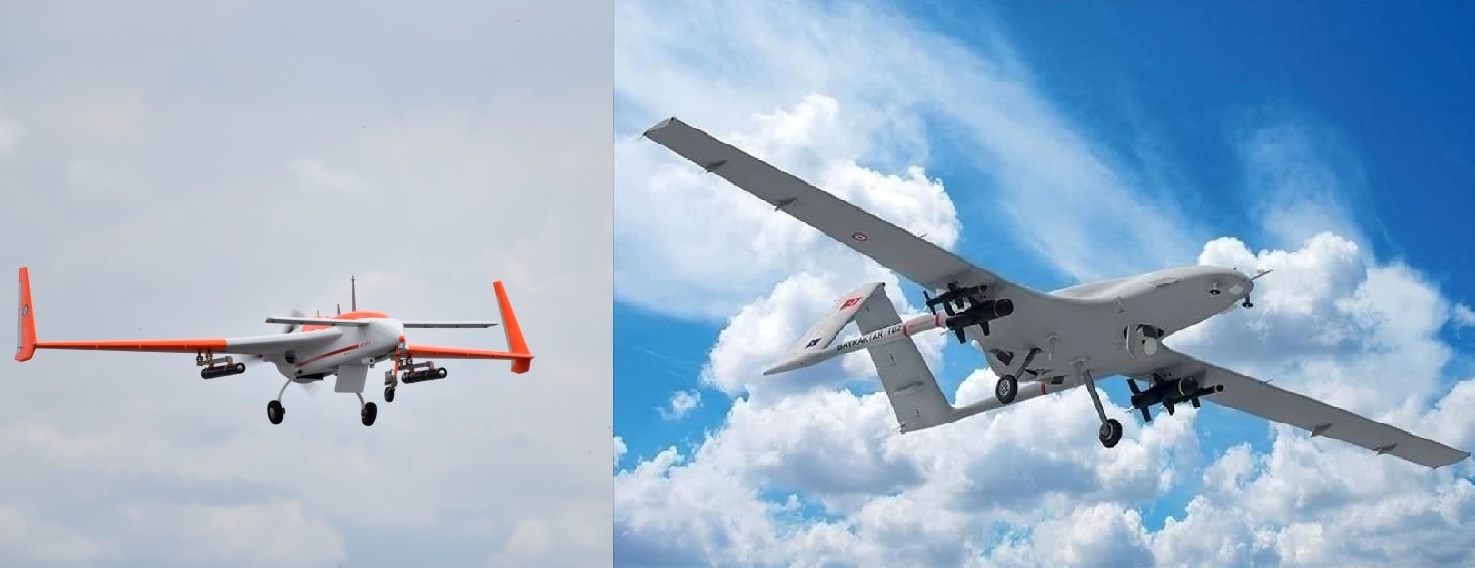
The evolution of unmanned aerial vehicles (UAVs) has significantly transformed modern warfare, offering enhanced surveillance and precision strike capabilities. Two notable UAVs in this domain are India's SRUAV-Weaponised Rustom-1 and Turkey's Bayraktar TB2. This article provides a detailed comparison of their specifications, capabilities, and cost.
Design and Dimensions
-
Rustom-1: Developed by India's Defence Research and Development Organisation (DRDO), the Rustom-1 is a Short Range Remotely Piloted Aircraft System (SR-RPAS) with an all-composite structure. It has a wingspan of 7.9 meters, a length of 5.12 meters, and a height of 2.4 meters. The empty weight is approximately 720 kg, with a maximum takeoff weight (MTOW) around 800 kg
-
Bayraktar TB2: Produced by Turkey's Baykar company, the Bayraktar TB2 features a wingspan of 12 meters, a length of 6.5 meters, and a height of 2.2 meters. It has an empty weight of 500 kg and an MTOW of 650 kg
Performance
-
Rustom-1: The Rustom-1 can reach a maximum speed of 225 km/h, with an operational range of 200 km. It operates at altitudes up to 20,000 feet and has demonstrated an endurance of 10 hours.
-
Bayraktar TB2: The TB2 has a maximum speed between 70 to 120 knots (approximately 130 to 220 km/h) and a communication range exceeding 150 km. It boasts a service ceiling of 22,000 feet and an endurance exceeding 20 hours.
Payload and Armament
-
Rustom-1: The SRUAV-Weaponised variant is expected to carry a payload of 95 kg, potentially including four Anti-Tank Guided Missiles (ATGMs), possibly the NAG-MK2. This armament would enable it to engage armored targets effectively.
-
Bayraktar TB2: The TB2 has a payload capacity of 150 kg and is equipped with four hardpoints capable of carrying laser-guided smart munitions, such as the MAM-L and MAM-C missiles, suitable for precision strikes against various targets.
Operational Capabilities
-
Rustom-1: Initially designed for Intelligence, Surveillance, and Reconnaissance (ISR) missions, the weaponized Rustom-1 expands its role to include offensive operations, enhancing its versatility on the battlefield.
-
Bayraktar TB2: The TB2 is a combat-proven platform with autonomous takeoff and landing capabilities, utilized in various operational theaters for both ISR and strike missions. Its extended endurance and higher service ceiling provide a tactical advantage in sustained operations.
Cost Considerations
-
Rustom-1: As an indigenous platform, the Rustom-1's development and production costs are not publicly disclosed. However, domestic production is expected to reduce procurement and maintenance expenses compared to imported systems.
-
Bayraktar TB2: The unit cost of the TB2 varies based on configuration and quantity. Open sources indicate prices ranging from $1 million to $5 million per unit. For instance, Romania's planned acquisition of 18 TB2 drones for $300 million suggests a unit cost of approximately $16.7 million, potentially including additional equipment and support services.
Conclusion
Both the SRUAV-Weaponised Rustom-1 and the Bayraktar TB2 offer distinct advantages tailored to their respective operational requirements. The Rustom-1's development reflects India's commitment to self-reliance in defense technology, providing a cost-effective solution with capabilities suited to regional needs. In contrast, the Bayraktar TB2's combat experience and extended endurance make it a formidable asset in various conflict scenarios. Decision-makers should consider mission-specific requirements, budget constraints, and strategic objectives when selecting between these UAV platforms.
——— End of Article ———