MURMANSK, Russia — Russian scientists have identified a previously unknown rare-earth mineral, named Kola ashcroftine, at the Kirovsky mine in the Khibiny massif on the Kola Peninsula in the Murmansk region, according to the Russian Ministry of Science and Higher Education.
The discovery was made by researchers from the Kola Science Center of the Russian Academy of Sciences, St. Petersburg State University, and the A.E. Fersman Mineralogical Museum. After comparing the specimen with existing mineral databases and finding no match, the research team confirmed that it represented a new mineral species.
New Mineral Contains Rare-Earth Element Yttrium
Kola ashcroftine contains the rare-earth element yttrium along with silicon, potassium, sodium, calcium, manganese, fluorine, and carbonate groups. According to the ministry, the presence of calcium, manganese, and fluorine distinguishes the mineral from related species, while its crystal structure ranks among the most complex known to science.
The Khibiny massif, where the mineral was found, is one of Russia's best-known geological regions and is recognized for its rich deposits of rare minerals and rare-earth elements.
Crystal Structure Among the Most Complex Known
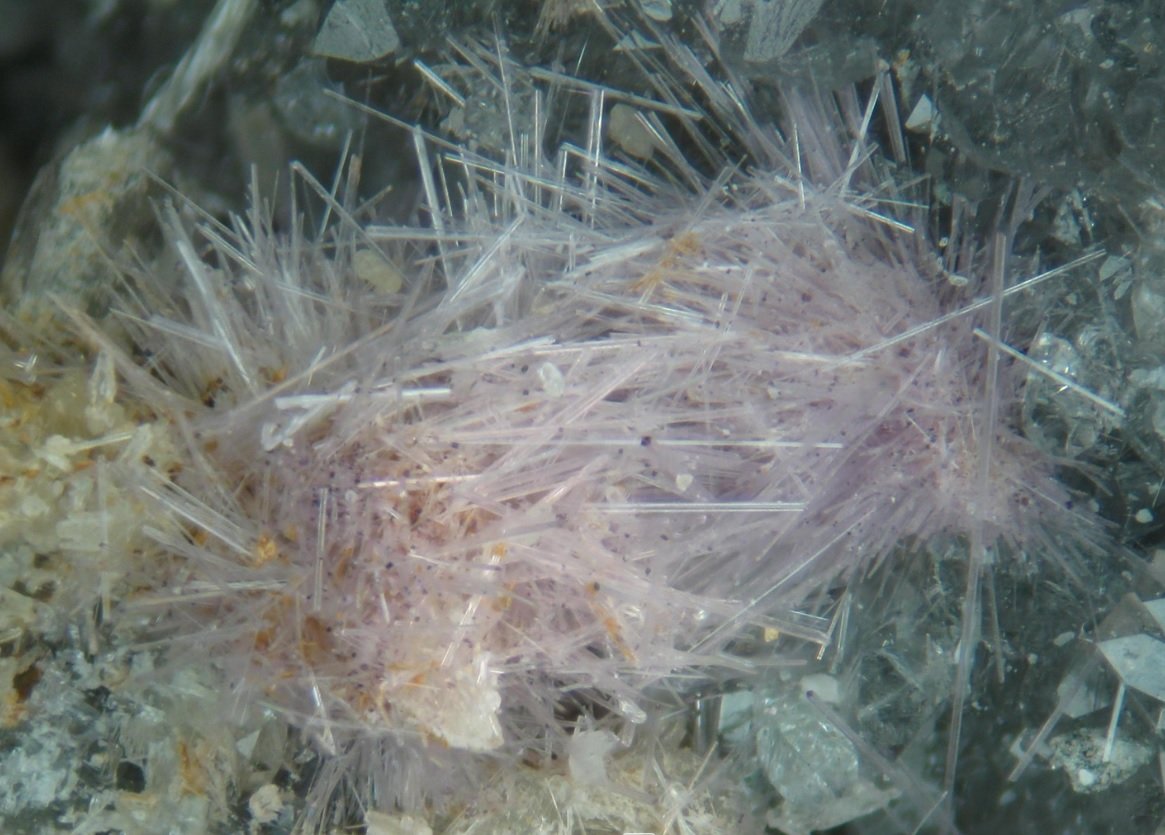
In appearance, Kola ashcroftine resembles ashcroftine-(Y), a rare pink, transparent and brittle silicate mineral previously reported from Greenland, Canada and Italy. However, the newly discovered mineral forms extremely thin, microscopic needle-like crystals.
A scientific study published in the journal Minerals in May 2026 described the mineral under the designation KA (Kola ashcroftine). Researchers determined its idealized chemical formula as:
K₆(Na₄Ca)(Y₈Ca₃Mn)Si₂₈O₆₈(OH)₂₈F₂·9H₂O
Single-crystal X-ray diffraction analysis showed that the mineral has a tetragonal crystal structure built from silicate nanotubules measuring approximately 2 nanometers in diameter. Researchers said this unique internal architecture places Kola ashcroftine among a small group of very complex minerals. According to the Russian Ministry of Science and Higher Education, it ranks within the top 3.5% of the most structurally complex minerals currently known to science.
Scientists also noted that the mineral is related to ashcroftine-(Y), although exact equivalence remains under discussion because historical structural data for the original ashcroftine material is limited.
Estimated Value Exceeds Gold by Volume
Due to its rarity and unique composition, Kola ashcroftine has been assigned a high estimated value.
According to the Russian Ministry of Science and Higher Education, a thin coating of the mineral on host rock is valued at approximately $145 (about 12,470 rubles) per millimeter, making it more valuable than gold by volume. The estimate specifically refers to the mineral coating on rock rather than the bulk mineral itself.
Further Research Planned
Researchers said they will continue studying Kola ashcroftine to better understand its physical and chemical properties and to evaluate its potential practical and industrial applications.
The discovery adds another mineral species to the Kola Peninsula's long history of mineralogical discoveries and further highlights the scientific importance of the Khibiny massif as a source of rare minerals and rare-earth elements.
The announcement comes shortly after Rosgeology reported the discovery of Russia's largest ore gold deposit near the Fedorovskoye-Kedrovskoye area on the border of the Khakassia and Kuzbass regions.
——— End of Article ———