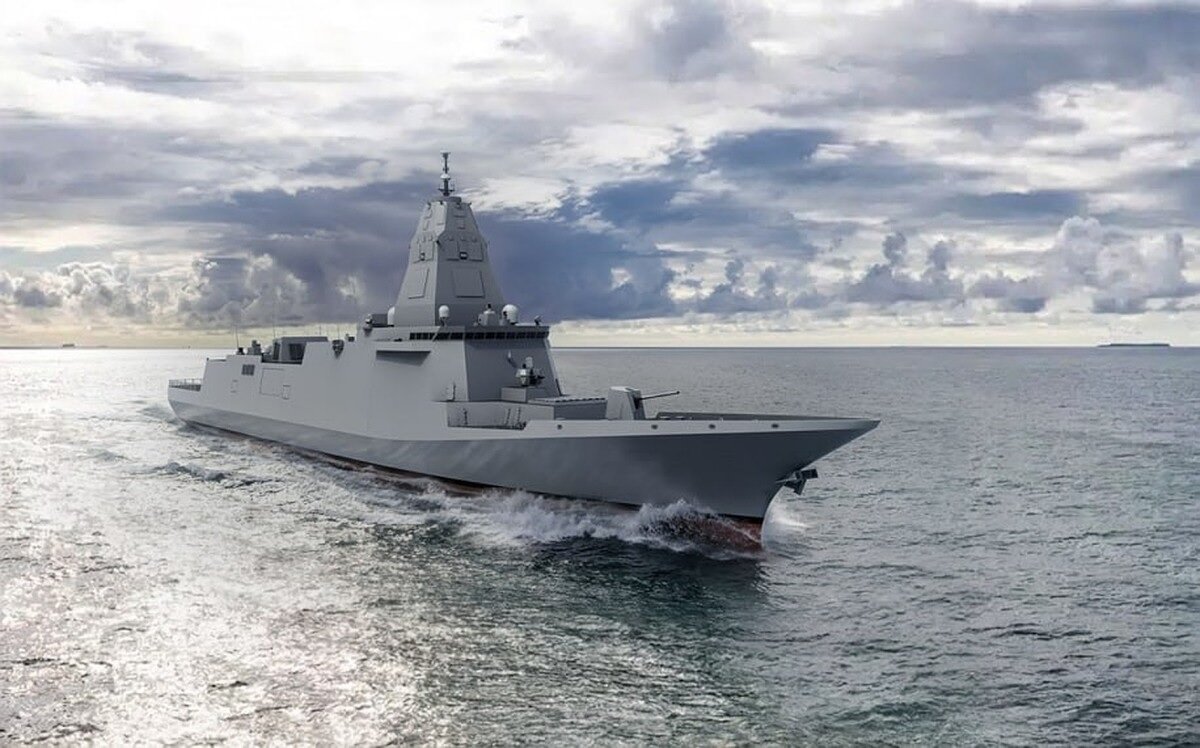
SEOUL — South Korea's Defense Acquisition Program Administration (DAPA) has signed a contract with Hanwha Ocean for the detailed design and construction of the lead ship of the Republic of Korea (ROK) Navy's Next-Generation Destroyer (KDDX) program, officially moving the project into its development and construction phase.
The KDDX program is valued at KRW 7.8 trillion (approximately US$5.4 billion) and will deliver six next-generation guided-missile destroyers in the 6,000–7,000-ton class for the ROK Navy. The agreement signed on July 31, 2026, covers the detailed design and construction of the first ship and is worth approximately KRW 838 billion (about US$580–585 million).
Under the current schedule, the lead destroyer is expected to be delivered by June 30, 2032, while the remaining five ships are planned for sequential delivery through 2036. DAPA also expects procurement of the follow-on ships to begin around late 2028.
Hanwha Ocean Selected After Competitive Evaluation
The contract follows Hanwha Ocean's selection as the preferred bidder in early July 2026 after a closely contested evaluation against HD Hyundai Heavy Industries (HD HHI).
According to DAPA, Hanwha Ocean outscored HD Hyundai Heavy Industries by 0.5867 points in the final evaluation. Although HD HHI completed the KDDX basic design phase in December 2023, a 1.2-point security deduction related to past procurement irregularities, including issues involving military secrets, affected its final score.
After review and objection procedures were completed, DAPA proceeded with the signing of the main contract.
The award marks a notable shift in South Korea's naval shipbuilding industry. While HD Hyundai Heavy Industries has traditionally led the detailed design and construction of the country's major surface combatants, Hanwha Ocean will now take the primary role in building the ROK Navy's next-generation destroyer. The company has previously built Ulsan-class frigates and has extensive experience in naval shipbuilding, particularly submarines.
Designed as South Korea's First Indigenous Aegis-Equivalent Destroyer
The KDDX class is intended to replace the aging Gwanggaeto the Great-class (KDX-I) destroyers and become a core asset of the ROK Navy's Task Fleet Command.
Unlike the Sejong the Great-class (KDX-III) destroyers, which rely substantially on the U.S.-made Aegis combat system, the KDDX is being developed as South Korea's first fully indigenous Aegis-equivalent surface combatant, often referred to as the country's "Korean Aegis" destroyer.
The ships will incorporate several domestically developed systems, including:
- Integrated Mast (I-MAST) housing an indigenous dual-band S/X phased-array multi-function radar and communication systems.
- A domestic Combat Management System (CMS) for command and control.
- An Integrated Electric Propulsion System (IEPS) designed to reduce the ship's acoustic signature while supporting future high-energy weapon integration.
- Korean Vertical Launch System (KVLS-I and KVLS-II) cells capable of deploying domestically developed surface-to-air and strike missiles.
- Advanced indigenous sonar systems.
New Technologies Planned for the KDDX
During the detailed design and construction phase, Hanwha Ocean plans to incorporate several technologies intended to improve the destroyer's operational capability and long-term support.
Among the planned features is a digital twin framework that will support ship design, construction, maintenance, and lifecycle management.
The destroyer will also include a multi-layered counter-unmanned aerial system (anti-drone) suite to address emerging unmanned aerial threats.
To strengthen network-centric operations, the design includes a high-bandwidth 5G-based wired and wireless communications network.
Additional technologies under consideration include manned-unmanned teaming (MUM-T) combat systems, enhanced cybersecurity measures to protect operational networks, and automation technologies aimed at reducing crew requirements in response to long-term naval manpower constraints.
DAPA Highlights Strategic Importance
Jung Jae-jun, Head of DAPA's Advanced Capabilities Program Bureau, described the KDDX project as a national program that brings together South Korea's warship construction and defense industry capabilities.
He said DAPA will continue examining execution strategies for follow-on vessels to support timely deployment that meets future operational requirements. He added that successful completion of the KDDX program is expected to strengthen the international competitiveness of South Korean naval shipbuilding and support future warship export opportunities.
Following the contract signing, Hanwha Ocean said detailed design work will begin immediately under the agreement, which runs through June 30, 2032 for the lead ship. The KDDX program represents an important step in South Korea's ongoing naval modernization effort and expands the country's role in developing advanced indigenous surface combatants.
——— End of Article ———