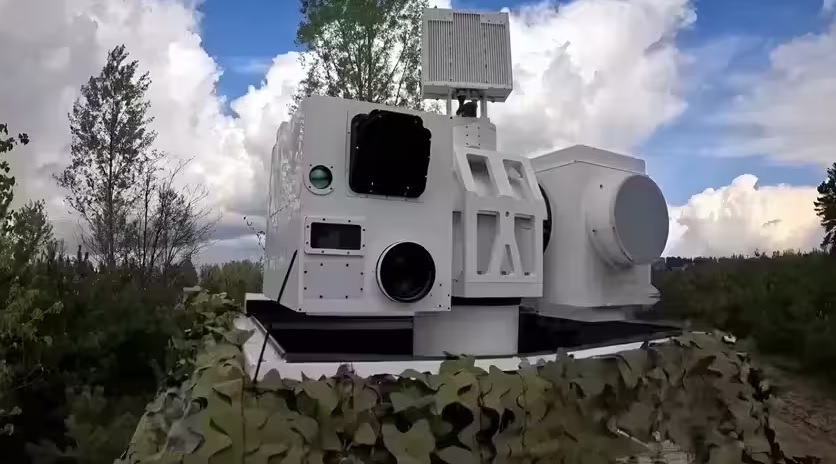
MOSCOW, — April 9, 2026 : Russia-based developer LazerBuzz has confirmed that its Posokh laser air defence system successfully destroyed a fixed-wing first-person view (FPV) unmanned aerial vehicle (UAV) at a distance of 1,500 metres during recent tests, marking a further extension of the system’s operational range.
According to the developer, the latest trial demonstrated a 0.5 km increase in effective engagement distance compared to previous results. The test was conducted under a mock attack scenario involving an aircraft-type UAV, where the system detected, tracked, and neutralised the target using focused ytterbium laser radiation technology.
System Performance and Test Results
During the April 2026 test, the Posokh system engaged the UAV and achieved target destruction in less than 0.5 seconds. The system operates with a laser beam power output of up to 80 kilowatts and is capable of functioning in a fully automatic mode. This allows it to detect, track, and engage aerial threats without manual operator intervention.
The system uses an integrated radar suite for early detection and targeting. Once locked, the laser delivers a concentrated beam that physically damages critical drone components such as onboard electronics and batteries. In the recent trial, this resulted in structural and functional failure of the fixed-wing UAV.
LazerBuzz stated that the increased range was achieved through the integration of new components and optimisation of software algorithms, improving both targeting precision and energy delivery efficiency at extended distances.
Development Progress and Previous Testing
The April 2026 results build on earlier tests conducted in late December 2025, when the Posokh system successfully engaged an FPV drone at a distance of 1 kilometre. That test itself marked an improvement over an earlier maximum operational range of approximately 700 metres.
The latest trial confirms stable and repeatable performance at the extended 1.5 km range, indicating continued progress in the system’s development cycle.
Earlier prototype versions of the system operated at significantly lower power levels, including configurations around 3 kW. The current 80 kW configuration represents a substantial increase in output, aligned with its intended operational role in protecting industrial and critical infrastructure.
Operational Role and Design Approach
The Posokh laser system is designed as a short-range air defence solution focused on countering small unmanned aerial threats, particularly FPV drones. Unlike electronic warfare systems that rely on jamming or signal disruption, Posokh applies a direct physical effect to neutralise targets.
This approach is intended for scenarios where electronic suppression methods may be less effective, such as autonomous or pre-programmed UAVs. By targeting essential drone components, the system ensures immediate disablement rather than temporary disruption.
The platform is primarily intended for deployment in fixed-site defence roles, including the protection of industrial facilities and other critical infrastructure assets.
Development Status
LazerBuzz indicated that development work on the Posokh system is ongoing, with further enhancements planned for the laser-based air defence platform. However, the company did not provide additional details regarding deployment timelines, production status, or potential integration with other defence systems.
The April 2026 tests were conducted at an undisclosed location.
——— End of Article ———