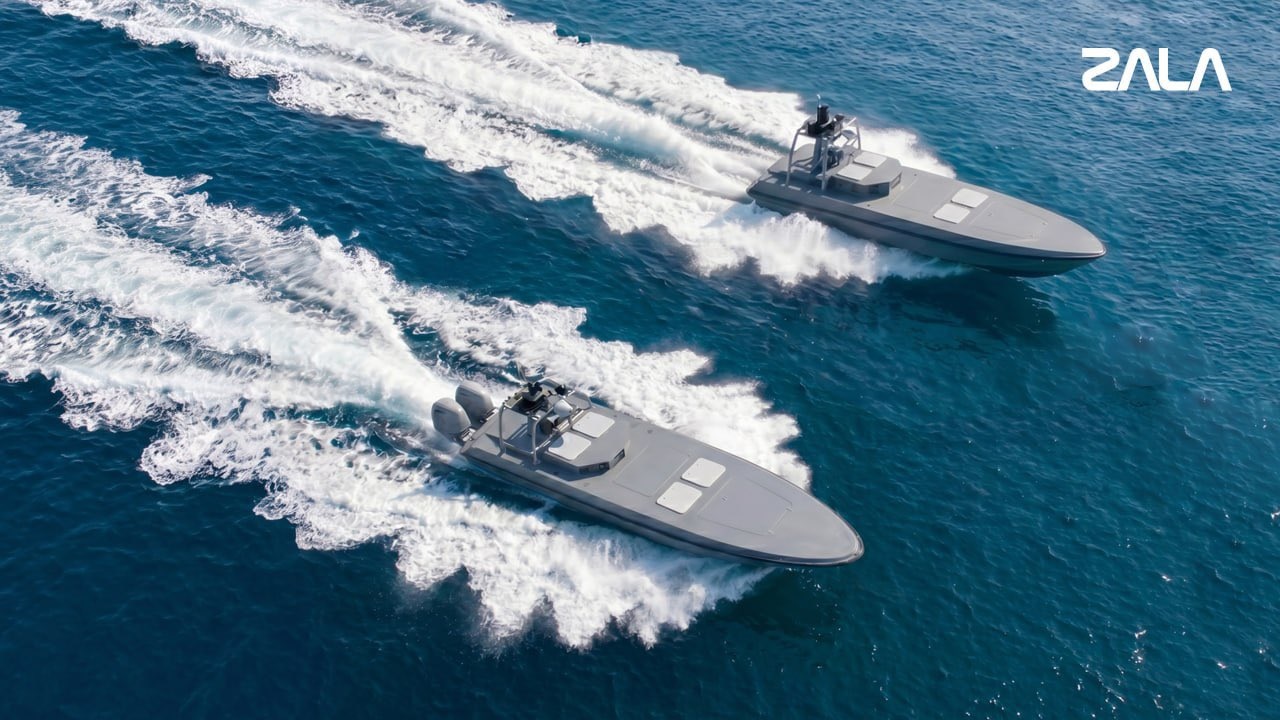
MOSCOW, — June 11, 2026 : Russian unmanned systems developer ZALA Aero Group has officially entered the maritime sector with the unveiling of its new KAMA family of Unmanned Surface Vehicles (USVs) at the International Naval Salon FLOT-2026 in Kronstadt. The debut marks a significant expansion for the company, which is widely recognized for developing unmanned aerial systems, including the Lancet and KUB-BLA loitering munitions.
A subsidiary of Kalashnikov Concern, ZALA presented two variants of the KAMA platform during the exhibition, which opened on June 10 and runs through June 14 at the Museum of Naval Glory and the Congress and Exhibition Center in Kronstadt. The company stated that the vessels are designed primarily for civilian and special-purpose maritime operations.
Multi-Purpose Maritime Platform
According to information released at FLOT-2026, the KAMA family has been developed as a versatile and modular unmanned surface platform capable of supporting a broad range of missions. Unlike ZALA’s well-known aerial strike systems, the new maritime platform is intended for both civilian and security-related applications.
The KAMA USVs can be employed for hydrographic surveys, enabling the mapping of underwater terrain and collection of navigational data. Other intended roles include environmental monitoring, detection of illegal discharges and pollution sources, maritime patrol operations, protection of water areas, search-and-rescue missions, emergency response activities, and autonomous cargo transport.
Company representatives noted that the platform can be configured with different sensor packages, monitoring equipment, or transport modules depending on operational requirements.
Technical Specifications
ZALA disclosed several key performance characteristics of the KAMA platform during the exhibition. The vessels are capable of operating continuously for up to 12 hours and can reach a maximum speed of 12 knots (approximately 22.2 kilometers per hour).
The platform has an operational range of up to 700 kilometers from shore, while its payload capacity of up to 600 kilograms allows the integration of a wide range of mission-specific equipment and sensors. The vessel is also designed to maintain position in sea conditions of up to Sea State 3, enabling operations in moderate maritime environments.
For operations in poor visibility and nighttime conditions, the KAMA USVs are equipped with thermal imaging cameras. The vessels also feature an automatic return-to-base function, which activates if communication with the operator is lost.
Leveraging Experience in Autonomous Systems
The development of the KAMA family reflects ZALA’s effort to apply its experience in autonomous navigation, artificial intelligence, remote-control communications, and unmanned systems management to maritime operations. These technologies have previously been employed across the company’s aerial drone programs and are now being adapted for use in surface vessels.
ZALA stated that unmanned surface vessels offer several advantages compared with unmanned aerial vehicles, including greater endurance, longer operational range, and increased payload capacity. These characteristics make such platforms particularly suitable for extended monitoring tasks, environmental research, cargo delivery, and maritime rescue operations.
Growing Focus on Unmanned Maritime Technologies
The unveiling of the KAMA platform comes amid increasing international interest in autonomous maritime systems. Unmanned surface vessels are being adopted globally for surveillance, logistics, hydrographic research, environmental monitoring, and maritime security missions due to their ability to operate without onboard crews.
By introducing the KAMA family at FLOT-2026, ZALA has expanded beyond its traditional focus on aerial drones and continued its diversification into robotic systems. The move follows the company's earlier development of a universal ground robotic platform and represents another step in its broader unmanned systems portfolio.
The company has not yet disclosed details regarding operational deployment plans, potential customers, production timelines, or additional variants of the KAMA family. However, the platform is being positioned to serve both civilian requirements and specialized maritime security tasks, highlighting Russia’s ongoing efforts to advance unmanned maritime technologies.
——— End of Article ———