PAVLOHRAD, Ukraine — Russian forces carried out three guided aerial bomb attacks on the Ukrainian city of Pavlohrad during the final 10 days of July, raising indications that extended-range aerial munitions may have been used in the strikes.
Pavlohrad, located in Ukraine's Dnipropetrovsk region about 75 kilometers from the front line, was hit on July 20, July 23, and July 30, according to local authorities and Suspilne Dnipro. The three attacks killed seven people and injured more than 45 others.
The strikes have drawn attention because of the reported distance between the suspected launch points and the impact locations. Open-source intelligence (OSINT) researcher Clément Molin assessed that the Russian aircraft likely released the weapons from approximately 150 kilometers away, a range exceeding that of standard Russian glide bombs.
The estimated launch distance has led analysts to suggest that Russia may have resumed using the UMPB-5R, a guided aerial bomb fitted with a jet engine to extend its range.
Three attacks in 10 days
The first strike on July 20 marked the first reported use of guided aerial bombs near residential buildings in Pavlohrad. According to local authorities, two people were killed and around 15 others were injured, including children. The attack caused fires in apartment buildings and surrounding areas, while several vehicles were also damaged.
A second strike followed on July 23, when a guided aerial bomb hit a food industry business at around 11:20 a.m. The attack killed three people and injured at least 19 others, including a two-year-old girl. The strike triggered a fire at the facility. Later updates reported that the number of injured increased, with several people remaining hospitalized the following day, some in serious condition.
On July 30, another guided aerial bomb struck the city, killing two people and injuring five others. Regional officials reported fires and damage in residential areas.
UMPB-5R suspected due to extended range
According to Clément Molin's analysis, the estimated 150-kilometer flight distance from the aircraft's launch point to Pavlohrad suggests the possible use of the UMPB-5R rather than a conventional glide bomb.
The UMPB-5R first appeared in limited numbers during late spring and early summer 2025. One of its earliest documented uses occurred on October 18, 2025, when Ukrainian prosecutors reported that a UMPB-5R struck Lozova in Ukraine's Kharkiv region after traveling approximately 130 kilometers.
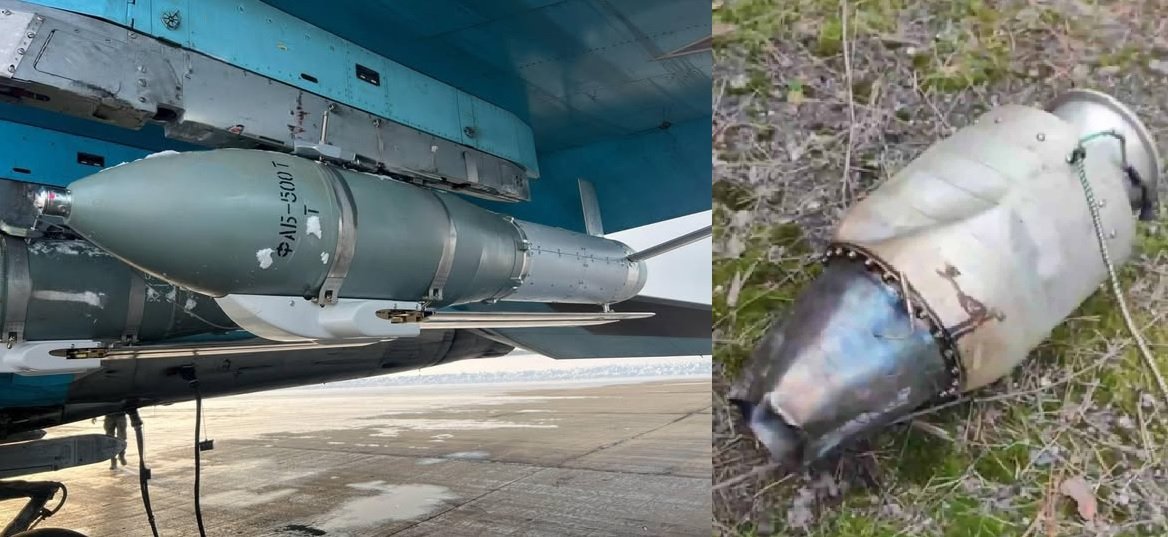
Fragments recovered from the Lozova strike, photographed by military communications specialist Serhii Flash in October 2025, showed remnants of a jet engine matching the Chinese-made Swiwin SW800Pro-Y. The same engine model has also been identified in Russia's S8000 Banderol missile.
According to Ukraine's Defense Intelligence (DIU), fitting the UMPB-5R with this jet engine increases its maximum range to up to 200 kilometers. Recent Russian tests of similar powered aerial munitions have reportedly achieved flight distances of 193 kilometers.
Photos published in October 2025 showed the SW800Pro-Y turbojet mounted on the bomb. The commercial engine reportedly produces about 80 kilograms of thrust and weighs approximately 10 kilograms.
Analysts also note that powered glide bombs of this type can exceed 400 kilometers per hour during the terminal phase of flight. Because of their speed, interception by anti-aircraft drones is considered largely ineffective, requiring conventional surface-to-air missile systems such as the Hawk-3 or Buk for engagement.
Other long-range guided bombs in Russian service
The UMPB-5R is not the only longer-range aerial weapon available to Russian aircraft.
In October 2025, reports indicated that Su-34 aircraft had been equipped with upgraded UMPK-500 unified glide and correction modules for FAB-500T aerial bombs. The upgraded module features an extended tail section and larger wings, with Russian sources claiming a range of more than 100 kilometers. Operational estimates indicate the bomb can reach up to 160 kilometers when released from altitudes between 12 and 14 kilometers. The design is reported to have served as the basis for the powered UMPB-5R.
Russian aircraft also carry the Grom-E1 guided bomb, which uses a rocket engine derived from the Kh-38 tactical missile. The weapon carries a 315-kilogram high-explosive fragmentation warhead and has a reported strike range of 10 to 120 kilometers. It is designed for launch from altitudes between 500 and 12,000 meters at aircraft speeds of 140 to 445 meters per second.
The integration of jet and rocket propulsion into guided aerial bombs enables launch aircraft to release munitions from greater distances behind the front line, reducing their exposure to Ukrainian air defense systems.
The three attacks on Pavlohrad during the final days of July highlight Russia's continued use of long-range aerial strike capabilities against targets well behind the front line. Local officials said the city is facing an increasing threat from such attacks, which provide residents with shorter warning times before impact.
Source : militarnyi
——— End of Article ———