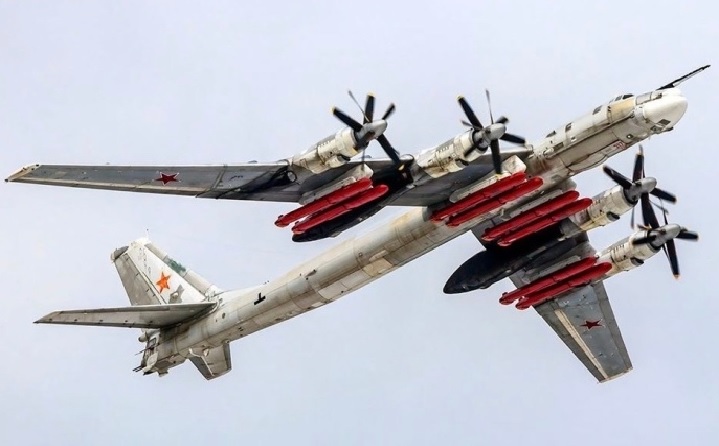
Moscow, August 19, 2025 — Russia’s Ministry of Defence announced that Tu-95MS nuclear-capable strategic bombers, escorted by Su-35S and Su-30SM fighters, conducted a six-hour patrol over the Sea of Japan. While officially presented as part of a “routine long-range aviation mission,” the timing and scope of the deployment reveal deeper strategic motives at a moment of heightened global tensions.
The Tu-95MS “Bear-H”, NATO’s designation for the four-engine turboprop bomber, has served as the backbone of Russia’s strategic bomber fleet since the Cold War. Despite its 1950s-era design, the aircraft has been heavily modernized to carry Kh-55 and Kh-101 cruise missiles, including nuclear-capable versions, extending its strike capability to several thousand kilometers. The bomber’s endurance allows for extended maritime patrols over contested regions, making it a central element of Russia’s nuclear deterrent.
Accompanying the bombers were Su-35S and Su-30SM multirole fighters, among Russia’s most advanced combat aircraft. These escorts, equipped with R-77-1 beyond-visual-range missiles and precision-guided munitions, ensure that bombers operating near sensitive airspaces remain protected against potential intercept attempts by regional air forces such as Japan, South Korea, or the United States.
Strategic Implications
This flight comes against the backdrop of two key dynamics:
-
Adapting to the Ukraine War – Russian air bases housing bombers have come under repeated attack from Ukrainian long-range drones and FPV swarms in recent months. By shifting some of its strategic aviation operations eastward, Moscow reduces its vulnerability while still demonstrating operational reach.
-
Pacific Power Signaling – The patrol coincided with ongoing U.S.–South Korea joint military exercises, which involve large-scale drills simulating defense against North Korean and regional threats. By deploying its long-range bombers at this precise moment, Russia sends a deliberate message: it retains the capability and political will to operate far from the European theater, in waters where American influence is dominant.
Comparative Power Projection
Russia’s use of the Tu-95MS over the Pacific mirrors the strategic bomber operations of other global powers:
-
The U.S. B-52H Stratofortress, with greater payload capacity and modern upgrades, regularly conducts patrols over the Asia-Pacific as part of Washington’s extended deterrence posture.
-
China’s Xian H-6K, based on the Soviet Tu-16 design, integrates modern avionics and standoff missile systems, symbolizing Beijing’s growing ability to project power in the Western Pacific.
In this context, Russia’s Tu-95MS patrols—despite being based on an older airframe—remain effective tools of strategic signaling, particularly when paired with long-range cruise missiles and fighter escorts.
Broader Security Context
The Sea of Japan has become a crowded arena of power projection. Japan continues to modernize its Aegis-equipped destroyers and air defense systems, while South Korea expands its KF-21 fighter program and missile arsenal. Against this backdrop, Russian bomber flights serve both as a show of strength and as a reminder of Moscow’s relevance in shaping regional security dynamics.
Military analysts note that while these patrols are described as “routine,” their timing almost always coincides with periods of heightened geopolitical tension. This reinforces the perception that Russia’s long-range aviation missions are not merely training flights but strategic demonstrations intended for multiple audiences—regional rivals, domestic populations, and Western adversaries.
The August 19 patrol of Tu-95MS bombers over the Sea of Japan illustrates Russia’s dual strategic calculus: adapting its force posture in response to the Ukraine conflict while simultaneously projecting global reach into the Asia-Pacific. By pairing legacy bombers with modern cruise missiles and advanced fighter escorts, Moscow continues to wield long-range aviation as a symbol of deterrence and geopolitical relevance.
At a time when the U.S. and South Korea sharpen their military cooperation and China asserts its regional ambitions, Russia’s presence in Pacific skies adds yet another layer to an already contested and multipolar security order.
——— End of Article ———