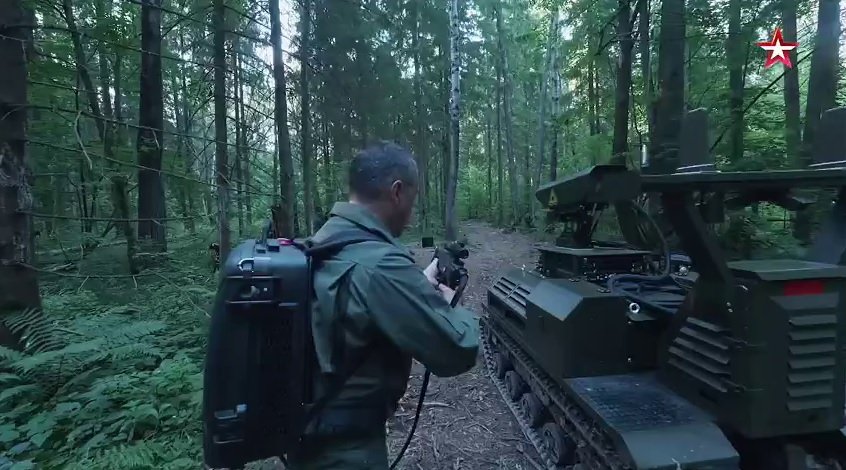
Moscow — Russian forces have demonstrated a portable laser system designed to neutralize mines and other explosive devices by burning through their casings and igniting the explosives inside without causing a detonation. The system was recently shown during tests featured on the Russian television program Military Acceptance on Zvezda.
A related higher-powered laser has also been integrated with the Courier-2 (Kurier-2) ground-based robotic complex, which is designed to remotely destroy anti-tank and anti-personnel mines, grenade launchers and other explosive objects without detonating them.
Russia has demonstrated a 1-kilowatt portable laser system designed to neutralize mines by burning through their casings without detonating them.
— The Defense News (@TheDefenseNews) August 24, 2026
The system can engage targets from 50–100 meters and is integrated with the Courier-2 unmanned ground vehicle for explosive clearance pic.twitter.com/TOQhVeX4P9
Portable Laser System
The portable version has a power output of 1 kilowatt, with its energy source carried in a backpack worn by the operator. The laser operates silently and can be controlled manually or remotely.
According to a plant representative identified by the call sign “Lis,” the system allows sappers to engage targets from 50 to 100 meters away. This distance is particularly useful against mines equipped with sensors that detect nearby people or equipment, including vibration or magnetic-field detectors. Keeping the operator farther away from such devices can reduce the risk associated with approaching them.
During the tests, the portable laser was first used in handheld mode against simple targets, including an old laptop battery, which ignited quickly.
The system was then tested against a plastic-cased anti-personnel mine. The effect was slower when the laser was held manually, so the unit was fixed to a tripod. Stabilizing the laser allowed the beam to remain concentrated on a single point for about one to two seconds. The mine casing then ignited and the explosive material burned rather than detonating.
Representatives involved in the demonstration said the portable systems shown were production-ready models that had entered manufacturing rather than experimental prototypes.
Courier-2 Robotic Laser System
The same basic principle has been applied to a higher-powered laser mounted on the Courier-2 unmanned ground vehicle. The stationary laser installation on the robot has approximately twice the power of the portable system and is heavier.
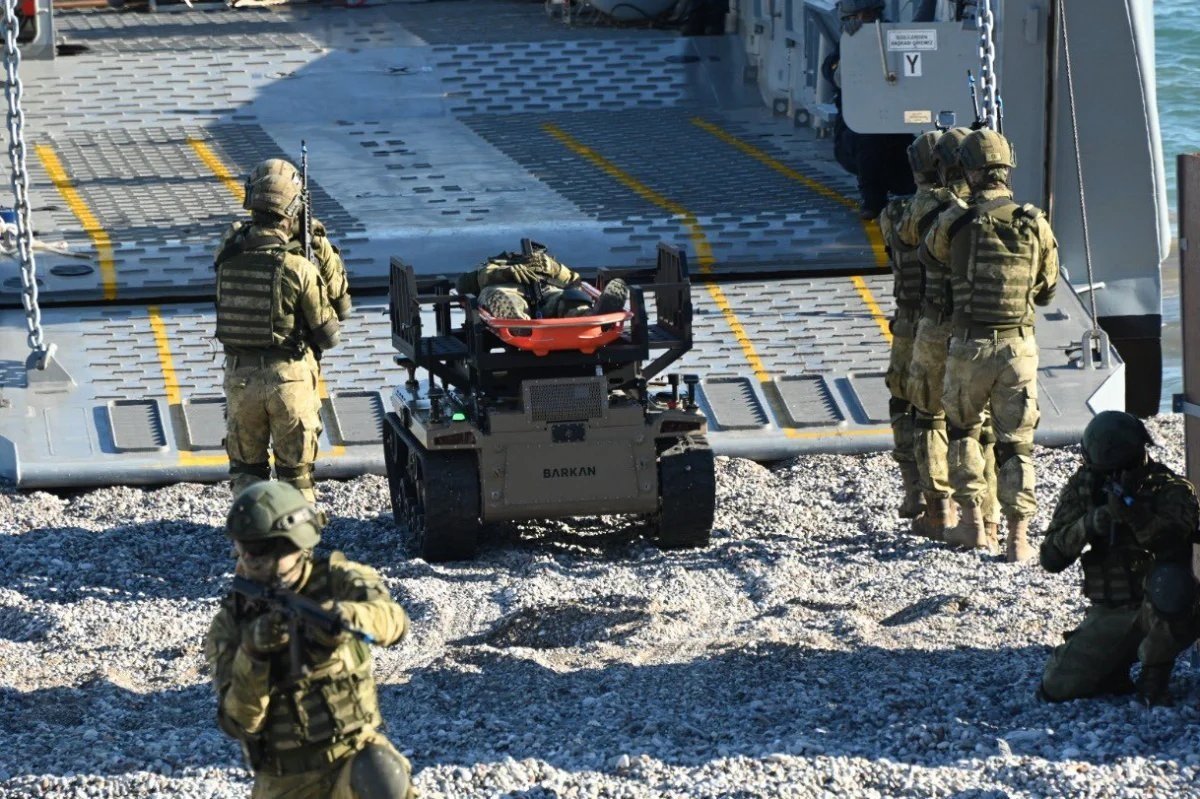
The Courier-2 is a tracked ground-based robotic complex capable of remotely engaging anti-tank and anti-personnel mines, grenade launchers and other explosive objects without detonating them.
During testing, the robot directed its laser at an un camouflaged anti-tank mine. The beam was first aimed at tree bark as part of the calibration process. It was then directed at the mine's fuse element.
The laser entered the fuse and caused the simulated explosive material to burn without detonating. Thermal imaging during the demonstration recorded temperatures of around 1,000 degrees Celsius.
After the fuse was disabled, the laser was directed at the mine's casing. The casing used in that demonstration was a 3D-printed model. The explosive material ignited after about four seconds. Once combustion began, the laser no longer needed to remain on the target, and the mine burned out completely within approximately two to four minutes.
Laser Can Engage Targets Over Obstacles
Another test involved a smaller target described as a “drop” at a range of 60 meters. A car was deliberately positioned between the Courier-2 and the target to obstruct the laser's direct path.
The robotic vehicle is equipped with a lifting mechanism that can raise the laser to a height of 1.5 meters. This allowed the system to raise the laser above the vehicle and engage the target.
According to the developers, from this elevated position the system can engage targets at distances of up to 500 meters.
A smoke screen was also used during the demonstration. The laser was still able to ignite the target through the smoke used in the test. Representatives explained that the wavelength used by the system is not significantly affected by the particle size of the smoke employed in the demonstration.
However, they also noted that denser aerosol systems can block laser beams more effectively. The Tucha protection system used on tanks was cited as an example of a system capable of providing greater obstruction to laser radiation.
Straight-Line Laser Engagement
Unlike conventional projectile weapons, the laser travels directly toward the selected point and does not follow a ballistic trajectory. Therefore, the system does not require a ballistic computer for the laser's engagement.
The operator selects the aiming point and activates the laser emission. The beam operates outside the visible spectrum and is therefore invisible to the naked eye under normal conditions, although its path can become visible when passing through smoke.
The system's operating principle allows explosive objects to be neutralized by heating and burning the explosive material rather than initiating a conventional explosion.
Designed to Increase Stand-Off Distance
The portable system and the Courier-2 robotic version are intended to allow explosive hazards to be engaged from a greater distance.
This capability is particularly relevant when dealing with mines equipped with proximity or other sensors that could respond to the movement or presence of personnel and equipment. The systems are also intended for situations in which a conventional explosion could create additional hazards, including populated areas or other locations where surrounding structures and people could be at risk.
The Courier-2 platform itself is a tracked unmanned ground vehicle capable of performing other tasks, including ammunition delivery, casualty evacuation and fire support. The laser-equipped configuration has undergone military testing for remotely clearing discovered explosive objects.
The portable backpack-powered laser and the Courier-2-mounted system therefore provide two configurations of the same basic technology: a mobile system operated by personnel at a distance and a robotic system that allows the operator to remain away from the immediate area of the explosive hazard.
——— End of Article ———